What Am I Reading – Chapter Twenty-Two

Hi Everybody!

The holiday season has now begun! I hope everyone is not getting too stressed out with Thanksgiving and Christmas planning! As for me, reading is a way to relax whenever I do feel overwhelmed. I finished the books from the last chapter and have been immersed in a new title that I want to show all of you!

The Night Circus by Erin Morgenstern is about many things. First and foremost, it centers on the titular object that arrives without warning. Called Le Cirque des Rêves (or The Circus of Dreams), it contains black-and-white canvas tents and breathtaking amazements, yet it’s only open at night. Behind the scenes, there’s a fierce competition between two young magicians named Celia and Marco. They’ve been training for this purpose since they were young and by their mercurial instructors, but unbeknownst to them, only one can be left standing. Things get complicated when they fall in love. However, the game must play out, and everyones’ fates from the performers to the patrons hang in the balance.

Morgenstern apparently wrote this novel during National Novel Writing Month (aka NaNoWriMo), and I can tell. This book has a non-linear structure, for it tends to jump around in the timeline. Some people may be irritated by this, but so far, I’m fine with it since the novel’s subject is about something that’s unique and follows its own set of rules. Hence, its structure does the same.

I like the characters so far. All of them have their own backstories and defined personalities. On the other hand, much like the movie Dunkirk, the book doesn’t spend much time with each character before moving on to another, yet it comes back to them eventually.

Jim Dale narrates the audiobook. For those who don’t know him and/or haven’t read the Harry Potter audiobooks, Dale is a world renown actor, composer, director, and singer, songwriter, narrator. He’s won a Tony for his role in the musical Barnum and several Audie awards for various audiobooks like Peter and the Star Catchers and the aforementioned Harry Potter series. He’s even been nominated for an Oscar for the title song for the movie Georgy Girl (he wrote the lyrics). In other words, he’s a big deal.

Now, you’re probably wondering how’s he doing narrating The Night Circus. He’s good so far. He makes his characters distinct with little touches. For example, Celia’s instructor and father Hector Bowen is voiced with eccentricity and a slight Northern English accent, while Chandresh Christopher Lefèvre – the owner of Le Cirque des Rêves has a similar vibe but with a more posh voice. I can’t wait to hear more of his narration!

We have now come to the end of the twenty-second chapter of “What Am I Reading?”

Subscribe below to get notified when I post new updates. Also feel free to email me here for any review suggestions, ideas, or new titles!

Love, Pride, Virtue, and Fate Book Review

There’s no doubt that reading helps people learn about a variety of subjects, especially those that they never knew about before. What makes this possible is how the material is presented. If it’s displayed in an accessible manner, readers will be able to not only learn, but also enjoy it. I thought about this aspect of reading after taking a look at Love, Pride, Virtue, and Fate by Bharat Krishnan – a very handy and enjoyable introduction to Hindu mythology.

Love, Pride, Virtue, and Fate is a collection of 25 tales in Hindu mythology that explores the traits mentioned in the title. The author strives to make connections between these stories to those in other mythologies. For example, much like the Greek gods taking sides in the Trojan War in The Iliad, the Hindu ones fought alongside both the Pandavas and Kauravas during the Kurukshetra War in the epic poem “Mahabharata.”

As someone who knows very little about Hinduism, I found the book to be very useful when it comes to understanding that religion. Most of the tales are no more than 5 pages long, and the language feels elevated while also believable, as in anyone from the present day would say them, hence making them timeless. Some include black and white drawings depicting vital moments in the tales, and they’re done pretty well. Each of the stories always end with Krishnan explaining why he included it in the collection. This was easily my favorite part, for not only he connects these tales to those in other mythologies, especially the Christian and Greek ones, but also he thoughtfully explains how each of them reflect a part of the Hinduism mentality and its values.

One of my favorite tales is “The Elephant God.” It involves Shiva – the Hindu god of destruction – cutting off the head of his son Ganesha after the latter prevents entry to the former. It didn’t help that the former didn’t know that he had a son. As a result, his wife – the goddess Parvathi – refuses to speak to him until he finds their son. Luckily, Shiva is able to find an elephant and place it on Ganesha’s head, thus making him the remover of obstacles.

Another tale that I enjoyed reading was “Fate.” That one deals with Kannagi – a merchant’s wife. She finds out that her husband was taken to the palace on trumped-up charges of stealing an anklet from the queen. Even though she proves that the allegations were wrong, her husband is executed anyway. As a result, she burns down the palace and becomes a goddess. This is why one shouldn’t mess with a strong, confident woman when she’s angry.

Occasionally, Krishnan will mention something politics-related due to his experiences in that field, but he does it in a way that doesn’t distract the reader from the overall themes.

Overall, Love, Pride, Virtue, and Fate by Bharat Krishnan is a wholly accessible collection of 25 of the most beloved tales in Hindu mythology. I would recommend this book if anyone is looking into that subject in the general sense. Not only did I learn something from it, but I also enjoyed it too!

Subscribe below to get notified when I post new updates. Also feel free to email me here for any review suggestions, ideas, or new titles!

The Southern Book Club’s Guide to Slaying Vampires Book Review

Ah, Halloween has passed, but that doesn’t mean we have to stop reading scary books. I prefer scary media with some comedy. That’s why Young Frankenstein is one of my favorite films of all time. So, when one of my coworkers told me about The Southern Book Club’s Guide to Slaying Vampires by Grady Hendrix, I knew it had to be strange, scary, and funny all at once. Now that I’ve read it, I have this to say: while it held my attention and was great in the scary department, I wish it had more comedy.

The Southern Book Club’s Guide to Slaying Vampires is about a women’s book club trying to protect its Southern suburban community from a mysterious and handsome stranger who turns out to be a vampire. Patricia Campbell’s life has become smaller and smaller after she gave up her job as a nurse to marry an ambitious doctor and become a mother. Luckily, she has her book club to look forward to. They consist of Charleston mothers who love to read true crime and suspense novels. When an artistic and sensitive stranger named James Harris moves into the neighborhood, Patricia is initially attracted to him. However, once some children go missing, she begins to suspect that the newcomer has something to do with it. She starts her own investigation, yet what she discovers is far more terrifying than she could imagine. Soon, she and her book club are the only ones standing between the monster they’ve invited into their homes and the unsuspecting community they’ve sworn to protect.

I wasn’t sure what I was getting into when I popped in the first disc, but I’m glad to say that it was anything but boring. Where should I start? It made me feel a whole bunch of emotions. It made me feel happy and supported when the book club had Patricia’s back as well as angry and frustrated when certain people like their husbands didn’t believe them. Patricia’s husband Carter even prescribes her Prozac to quell her talk about the newcomer! Such gaslighting! It all felt too real. Since this is a horror, it shocked me plenty of times. Let’s just say an earlobe gets bitten off and rats come into the house, and they only scratch the surface.

I totally bought Patricia’s frustrations as a housewife and mother. Her husband is distant, and her kids would rather do other things. I can understand her need to seek out something interesting, even dangerous. When nobody believed her about the theory surrounding the stranger and the missing children, I understood her anger and the actions that led into her low point even though I disagreed with what she did to cope. I can’t say what happens, but it does have a happy ending.

Many of the characters are one-note, but they have their moments to shine. For example, Kitty is the loud, abrasive member of the “book club” who gets traumatized by what she sees in James Harris’s attic. Meanwhile, Slick is the socially awkward and super religious one of the bunch, and something truly horrific happens to her. Mrs. Green – a woman who works as Patricia’s mother-in-law’s caregiver – is another standout. She’s the one who also suspects something strange is going on in the neighborhood, and gets pretty frustrated when the book club doesn’t do enough to protect the kids on Six Mile. She even asks them what her kids’ names are. 

From what I understand, the novel is marketed as a horror comedy, but there wasn’t much of the latter. There were some funny bits in the beginning like Patricia trying to talk about Cry, the Beloved Country even though she didn’t read it. As the book progressed, it got darker and darker. It seemed like Hendrix wanted to make readers comfortable at first, but then decided to dig a hole deep enough to cover a person, yet shallow enough for one to get out. In other words, Fried Green Tomatoes and Steel Magnolias meet Dracula is far more accurate of a description than a horror comedy. Despite not having much comedy, the book still has light moments like the scenes when the book club members bond.

As I mentioned before, Bahni Turpin narrates the audiobook. I’ve mentioned her when I had talked about On the Come Up, and she has impressed me even more. Turpin has such a wide vocal range. She’s able to voice a proper white Southern lady, a sassy one from New Jersey with a sad past, and a black one frustrated with the community not doing enough for them. Even the men sound fairly distinct with the seemingly reasonable and pretty distant Carter Campbell and James Harris as a modern Dracula. 

Overall, The Southern Book Club’s Guide to Slaying Vampires by Grady Hendrix is a highly interesting and wonderful Southern horror novel. While it doesn’t have much comedy, it’s got enough lightness to get people through the darkness. It also has plenty of horror and gross-out moments, so be prepared. I would recommend it to those love horror books like those from Stephen King (obviously!), Southern characters, and book clubs! Just remember to read it during the daytime. No one will be bored while reading it. I guarantee it!

Subscribe below to get notified when I post new updates. Also feel free to email me here for any review suggestions, ideas, or new titles!

Legends of the Fall Book Review

I always like to review books from authors from my home state of Michigan. So today, I present to you a special one as parts of this book have been adapted into two movies (I’ll review both of them someday). It’s Jim Harrison’s 1979 debut set of novellas Legends of the Fall. He is known as “America’s foremost master” in that genre. While I can see some appeal to that work, it’s not my cup of tea.

Legends of the Fall by Jim Harrison is three stories in one. The titular novella is about three brothers and their lives of passion, madness, exploration, and danger at the beginning of World War I. The other two are Revenge, which shows how love causes a man’s life to be altered in drastic ways, and The Man Who Gave Up His Name, which deals with a man who’s unable to give up his obsessions with women, dancing, and food.

Since the book is three short stories, it’s best to review each of them individually. First on the chopping block is Revenge. Even though it starts off pretty slow (Harrison likes to digress), once the hero is introduced and how he got all mangled and left on the side of the road, it took a hold on me. I wanted him and his lady love – a woman who’s married to a crime boss – to be together. Oh, and it doesn’t help that the hero is friends with the crime boss. It was pretty intriguing.

Next is The Man Who Gave Up His Name. The summary that I gave earlier doesn’t fully describe the story itself (I took it from the book’s blurb), for it makes the main character look like he’s going on a self-destructive path. It’s really about a  man only known as Nordstorm who’s going through a midlife crisis after his ex-wife and daughter call him out for being “unimaginative” and indifferent. This one is my favorite of the novellas mainly because I liked reading about this awkward guy exploring the world around him at a time in his life where he has already found so much success. My only complaint is that the violent subplot pops out of nowhere and comes up too close to the ending. 

Finally, it’s the title novella itself. If it weren’t for this story, where would Brad Pitt’s career be? (I’m aware that Interview With a Vampire was also released in the same year as Legends of the Fall, but still.) I liked how the book explored sibling dynamics among the brothers, especially between Tristan and Alfred, and how the father reacts to their decisions. However, I’m going to be honest. This was my least favorite story of the bunch. This is for many reasons like my expectations, but the main one is that it emphasizes the parts of Harrison’s works that I’m not a fan of. It’s too macho and self-indulgent for me. For instance, did we need all the details of Tristan’s voyages? In addition, there’s a lot of telling, but not much showing. For example, when Susannah – Tristan’s first wife – loses her mind when she’s married to Alfred, Harrison basically repeats that she goes mad, instead of showing how she does that. I liked reading those parts involving Susannah, but because the author glossed over them to tell more of Tristan’s travels and other stuff, I felt disappointed. 

In 2014, Harrison told The Atlantic that it took him nine days to write this particular story after thinking about it for a long time. When he re-read it, he only had to change one word. In other words, he made word vomit. I get that he was thinking primarily of Tristan, and that character and other male ones are pretty fleshed out. It’s a good character study; I personally wish that he made more revisions to make it more concise in some parts and show more. 

Despite all of this, I still look forward to seeing the movie since it’s supposed to be different from the novella.

All in all, the suite Legends of the Fall by Jim Harrison is pretty okay. There were parts that I liked, and there were ones that could’ve been improved. I would recommend to those who like books by Michigan authors, character studies, and the masculine elements. In the meantime, I plan to watch the film versions of Revenge and Legends of the Fall for the future, so keep an eye out for those reviews.

What Am I Reading – Chapter Twenty-One

Hi Everybody!

It’s been awhile since the last chapter, but I hope everyone is having a great October! For me, it’s been good, but a little stressful due to wedding planning. I’m tying the knot in less than 3 weeks. Luckily, I’ve been reading Dalva by Jim Harrison, The Marxist Revolution: How Chico, Harpo, Groucho, and Zeppo Changed the Way We Laugh by Eddie Tafoya, and For Whom the Bell Tolls by Ernest Hemingway to help me relax

And now, I get to add two new titles, so let’s get started!

Britt-Marie Was Here by Fredrik Backman is about a socially awkward, fussy busybody woman who has more imagination, bigger aspirations, and a warmer heart than anybody realizes. When she leaves her cheating husband, Britt-Marie finds herself in the town of Borg – a place where everything is closed except for a few places and a road. She becomes the caretaker of the soon-to-be-demolished recreation center. Eventually, she gets to know the various characters in the town like the citizens, miscreants, drunks, and layabouts. Surprisingly, she’s given the task to lead the pretty untalented children’s soccer team to victory. In a town full of misfits, will Britt-Marie find a place where she truly belongs?

For those who have read My Grandmother Asked Me to Tell You She’s Sorry, one may recognize Britt-Marie as the naggy woman who loves order and routine in the apartment building Elsa lives in. While the events of Britt-Marie Was Here occur after the ones from the former, the latter is more of a stand alone novel than a sequel.

Even though Backman provided a backstory for Britt-Marie in My Grandmother, he dives even deeper in Britt-Marie Was Here. Granted, to an outsider, Britt-Marie is still a nag-bag, but she slowly becomes more open, flexible, and independent as she continues to live in Borg. Britt-Marie even reveals more of her life with how invisible she felt by her parents after her sister died; how ungratefully she was treated by her ex-husband, especially how he never put his shirts in the washer; and how much denial she was in when the affairs were going on. Although there’s not a whole lot of story, Britt-Marie is such a compelling character that I’m willing to look through that.

Despite the sadness, Backman still infuses humor to the situation. When Britt-Marie first arrives at the recreation center, she gets hit on the head with a soccer ball (uh, I mean football). Talk about first impressions, eh?

Joan Walker narrates a Fredrik Backman audiobook once again. She brings an austere, but vulnerable vibe to Britt-Marie. Her foreign characters have vague, but appropriate accents. The volume issue that I mentioned in my review of My Grandmother is not as prevalent, but Walker has a tendency to voice the teens as younger than they should be. This is a disappointment, for she voiced Elsa – the 7-year-old in My Grandmother – perfectly. We’ll see if she improves, but it’s a good story so far.

And now, let’s pass it over to the second and final book of this latest installment…

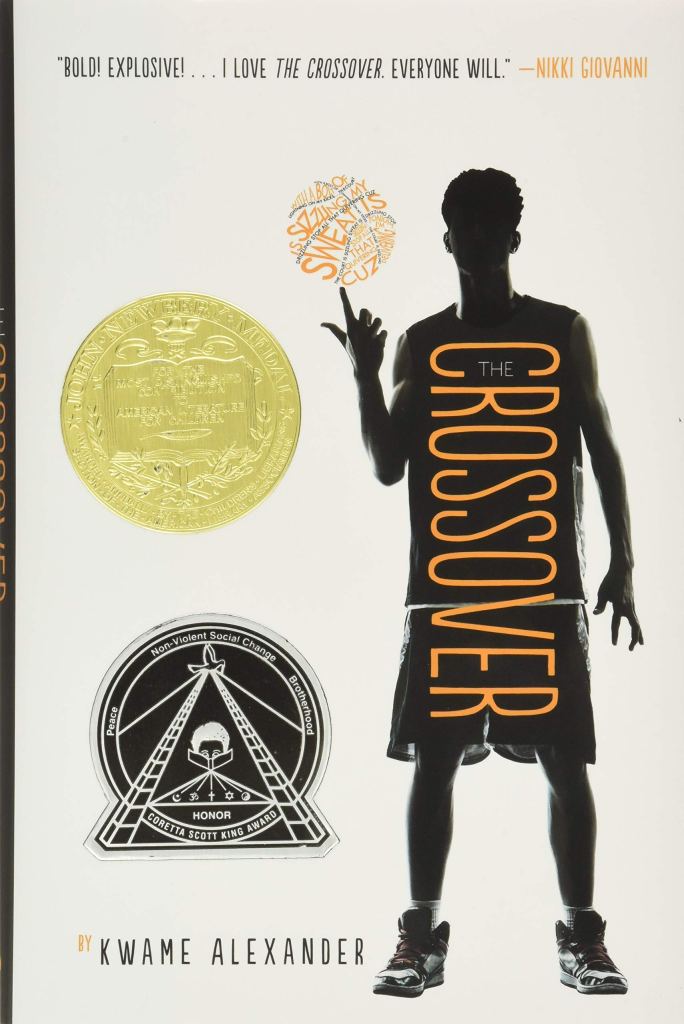
The Crossover by Kwame Alexander is a Newbery Award winning book that tells the story of Josh and Jordan (aka JD) Bell – twin 13-year-olds who love playing basketball – in verse. The twins must come to terms with growing up on and off the court. This is especially true when they realize that breaking the rules comes at a price.

As a Children’s Librarian, one of the tasks that I have to do every year is host Battle of the Books for 5th graders. The Crossover was one of the titles that we picked for 2022, and it’s pretty easy to see why. It’s full of fun and honesty. I was hooked on the first page. Josh and JD act like real brothers. They play basketball, but they have their differences. Josh, who goes by the nickname Filthy McNasty on the court, loves his dreads, English, and language. He is a good dunker too. JD has a bald head, and he loves to place bets. He’s also good at free throws. I also love the supporting characters like their dad. He is a former basketball player who loves jazz, especially Horace Silver. I imagined him being played by Tommy Davidson if there ever was a movie adaptation. I can’t wait to read it more!

We have now come to the end of the twenty-first chapter of “What Am I Reading?”

Subscribe below to get notified when I post new updates. Also feel free to email me here for any review suggestions, ideas, or new titles!

The Lesser Blessed Book Review

Warning: Some elements of this review may not be suitable for those under the age of 14.

When readers think of the classics, what do they often think about? The Catcher in the Rye? Pride and Prejudice? The Great Gatsby? In other words, works by white and mostly male authors who are dead. Luckily, Canada has been working to include more authors of color in their canon. For example, The Lesser Blessed by Richard Van Camp has achieved the status of an Indigenous classic and has been included on the CBC’s list of 100 novels that make you proud to be Canadian. Is the book worth all of that? I say it is.

Originally published in 1996, The Lesser Blessed is a coming of age story of what it is to be a young Native man growing up in Canada. Larry Sole is a Dogrib Indian growing up in a small town in the Northwest Territories. At age 16, he loves Iron Maiden and Juliet Hope – the high school “tramp.” When Johnny Beck – a Metis – moves to town, Larry is pretty much ready for anything, especially confronting his memories and his future.

I enjoyed it. Larry is like any other teenage boy right down to his thoughts about doing it doggy style. At the same time, he is fleshed out as a character. He can be brave, but he can also be vulnerable. He is a great storyteller, yet he has a hard time telling his own story. He has a traumatic past that involves his abusive father and an accident that killed many of his cousins. How he deals with them is very much in line with his self-deprecating and bottled up behavior. Also, the book is very aware that it takes time for him to heal, especially with the poem that Larry recites at the very end.

There were some people who compared Larry to the noted literary character Holden Caulfield. I can sort of see why. Both are teenagers and full of contradictions. I mentioned Larry’s above. As for Holden, he’s 6.5 feet tall with some grey hair, yet he claims that he acts more like a 13-year-old than an adult, and he distances himself from others despite wanting a connection too. Both are naive. However, the main difference between the two is that Holden is a cynic who has an allergic reaction towards phoniness, while Larry is more optimistic and a softie. While both paint their environments in realistic manners, they do so from opposite directions.

Johnny is a very charismatic character, as in one who’s so unique that he draws in outcasts like Larry. He’s one of those troublemakers that wouldn’t be one if it weren’t for the environment that he was raised in. For example, he changed the seating arrangements in one of his classes, so he and other students could focus better despite the ire of their teacher.

With a story that doesn’t shy away from tough topics, it helps that the environment is just as real. Van Camp really shows how crappy the town, in which the main characters live in, is with how much snow it falls every winter, the fights that occur at the school, and the floaters – the drunks that come during that particular season. The author integrates elements of the Indigenous culture at various points of the book too. These include various phrases as well as the Dogrib creation story.

I wish Juliet was a little more developed. I appreciated the moments, in which she isn’t talking about past relationships, the male characters, or her body. At the same time, this book is told through the eyes of a mostly horny teenage boy. In addition, there’s a movie version of the book (which has gotten accolades), so maybe she got more character development. This is why I’m not complaining too much.

The copy I read was the 20th Anniversary special edition. This consists of an introduction from the author himself about the novel’s legacy as well as two short stories “Where Are You Tonight?” and “How I Saved Christmas.” The first short story shows readers what the main characters are doing in one night, and it displays some unexpected character development, especially from Johnny. The second one details how Larry saved Christmas in his own words. I think his storytelling is best exemplified here as I could picture the dentist office and the man who often played Santa Claus, in which the author, uh I mean Larry, describes.

Overall, The Lesser Blessed by Richard Van Camp is an enjoyable novel that deserves the recognition that it’s gotten in Canada over the years. Its realism adds an interesting dimension to YA literature. In fact, some don’t even consider this novel YA because of the content. I don’t blame them, but I would recommend this book for older teenagers and beyond, especially if they are looking for Indigenous authors and protagonists. 

Subscribe below to get notified when I post new updates. Also feel free to email me here for any review suggestions, ideas, or new titles!
I Owe You One Book Review

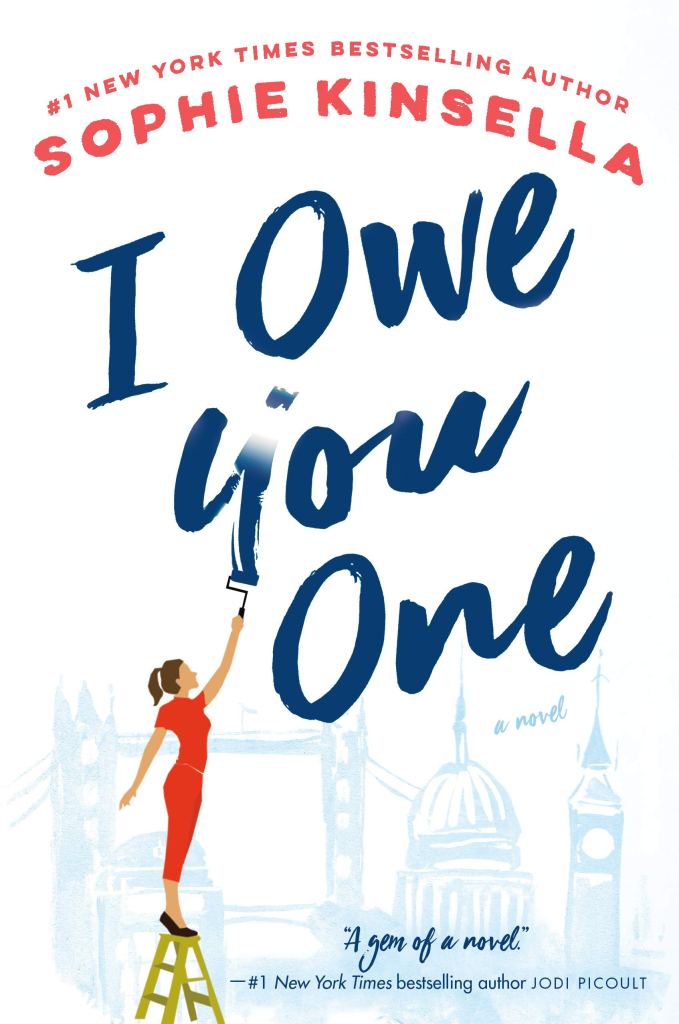
Anyone who has read romance novels will know how predictable they can get. Some like the familiarity, while others want something more atypical. For me, it depends if I’m reading it before going to bed, or if I’m doing that during the daytime. I bring all of this up because I read I Owe You One by Sophie Kinsella recently, and reviews were mixed for reasons including the one mentioned above. What do I think? Despite its predictable nature, I liked it, for it’s a good read before going to bed.

I Owe You One is about a woman with a complicated family, a handsome guy, and an IOU that changes everything. Fixie Farr likes to fix things. That’s her nature, even if it means picking up the slack from her siblings instead of striking out on her own when running the family housewares store. Then one day at a coffee shop, a handsome stranger asks her to watch his laptop. Not only does she agree, but she also saves it from a certain disaster. It turns out that the stranger – Sebastian – is an investment manager. He scribbles an IOU on a coffee sleeve and attaches his business card. Fixie would never claim that. Would she? And then, her childhood crush Ryan comes back into her life, and she tries to convince Sebastian to give him a job. As a result, Fixie and Sebastian pass a series of IOUs to each other. It gets to the point where she is torn between her family and the life she wants to live. Will she take a stand and grab the life and love she really wants?

Before going into this novel, the only thing that I knew was that the author Sophie Kinsella had written Confessions of a Shopaholic. I never read that book, but from what I’ve read, I get the feeling that she likes to write quirky female protagonists with a “fatal” flaw and that they experience character growth. There’s nothing inherently wrong with that, but some readers have issues with how formulaic her stories can be. Even Goodreads user KP outlines the steps to what goes in Kinsella’s novels. I personally didn’t care because these romance books are pretty predictable already. Even One Day in December had some cliched aspects in it. It really depends on one’s tolerance of the book’s lightness and foreseeable nature. 

I liked Fixie and her OCD-like tendency to fix everything in sight even though she’s a hot mess. I wanted her to think of herself more, especially when other people like her self-centered siblings Jake and Nicole walk all over her. It feels like a Cinderella story minus royalty. Her siblings are like the stepsisters but redeemable, Uncle Ned is the stepmother, Ryan – Fixie’s childhood crush – is like the douchebag version of the Prince, and Sebastian is like the fairy Godmother who happens to be the real Prince Charming in disguise. In addition, the most obvious reference is that both main characters are known by their “nicknames” and are doormats. But then again, one can say that a lot of romance and chick-lit are basically Cinderella tales. 

Going back to the predictability side of things, there were plenty of instances, in which I had to roll my eyes. I swear that in almost every scene up until Fixie and Sebastian get together, there’s always something that goes wrong due to Fixie’s fix-it like tendencies or something else. I get that it’s pretty common in rom-com books, but I wanted it to have a balance of things going right and things going wrong.

At the same time, when things started to go right for Fixie, I really felt for her. The moments where she stood up to her family had me cheering for her. When she showed off her skating at the local rink, I was rooting for her. And, when she and Sebastian get together at the end (did you think I was not going to spoil it for you?), it was all worth it!

Reading it before going to bed allowed me to enjoy what was happening on every page instead of nitpicking at certain details. That helped me to overanalyze it less. If I read it during the daytime, I would have been more critical of the novel.

All in all, I Owe You One by Sophie Kinsella is an enjoyable book for those like all the familiarity that romance novels, especially a Kinsella one, bring. Fixie is a flawed, yet quirky character that one could either get irritated at, or root for. This really depends on one’s tolerance for the book’s predictable nature. As stated earlier, it’s best to read the book before getting some shut eye. In addition to those who enjoy the genre’s cliched nature, I would also recommend it to those who like reading about female protagonists learning to live life the way they want to and to stand up for themselves. I owe you one review of this book, and now, you owe me a read…nah, I’m just kidding.

Subscribe below to get notified when I post new updates. Also feel free to email me here for any review suggestions, ideas, or new titles!

Blowback Book Review

I’ve been on a high recently with thrillers, so I decided to expand my suspense-filled horizon with Brad Thor. From what I’ve gathered, Brad Thor is a thriller novelist, known for the Scot Harvath series. For those who don’t know, Scot Harvath is an ex-Navy Seal, now a Secret Service agent. His books have garnered accolades from many organizations, including NPR, who listed his fourth Scot Harvath novel Blowback as “100 Best Ever” Killer Thrillers in 2010. Today, I’m looking at that book, and while it’s a good action thriller, I wouldn’t necessarily put it on a best list.

In Blowback, Harvath’s counterterrorism career crashes and burns after footage of him beating up an Iraqi fruit vendor turns up, but wait, the president brings him back after the War on Terror takes a chilling turn. Underneath an Alpine glacier, a weapon that was designed to destroy the Roman Empire has been discovered. It’s up to Harvath to retrieve this ultimate weapon of mass destruction before another organization takes it and uses it for America’s downfall.

As I had predicted in the “What I Am Reading” series, it was certainly action packed. Almost every chapter contained the main character running from danger, discovering dead bodies, or fighting the bad guys. It kept my interest, which is what an action/adventure thriller is supposed to do. 

Scot Harvath stands out as an action hero because of how vulnerable he can be. Throughout the novel, he thinks about his age and contemplates on settling down even though his job prevents him from getting into long-term relationships. 

So then, how does Brad Thor stand out from other action/adventure suspense authors? That’s a very good question with a simple answer. He’s willing to include politics into the story as the subplot involves a highly ambitious Democrat senator and her attempt to get into the Oval Office. Her name is wait for it…Helen Carmichael (do those initials ring a bell?). She wants to prove that the video of Harvath beating up the vendor is really him, so she can turn the voters against Republican President Jack Rutledge. 

As one has figured, Thor is more conservative than his peers, but he incorporates his political views in very subtle ways. It also helps that the Helen Carmichael plot is just as engaging as the main story, and the twist resolution is great!

How about the main plot? It’s good. The beginning was a bit slow due to all of the exposition. The middle moved faster than a barefoot jackrabbit on a hot greasy griddle in the middle of August. The moment I got engaged with the book was when Jillian Alcott – a British paleopathologist – was introduced. She’s pretty badass; she even kills a high ranking Al-Qaeda official. Also, like Emma in Nighthawk, Jillian has some good banter with Scot. Sadly, it has come to my attention that she’s not in any other Scot Harvath book.

Another thing that made me intrigued with the novel is the talk about the weapon itself. Scot and Jillian learn a whole lot about it, especially how Hannibal may have used it while crossing the Alps. Now, I understand that some readers might be bored by these passages because in some ways, they stop the momentum of the book. For me, those sections made the novel far more interesting since it adds understanding to how the weapon was used and how it could be utilized in the present day. I’m also a history person, and it’s clear that Thor really likes ancient history. 

And then the third act came along, and I don’t know why, but I could barely remember what happened during it. At that point, the book seemed to jump from one place to another, and it lost me. I’m sure there are readers who love the climax, but I couldn’t get myself into it. I blame the history sections.

In addition, the book was published in 2005, which was during the Iraq War and the War in Afghanistan. This means that the bad guys are mostly Muslim terrorists, which sadly permits casual racism in the book. At one point, Scot remarks that while not every Muslim is a terrorist, every terrorist is a Muslim. I understand the sentiments at that time, but did Thor forget that the Oklahoma City Bombing was perpetrated by people who weren’t Muslim? I could ask the same question with Scot, yet I haven’t read any of the prior books in the series. What I’m saying is that some of the writing has not aged well. At the same time, I’m going to give it a benefit of a doubt, for maybe Scot has evolved on his views on terrorism in future novels, especially the Islamic kind.

All in all, Blowback by Brad Thor is an effective action thriller. It stands out in many ways than one, more good than bad. I wish the ending to the main story grabbed my attention more, but that might just be me. I would recommend this to those who read similar books by Clive Cussler and Vince Flynn. 

Subscribe below to get notified when I post new updates. Also feel free to email me here for any review suggestions, ideas, or new titles!
What Am I Reading – Chapter Twenty

Hi Everybody!

I hope you all had a great September so far! I sure have ! I’ve read a ton during this month, especially the titles that I mentioned in the last chapter.

In the meantime, I finished up A Heartbreaking Work of Staggering Genius by Dave Eggers and On the Come Up by Angie Thomas. The funny thing is that Bahni Turpin narrated the latter’s audiobook as well as the one for this title!

The Southern Book Club’s Guide to Slaying Vampires by Grady Hendrix is about a women’s book club trying to protect its Southern suburban community from a mysterious and handsome stranger who turns out to be a vampire. Patricia Campbell’s life has become smaller and smaller after she gave up her job as a nurse to marry an ambitious doctor and become a mother. Luckily, she has her book club to look forward to. They consist of Charleston mothers who love to read true crime and suspense novels. When an artistic and sensitive stranger moves into the neighborhood, Patricia is initially attracted to him. However, once some children go missing, she begins to suspect that the newcomer has something to do with it. She starts her own investigation, yet what she discovers is far more terrifying than she could imagine. Soon, she and her book club are the only ones standing between the monster they’ve invited into their homes and the unsuspecting community they’ve sworn to protect.

I wasn’t sure what I was getting into when I popped in the first disc, but I’m glad to say that boring would be the last thing that I would describe it. Where should I start? It got me feeling a whole bunch of emotions. It made me feel happy and supported when the book club had Patricia’s back as well as angry and frustrated when certain people like their husbands didn’t believe them. Patricia’s husband Carter evens prescribes her Prozac! Such gaslighting! It all felt too real. Since this is a horror, it shocked me plenty of times so far. Let’s just say an earlobe gets bitten off and rats come into the house.

I totally bought Patricia’s frustrations as a housewife and mother. Her husband is distant, and her kids would rather do other things. I can understand her need to seek out something interesting, even dangerous. When nobody believed her about her theory about the stranger and the missing children, I understood her anger and the actions that led into her low point even though I though disagreed with what she did to cope. I’d love to see how she turns it around.

As I mentioned before, Bahni Turpin narrates the audiobook. I’ve mentioned her in the last chapter when I had talked about On the Come Up, and she has impressed me even more. Turpin has such a wide vocal range. She’s able to voice a proper white Southern lady, a sassy one from New Jersey with a sad past, and a black one frustrated with the community not doing enough for them. Even the men sound fairly distinct with the seemingly reasonable Carter Campbell and the stranger as a modern Dracula. After a little break, I look forward to listening to the rest of the story!

We have now come to the end of the twentieth chapter of “What Am I Reading?”

Subscribe below to get notified when I post new updates. Also feel free to email me here for any review suggestions, ideas, or new titles!

What Was Your Name Downriver: Tales of the Shattered Frontier Book Review

Full disclosure: I was given a free physical copy of this book in exchange for an honest review.

I’ve read plenty of unique genres like comic thrillers, but none have been as bizarre as the western-fantasy hybrid. I’ve read plenty of fantasy, yet I’ve never read any westerns. When I came across the novel What Was Your Name Downriver: Tales of the Shattered Frontier by Anthony Lowe, which happens to fall into that genre, I wasn’t sure what to expect. Now that I’m done with it, I can say that it’s great…and then the main characters get off the boat.

Consisting of a novella and two short stories, What Was Your Name Downriver: Tales of the Shattered Frontier tells the stories of two women – Evaline Cartwright and Trivan Esterhazy – who meet on a riverboat and navigate a hostile environment with wit and weapons as they try to get back to civilization.

I’ve never read a book that contains both western and fantasy elements, but it works. Lowe uses the more familiar aspects of each genre to make something that feels new and avoids the cliched pitfalls. Even though I’ve never read any westerns, I’ve watched some western films. I was able to identify some recognizable tropes like the standoff, gambling, and trying to resolve issues with guns, but they’re done in such ways that feel natural. With the fantasy genre, I was able to identity some of its familiar elements like magic and discrimination against the unknown.

In addition, the voices of many characters fit right into the western atmosphere. Everytime I heard a person talk in the book, I felt I was there with them on the riverboat or in the saloon. For example, this set of dialogue spoken by one of the men at a gambling table on the riverboat occurs at the very beginning of the book:

“Tell you what I heard,” said one of the men, waiting his turn. “Feller gets stopped by a lawkeeper near Little Horn. Middle of the night. He gets stopped on account of the five or maybe six, ‘rathlings tied up in his cart. Lawkeeper shines a light, sees the tears in the young’uns eyes and their little knifey ears. ‘What is the meaning of this?’ asks the lawkeeper. He’s reachin’ for his gun at this point, I think.”

The man with the cart, he just can’t stop smiling. He just looks at the lawkeeper and says, ‘A kindness, mister. A kindness. These children is without their parents. Orphans,’ this man keeps saying. ‘Orphans, believe you me.’ The lawkeeper ain’t buying it. He asks the man, ‘How do you know them ‘raths is orphans? How do you know?’

And the man with the cart replies, and he’s still smiling when he says, ‘I know they’s orphans ‘cause I killed their parents myself” (p. 1-2).

 Lowe clearly has spent time reading western books and watching movies in that same category.

I also liked the protagonists – Evaline and Trivan. Initially, they are seen as the complete opposites of one another. Evaline is a bounty hunter with a reputation, while Trivan is a shy half-rath who’s forced to run after her father’s death and after violence was inflicted onto her. And yet, like the genres in the book, they surprisingly mesh well. They both want to leave their pasts behind. Also, their wants and needs don’t feel too contrived. In fact, the short story “The Horse Thieves of Ariasun County” reveals Evaline’s backstory and why she would go to great lengths to protect someone like Trivan. I really enjoyed reading that novella. Anyway, the main story is a  great buddy film but in book form. Like other readers, I wish Trivan was a little more developed, yet I know that Lowe will probably have more titles in The Shattered Frontier series, so there will be plenty of chances for her to grow.

Before I forget, the short story “Gunfight at the Thornmount Colossus” takes place after the events of the novella. It continues the banter between the Evaline and Trivan as the former wants to go to a gunfight. The latter tries to convince her not to go because the gunslingers in the books she reads always live, but that doesn’t happen in real life. She also doesn’t want Evaline to die (p. 176-177). Yet beyond that, it didn’t leave much of an impression on me.

Now, I bet all of you are wanting to know why I said that the collection was great and then they got off the boat. That was my way of saying that it was engaging until roughly that point. Once they left the riverboat, Evaline and Trivan were going from one place to another so fast that it got pretty confusing. Luckily, in the midst of all of that, there were some great moments like Evaline warning Trivan not to attack the imaginary people, saying that the “best revenge is leaving them behind” (p. 105). 

Evaline ends up shooting those scoundrels because she didn’t know them.

What Was Your Name Downriver: Tales of the Shattered Frontier by Anthony Lowe is an enjoyably unique collection of stories that effectively blends the western and fantasy genres. It also captures the voices of characters that one would find in the former category, and like a pair in a buddy movie, the protagonists are memorable together. I would recommend it to those who not only read a lot of western and fantasy novels, but also to those who like stories that involve two people on opposite ends who have to work together. It didn’t always grab my attention, but when it did, it did in a good way.

Subscribe below to get notified when I post new updates. Also feel free to email me here for any review suggestions, ideas, or new titles!