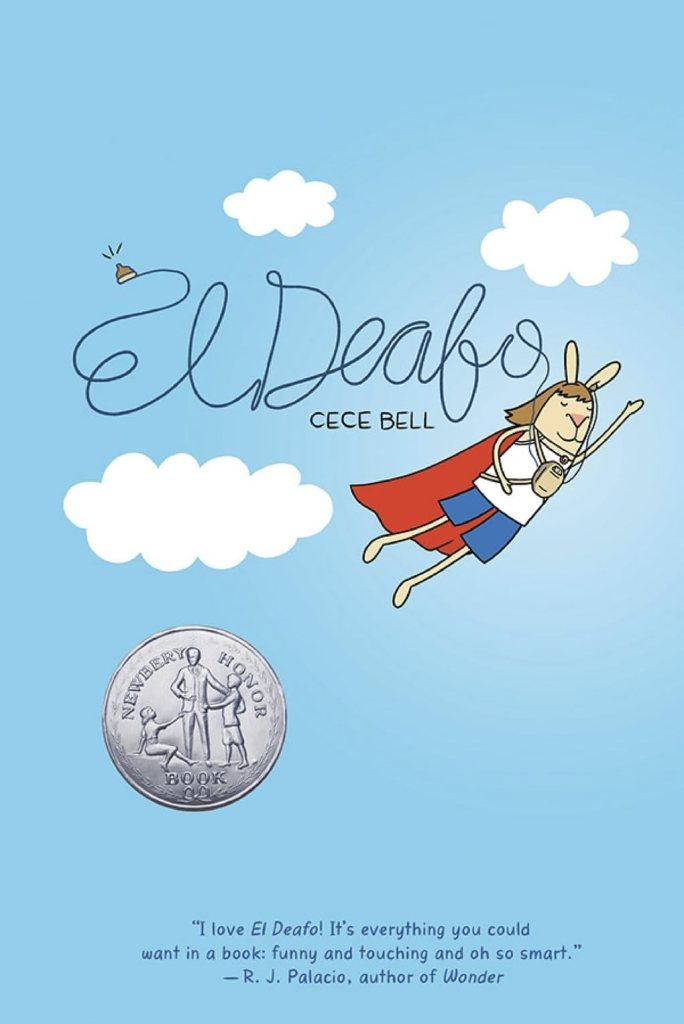
When I started at my first librarian job in Clarkston, Michigan, I discovered that some of the patrons were Deaf. Some knew American Sign Language (ASL) more than others, and I wanted to learn that. Since then, I’ve taken two ASL and one Deaf culture class. I also take the time to read about those who identify as Deaf/deaf whenever I can, so I can gain a more thorough understanding of that community. Why am I telling you all of this? Simple, it’s because I read El Deafo by Cece Bell. It’s a humorous graphic novel memoir about the author’s life as a deaf child.
El Deafo is about Cece and her life growing up as hearing impaired. At age 4, she lost her hearing due to meningitis. At first, things were good as she was enrolled in a school, in which every kid in her class was deaf. However, when her family moves to a different town, she’s sent to a hearing school. It doesn’t help that she has to carry around a giant hearing aid strapped to her chest. Cece thinks that people are staring at her Phonic Ear – the powerful aid that will help her hear her teacher. It also repels potential friends. Soon, she discovers that her Phonic Ear can hear the teacher anywhere in the school. With this superpower, she soon becomes El Deafo! At the same time, this makes her feel even more different and lonely. Can Cece channel her powers into finding the thing she wants most, a true friend?
There are many things that I adore about this graphic novel. One of them is how funny it can be. For example, whenever Cece is in a difficult situation, she imagines herself as a superhero fighting off various villains. At one point, she’s at a sign language class that her mom made her go to. As she’s imagining fighting her motherly nemesis, she actually kicks her parent in real life.
I also like how others’ reactions to Cece are handled. Throughout the novel, she comes across people who react to her in different ways. One friend Ginny talks extremely loud and slow even after Cece tells her not to do that. Another potential pal starts doing sign language when she notices Cece’s hearing aid, yet Cece herself never really learned it. (Side note: the real Cece Bell admitted that she’s not a part of the Deaf community for a variety of reasons. Since she’s not a part of that culture, that’s why I refer to her as the lower case deaf as opposed to the upper case Deaf.) When Cece actually obtains a true friend with Martha, a tree branch wacks into the former’s eye. The latter, thinking that she was responsible for the injury and making Cece blind, avoids her deaf friend. A lot of these people have good intentions, but their preconceived notions about disabled people only makes things more difficult for Cece to make a true friend.
Additionally, the illustrations and speech bubbles emphasize certain aspects of being deaf. For starters, the panels often rely on close ups to focus on the reactions of Cece and other characters. This makes sense as she was taught to lip read from an early age. With the speech bubbles, they reinforce the difficulty that Cece faces while communicating with others. When she initially loses her hearing, the words begin to fade. When she’s getting tested, the speech bubbles have no text in them. When she’s not wearing her big hearing aid, the words look gibberish.
Moreover, I like how it’s a story about acceptance. Cece struggles to believe that being deaf is anything else besides different. She has a hard time making friends because of her belief that people will stare at her giant hearing aid. It also doesn’t help that when she did, they didn’t always treat her as the pals she deserved. By the end, when she applies her superhero imaginations to real life, she realizes that being different can be a good thing.
Most importantly, I found Bell’s decision to portray everyone as rabbits wonderfully inspired. The body parts that’s most associated with that animal are the ears. By highlighting those, Bell efficiently persuades readers to understand why she felt so self conscious while wearing her Phonic Ear in school.
I will admit there was one scene that was a little tough to get through. It was when Cece is at the sleepover, and the girls try to put makeup on her. Her refusal made me want to yell, “Tell them no!”
Instead, she tells them that the makeup would mess with her hearing aid. I know that this is in the part of the book, where she’s still lying to others to avoid prejudice, yet it still made me feel slightly uncomfortable.
If I had one complaint about the novel, it’s when Cece wins over her class with the powerful Phonic Ear. She puts it to use when some of the kids want to party before the teacher gets back in the classroom. It reminded me of Rudolph the Red-Nosed Reindeer television special, in which the other reindeer make fun of the title character’s nose, and yet, they want to include him in everything once Santa decides to use him for the trip. The difference is that the book establishes that some of the kids, i.e. her crush Mike, like her for who she is.
El Deafo by Cece Bell is a great graphic novel memoir. It’s a heartfelt and funny look at growing up deaf. It’s a little sad and hard to get through at times, but it’s worth the read. I would recommend it to both kids and adults, especially to those who have disabilities, know people who are Deaf/deaf, had to stay extensively at a hospital, and love graphic novels. Everyone has a superpower; we need to embrace them.
Subscribe below to get notified when I post new updates. Also feel free to email me here for any review suggestions, ideas, or new titles!

