Content warning: this book review will discuss gruesome medical details.
Some stories work both as a physical book and as an audiobook. Others tend to fare better in one of those formats. Usually, readers think the novel is superior to the audiobook because the former allows them to imagine what the characters sound like and how the narrator would read it. Even though there are plenty of narrators who do a great job with the material (I should know, I’ve reviewed a handful of them), there are definitely ones that threaten to ruin the enjoyment. One example was last week’s Mockingjay by Suzanne Collins, and another is this week’s The Radium Girls: The Dark Story of America’s Shining Women by Kate Moore. The book is great, but the audiobook narration is subpar due to how irritating it can be.
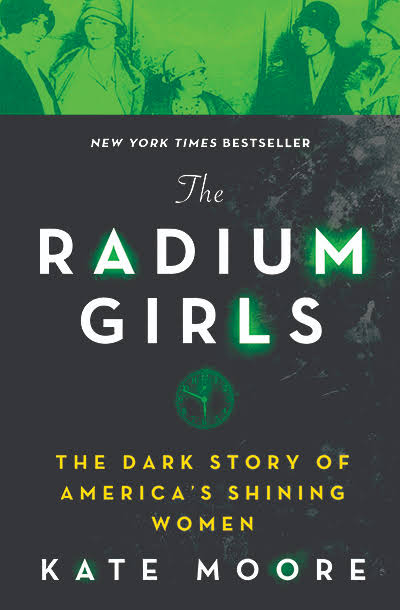
The Radium Girls: The Dark Story of America’s Shining Women is the true story of the women who were harmed by radium and how they fought against it. When the Curies discover radium, it’s heralded across the nation as the fresh face of beauty and a wonder drug. The popular element shines through during the First World War. During that time, radium-dial factories hired hundreds of girls to paint watch dials with radium paint. They would decorate themselves with said paint. The glittering chemical covers their bodies from head to toe, and they literally light up the night. These “shining girls” are the luckiest alive until they start getting sick one by one. The factories who gave them opportunities ignore all their claims of radium’s gruesome side effects and the women’s cries of corruption. As radium takes its hold, the brave shining girls find themselves embroiled in one of the biggest scandals in early twentieth century America and in a groundbreaking battle for workers’ rights that still resonates today.
Unlike a lot of nonfiction I read for this website, I actually knew about the radium girls and their story. When I was a teenager, I saw a production of the play These Shining Lives by Melanie Marnich at Aquinas College in Grand Rapids, Michigan during a weekend tour of the college. It was impactful seeing those women slowly die from unknowingly being poisoned at work and fight for what lives they had left.
Moore expands on the characters presented in the play. She takes her time introducing each girl who worked at the radium dial companies in Orange, New Jersey and Ottawa, Illinois. Specifically, she details their physical features, personalities, and if they got married and children. Even though there are a lot of women the author follows throughout, this allows readers to get to know them on a personal level, especially when they start getting sick.
Moore truly tests the word non-sugarcoated by holding nothing back when describing each of the girls’ illnesses. For example, many of them had tooth loss, abscesses, bone decay, tumors on various parts of the body, and intense pain due to radium exposure. One even had her entire lower jaw removed. If that wasn’t enough, Moore informs readers that one former worker Charlotte Purcell had so much intense pain in her arm that she agreed to have it amputated, thus allowing her to live until 1988. The photographs in the book show some of the women before and after working at the radium dial companies. They can be gruesome, especially to those who get weak while reading medical-related stuff.
The biggest strength of this book is the research. Moore mainly relies on court documents, business materials, letters, and diaries to tell the stories of the radium girls, and it shows. One could easily get lost in it, but she maintains the momentum like it’s a play. She always keeps the tales and what the women went through front and center. In addition, the author makes it clear of how popular radium was in the early twentieth century. This was especially true when various corporations declared it to be a wonder drug to cure everything. On top of that, there was a song called “The Radium Dance” that was popular during the 1900s. These help to set up the environment the women were in while they and various doctors were trying to prove that radium was far more dangerous than the businesses and public realized.
There are some readers who have complained about how repetitive it can get with what the women looked like, how they suffered, how they were taken advantage of by the businesses, and how they fought back. To me, that repetition is the point, for it ACTUALLY HAPPENED. And, the most frustrating thing about it is how little things have changed, especially how workers are still being used by the companies and ignored when problems come up. Moore brings up that the radium girls’ tales are important because they led to more regulations in the workplace, especially in regards to how workers handled radium and plutonium during the Manhattan Project and to the creation of the Occupational Safety and Health Administration.
This all leads to my big complaint, which is the audiobook. It’s narrated by Angela Brazil. She is an actor and member of the Resident Acting Company at Trinity Repertory Company in Providence, Rhode Island. Moreover, Brazil has recorded several audiobooks for nonfiction books like The Language of Butterflies and The Horse by Wendy Williams (not that Wendy Williams), romance novels by Laura Frantz, and “Mr. Monk” books based on the television show. I’m going to be very honest. Brazil is one of the worst audiobook narrators I’ve ever heard. She’s overly chipper and energetic, which annoyed me highly in the beginning, yet she somewhat dials this back during the course of the book. It also didn’t help that she was super focused more on the words than on the emotions. What bothered me the most was her tone. She sounded like an annoyed flight attendant saying, “Buh-bye” to the guests. I was shocked to read that Brazil is a professional actor because this is a performance I expect more from an amateur. This narrator should have been recast.
The Radium Girls: The Dark Story of America’s Shining Women by Kate Moore is an excellent book with a mediocre audiobook. Moore allows readers to be fully invested in each of the women who worked at the radium dial companies even if there’s a lot of them. And, she does a great job with the research and maintaining the pacing and the story. I simply wish that it had a better audiobook narrator. But then again, I have to wonder if it really needed one in the first place because the book itself is enhanced more with the visuals than it is with the audio. This is why I would recommend the physical print to all readers, especially to those who are interested in medicine, workplace tragedies, and stories about fighting businesses. Whatever you do, don’t listen to the audiobook!
Subscribe below to get notified when I post new updates. Also feel free to email me here for any review suggestions, ideas, or new titles!

