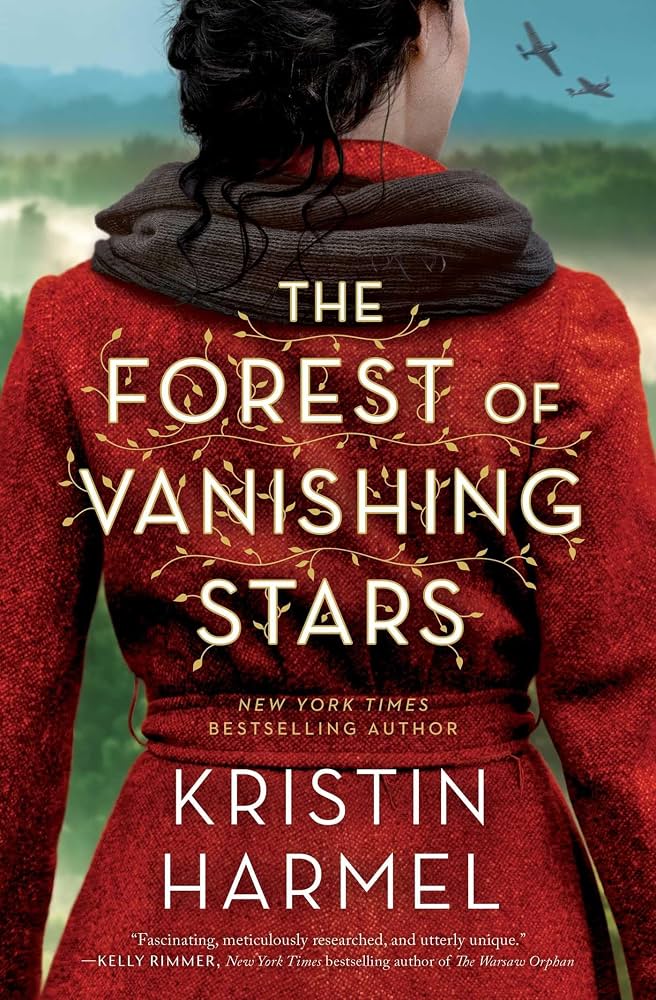
When I discussed Lilac Girls by Martha Hall Kelly awhile back, I talked about some of the ways that one can stand out while writing stories involving World War II. It’s easy to get lost in those kinds of plots because of how vast they are in the historical fiction genre. Luckily, Kristin Harmel found a way to be distinct with a fairy tale inspired by the Bielski partisans. It’s called The Forest of Vanishing Stars, and I really liked it due to the atmosphere, how research informs the story, and the characters.
The Forest of Vanishing Stars is about a young woman who uses her knowledge of the forest to help Jewish refugees escape from the Nazis. After being kidnapped from her wealthy German parents and raised in the wilderness in eastern Europe, Yona acquired plenty of survival skills, but not much on human interactions. When her kidnapper dies, she is left alone. In addition, World War II has just begun. Her solitary existence ends when she comes across a group of Jewish people fleeing Nazi persecution. Yona vows to teach them how to survive in the forest, and they enlighten her on lessons about opening her heart after years of isolation. She finds a special connection with Aleksander, the leader of the small refuge group. At first, she feels that she has found a family, but once she is betrayed, she flees the forest and stumbles onto a German-occupied village. This leads into a shocking revelation that makes her past and present collide. As a result, she must decide where to place her loyalty and trust.
Some reviewers compared this book to Where the Crawdads Sing by Delia Owens because both books had female protagonists living alone in an isolated area, and they fall in love with two completely different men. I can definitely see that. At the same time, Yona is a little more active of a character than Kya is. And the main difference is how the environments are portrayed. In Where the Crawdads Sing, the marshes of North Carolina are depicted as lonely, but beautiful to look at (much like Kya). In addition, it could be a place that someone can book on AirBnB. In The Forest of Vanishing Stars, the Nalibocka Forest (in present day Belarus) serves as the backdrop, and there’s more of a sense of danger in that area as anything or anyone could kill a person because of one false move. Nonetheless, it’s also a giver as long as one knows how to utilize it to the best of their abilities, which is what Yona is good at.
The Forest of Vanishing Stars has a more realistic environment, for Harmel put in a lot of research. This includes finding information on the Nalibocka (now Naliboki) Forest, how people survived there during the second World War, and the Bielski partisans who saved thousands of Jewish people and smuggled them in said forest during that conflict. One can easily tell because of how informed it was. It also helps that Harmel doesn’t shove the information down one’s throat. Much like Li-yan from The Tea Girl From Hummingbird Lane, Yona learns and later teaches others about surviving in the woods at the same time as the readers. Harmel does well with providing information about the forest and how various people lived through the war while moving the story along.
Speaking of the story, I thought it was intriguing. It read like a fairytale. Yona gets kidnapped by an old woman named Jerusza. She sees danger in Yona’s life if she is left with her parents. However, Jerusza also foreshadows the child’s savior-like nature, so the former teaches the latter the tactics of how to survive in a forest. She reveals to Yona that her parents were less than stellar people. This leads to her questioning loyalty and trust. Even though Jerusza raised her, she didn’t love her like a guardian usually does and was harsh on her at times. On the other hand, Yona wonders if her upbringing would’ve been that different if she was never taken and was raised by loving, but potentially problematic parents. This was an interesting take on the typical girl-gets-raised-in-an-isolated-area-without-knowing-her-true-identity fairy tale.
The supporting cast were fascinating as well. During the novel, Yona encounters two groups of Jewish refugees who have escaped the ghettos. One is led by Aleksander, a young, charismatic man who lost all of his family members. She falls in love with him as she teaches him and the other members how to survive. However, he cheats on her. This results in her leaving the forest and going into a German-occupied village. The other group is led by Zus, a man who is dealing with his own trauma of losing his wife and daughter. He’s respectful of her space, but he deeply cares for her. Again, this is reminiscent of Where the Crawdads Sing with the two potential male lovers for the female protagonist, who couldn’t be more opposite of each other. Some reviewers were annoyed with the amount of romance that was present in the novel. I wasn’t bothered by this since it challenged Yona’s isolation and gave her a deeper understanding of community.
Another set of supporting characters that I have to mention are the nuns. They were based on the Martyrs of Nowogródek – a group of 11 members of the Sisters of the Holy Family of Nazareth who sacrificed their lives in order to spare those who were slated to be executed by the Gestapo. They wanted to do everything that they could in order to let others survive even if that meant offering themselves in exchange. One of them engages with Yona in a lot of philosophical discussion on how God would’ve seen and reacted to the atrocities committed by the Nazis. They are expectedly portrayed as noble, yet Yona, to a degree, questions their decision to let the Gestapo kill them.
My only complaints are that there are certain parts of the novel that didn’t feel believable. One of them involves Yona being instilled that she is going to be a savior to people, but she doesn’t really do anything that would justify that. I mean, she teaches people how to navigate through a potentially dangerous forest and tells them when to move. However, she doesn’t do anything that single-handedly saves them besides one thing, but I’m not revealing any more spoilers. The other unbelievable aspect was how she was able to recognize her father. Jerusza kidnapped Yona when she was about 2 years old. Through a good chunk of the book, Yona vaguely remembers a man hovering over her while she was in her cradle. And yet, when she figures out who he is, she does this almost immediately. From what I understand, many 2-year olds don’t remember a whole lot, so the fact that Yona was able to recognize her father instantly felt unrealistic.
I also tried listening to the audiobook narrated by Madeleine Maby. She’s an actress and has narrated several books including the Astrology Self-Care series and those written by Kristin Harmel (surprise surprise). However, I was not able to finish it due to issues with the physical audiobook, so I ended up reading the rest with a physical copy. From what I’ve heard, Maby is ok. Her vocal characterizations of Yona give her strength, naivety, and vulnerability, while Jerusza has a mystical old woman voice that doesn’t come off like a caricature. Sadly, the rest of the voices aren’t as effective. The men’s vocals are similar, and every older woman that Yona comes across sounds like an offshoot of Jerusza. With this being said, I would recommend reading the physical novel as opposed to listening to it.
The Forest of Vanishing Stars by Kristin Harmel is a pretty good fairy tale about surviving in a forest during World War II. The woods feel like a character in of itself with its caring nature, yet there’s always a sense of danger lurking around. Yona feels like a female protagonist in a fairy tale, but her questions regarding loyalty and trust add layers to her character. I would recommend this book to those who like stories set during World War II and involving protagonists growing up and/or surviving in isolated areas. I’m not going to mistake it for any other WWII-based novel anytime soon.
Subscribe below to get notified when I post new updates. Also feel free to email me here for any review suggestions, ideas, or new titles!


One thought on “The Forest of Vanishing Stars Book Review”