Content warning: this review contains some spoilers and mentions suicide.
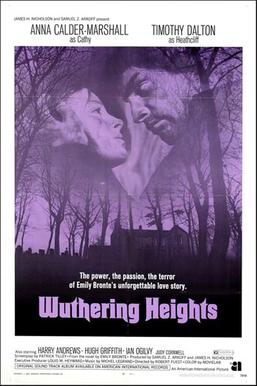
Welcome to Part 6 of looking at various adaptations of Wuthering Heights and seeing if they can capture the spirit of the book by Emily Brontë. Today, I’ll be reviewing the 1970 movie starring a pre-James Bond Timothy Dalton as Heathcliff.
If one is keeping track, this is the first film adaptation of the story since 1939. It must have been daunting for American International Pictures to rise to such an occasion. At the time, they were best known for low-budget movies in genres like horror, western, and science fiction, with some being directed by Roger Corman. However, they had a way to stand out from other versions. Founder Samuel Z. Arkoff devised a formula for producing a successful low-budget flick. It was called the “ARKOFF formula,” and it consisted of action, revolution, killing, oratory, fantasy, and fornication. Did it work for this Wuthering Heights adaptation? Well, it’s a mixed bag. I’ll explain with each letter.
Action meant having exciting and entertaining drama, and this one certainly has them. While there were parts that I didn’t care much for, there were a few standout scenes that made the film pretty entertaining. One of them is when Catherine and Heathcliff spy on the Lintons by barking at them, which results in the latter’s dog chasing after them and injuring her in the process. This is better than the similar scene in the 1967 BBC series because Catherine and the canine are in the same shot, and that animal looks menacing. Another is when Catherine returns to Wuthering Heights after her stay with Lintons, Hindley orders Heathcliff to smile at and shake hands with her. In other adaptations, Heathcliff would do that reluctantly, but in this case, he kicks his abuser in the knee and runs to the stable with others trying to catch him. It was very fun to watch.
Revolution is supposed to show novel or controversial themes and ideas. This version has an infamous way of doing that. One of the subtexts of the book is the idea that Catherine and Heathcliff are half-siblings because Mr. Earnshaw is his father. This adaptation brings that to the forefront. Like the 1967 BBC series, Mrs. Earnshaw is not keen on the idea of bringing that dirty boy into her home. The 1970 flick takes this one step further by having her assert that Hindley will inherit the estate because he is her son, not Heathcliff. This was likely done to shock audiences and to justify why Catherine and Heathcliff shouldn’t be together (and possibly to secure a white guy as Heathcliff). This becomes more apparent when they have their rendezvous in the orchards behind Thrushcross Grange, even though I’m not sure they’re aware that they’re half-siblings. At the same time, it didn’t make too much of a difference because someone was going to go on that route at some point. I think it would have been more revolutionary if the studio had cast a multiracial actor as Heathcliff to explore racism in 18th-century/19th-century England.
Killing refers to what Arkoff describes “a modicum of violence.” He wanted to show a little bit of cruelty. Wuthering Heights fits the bill with some scenes of Hindley abusing Heathcliff and vice versa. Furthermore, when Catherine is locked in her room wanting to die, she tries to take her own life in disturbing ways. This works because Catherine in the novel and other versions simply doesn’t want to live after she finds out that Heathcliff marries Isabella. Also, Catherine’s pregnant, which brings in more shock value. The violence that doesn’t work is when Heathcliff dies after Hindley shoots him. In the previous adaptations, Hindley contemplates killing Heathcliff for essentially ruining his life, but he never goes through with it because he’s a coward. On the other hand, this version allows Hindley to murder Heathcliff because it portrays the former more sympathetically. By doing this, it lets the bad guy win. As much as Julian Glover tries to make his character work, Hindley is not one I would want to get a sympathetic treatment.
Oratory is all about notable dialogue and speeches. With a novel like Wuthering Heights, this would be a slam dunk because it contains some memorable lines, especially “He’s more myself than I am. Whatever our souls are made of, his and mine are the same.”
However, American International Pictures fumbled this one. Sure, there are some notable dialogues from the book that made it into the film, yet some were omitted, like the aforementioned line. The closest is when Catherine says, “I am Heathcliff.”
Fantasy involved acted-out fantasies common to the audience. The novel is all about two lovers who can’t be together, so this fits perfectly. The movie plays into this, especially when they have their trysts in the orchards, Heathcliff digging up Catherine’s grave, and chasing her ghost at the end. And, it takes this one step further with Nelly having feelings for Hindley. In many adaptations, she is often an older woman, but in the novel, she’s closer to Hindley’s age. In this version, Judy Cornwell is a young Nelly. I understand her feeling sorry for Hindley, yet I’m not sure why she had to have a crush on him. I can believe that the writers and director Robert Fuest were aware that Nelly is not as objective as she wants to be in the novel, and to give her something to do besides narrate the story. In fact, they omit Mr. Lockwood. It doesn’t work because it gets dropped halfway through when Hindley allows Nelly to serve at Thrushcross Grange.
Fornication is sex appeal for young adults. Timothy Dalton’s shirts are unbuttoned at times, and the cleavages of Anna Calder-Marshall (Catherine) and Hillary Dwyer (Isabella) are on full display. In addition, Catherine and Heathcliff have intense makeout sessions, which will make people think that they’re going to certain places. Moreover, those scenes are depicted with a sheen that can only be found in shampoo commercials from that time. And of course, the best scene is when Heathcliff is chasing after Catherine’s ghost from the Moors to the Wuthering Heights estate at the end. It’s like she’s teasing him to get the prize. It highlights the supernatural elements in the story in a unique way.
The main problem of this Wuthering Heights version is its budget limitations. It’s not that it needs to be lavish. The sets are realistic, and I like the color schemes of each (Wuthering Heights being brown and grey, Thrushcross Grange being white, and the English Moors being blue). The problem is that it feels like it had a time crunch to get it done. It wouldn’t shock anybody at this point when I say that it cuts the second half of the book, although it includes notable scenes like Heathcliff digging up Catherine’s grave. What’s more egregious is that it moves at such a quick pace that scenes are not as developed as they should be. When it seems that something is going to happen, it cuts to the next part. That disjointedness might bother viewers who’ve never read the novel.
And of course, I can’t forget to talk about the performances. Anna Calder-Marshall plays Catherine, and she’s fine. She has some big emotional moments, like when she’s dying in her bedroom, but she’s a bit too high-class. An actress playing Catherine needs to show the wild side and build it up to the character’s death. But then again, the little girl playing the young Catherine doesn’t help either when she’s not given opportunities to display that volatile side. Plus, it’s a hard act to follow when Angela Scoular did such a fantastic job with the role prior.
As I mentioned earlier, Timothy Dalton plays Heathcliff. He’s another white guy in the role, but he does a decent job. Some people have complained that he doesn’t brood enough, yet I think that he interpreted the character who has spent so long bottling up his emotions so much that when he does express them, it leads to some great outbursts, even if they are comical. My favorite is when Heathcliff finds out that Catherine died, Dalton screams and bashes his head against a tree.
The Wuthering Heights 1970 movie is fine. It certainly wants to stand out from the others and build upon what the prior ones had established. Additionally, it actually fit the ARKOFF formula better than I expected, yet I feel that some changes weren’t needed. The flick has plenty in common with the 2026 film because of how provocative it wants to be, but it fails to deliver. They also want to appeal to a teenage audience. In addition, a lot of the problems could have been resolved if the film was named Hindley. On the other hand, there were scenes that I liked, and I enjoyed Timothy Dalton’s performance as Heathcliff. Although it’s not my favorite version, I would still recommend it to people watching every adaptation of Wuthering Heights, diehard Timothy Dalton fans, and 19-year-old boys. Meanwhile, I’ll be watching the Monty Python parody version, which was released in the same year, with my semaphore flags.
Now, let’s see how this one fits into the ranking.
- Wuthering Heights 1939 Movie
- Wuthering Heights 1958 Teleplay
- Wuthering Heights 1967 Series
- Wuthering Heights 1970 Movie
- Wuthering Heights 1950 Teleplay
- Wuthering Heights 2026 Movie
We’ll see how this ranking evolves after I see all the others.
Stay tuned next month when I review the 1992 movie with Ralph Fiennes and Juliette Binoche.
Subscribe below to get notified when I post new updates. Also feel free to email me here for any review suggestions, ideas, or new titles!

