Content warning: this review mentions suicide.
Full disclosure: I was given a free eARC copy of this book by Dutton Books and NetGalley in exchange for an honest review.
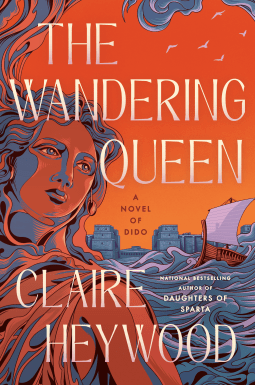
Three years ago, I reviewed The Shadow of Perseus by Claire Heywood – a feminist retelling of the Perseus myth. Now, she’s back with another revisioning of a story in ancient mythology – Dido the Queen of Carthage – and her romance with the soon to be founder of Rome, Aeneas in The Wandering Queen. As soon as I learned about this book, I knew I had to read it. The Wandering Queen is just as good as The Shadow of Perseus, but it has a major problem.
The Wandering Queen retells the story of Queen Dido – the founder of Carthage. When the King of Tyre dies, he decrees that Elissa – his clever and strong-willed daughter – and her half-brother Pygmalion will rule the kingdom equally. However, Elissa, who’s not well versed in the machinations of the court – finds herself sidelined by a band of merchants in favor of her more malleable brother. Forced out of her palace home, Elissa decides to forge her own path. While on her journey, she transforms from a sheltered princess to a formidable leader. When she leads her followers on an epic quest to search for a new home in a faraway land, she earns herself the name that will immortalize her: Dido – the wanderer. Then, one day, a stranger named Aeneas arrives at the gates, fleeing the Trojan War. As Dido and Aeneas find themselves increasingly drawn to each other, she has to make the impossible choice between power and love.
I’m aware of The Aeneid by Virgil. I read it in high school for my ancient mythology class. I don’t remember much of it besides the romance between Aeneas and Dido, and I had to look it up to refresh my memory. But then again, that seems to be the part that everybody recalls. As a result, a lot of my perspective on The Wandering Queen stems from how much I could remember from the original story.
Dido is one of the most famous side characters in all of literature. In The Aeneid, she basically exists just to be an obstacle for Aeneas as he journeys to Italy. It’s easy to label her as a doomed lover, but Heywood fleshes her out. In her notes, the author mentioned that she wanted to recenter Dido based on history – the leader, trickster, voyager, and survivor side of her – while incorporating and responding to Virgil’s narrative. Heywood essentially does this by having two alternating timelines. One is of Dido’s romance with Aeneas, and the other is of Dido aka Elissa’s time in Tyre and leaving to find a new home. It took me a little bit to realize that Elissa and Dido were the same person.
Heywood’s Dido is well developed and far more complex than the Virgil counterpart. Dido’s father, the King of Tyre, trains his daughter to be a strategic and just ruler. However, after his unexpected death, the council shuns her out of her rightful inheritance. She tries to do everything to maintain power, including marrying a local priest – a man she learns to love wholeheartedly. Dido is a confident figure, but she makes some dumb decisions. For example, she uses the word usurper while making her case to the council. Given her status, she should’ve been more careful. But, that’s what makes her compelling. Even with all of the smart choices, she still gives into her innermost desires, especially while falling in love with Aeneas. She identifies with him as a broken and wandering creature. As for Aeneas, he wasn’t as unlikeable as Perseus was in The Shadow of Perseus. I was rooting for the couple even though I saw some red flags, and no, I’m not saying this because I read The Aeneid.
Like The Shadow of Perseus, the gods aren’t involved in The Wandering Queen. I wasn’t bothered by the lack of gods in the latter because Heywood remembered to include them more. Characters mention them and hold festivals to honor them. Plus, Dido’s husband is a priest, so the gods play into his work. They don’t have an active role unlike in The Aeneid. For instance, in that epic poem, they’re the reason why it rains while Dido and Aeneas are on the beach, forcing them to seek shelter in the cave. In The Wandering Queen, the rain just happens.
Of course, this wouldn’t be a Claire Heywood novel without something divisive about it. In The Shadow of Perseus, it was the lack of fantastical elements. Here, it’s the ending. Many reviewers noted how it didn’t follow the end of Dido’s episode in The Aeneid. For those who don’t know, she takes her own life as Aeneas sails away on his ship. While Heywood depicts Dido contemplating and planning her suicide, she lets that queen live. Readers thought it was disingenuous to deviate from the epic poem. I wasn’t aware of that ending when I was reading The Wandering Queen. I thought it was more like the one from the movie Pocahontas as the titular character stands while John Smith sails away. This is especially true in how I imagined Dido’s hair blowing in a similar way to that of Pocahontas’s. Was it sad? Yes, yet it was satisfying in a way. However, I do agree that Heywood should’ve followed the original ending to be faithful to how the events unfolded in The Aeneid. It would’ve been more tragic, but it would’ve been more satisfying.
The Wandering Queen by Claire Heywood is a good retelling of Dido – one of the most famous side characters in all of literature. Heywood paints the Queen of Carthage in a vastly complex way. She’s strategic, but vulnerable. I rooted for her to get that second chance in love even when I knew how it was going to end. My only complaint is that the ending should’ve been more faithful to The Aeneid. As of now, I like this title a little more than The Shadow of Perseus. I would recommend The Wandering Queen to those who have read The Aeneid as well as love authors like Madeline Miller and retellings of ancient mythology. The book is out Tuesday, February 10, so grab it wherever you get your books.
Subscribe below to get notified when I post new updates. Also feel free to email me here for any review suggestions, ideas, or new titles!

