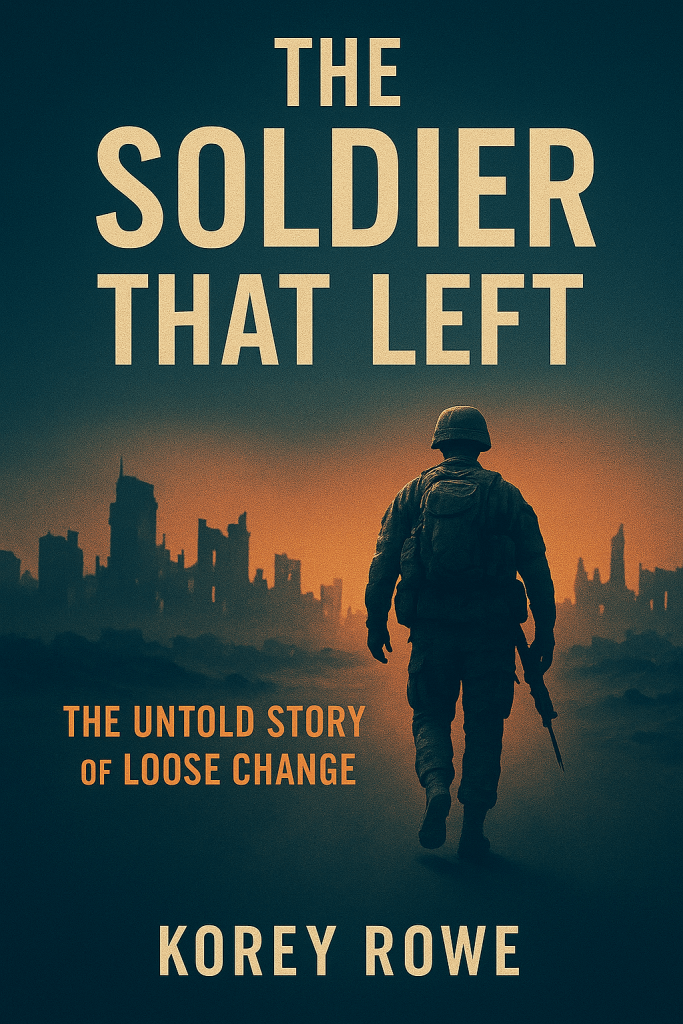
Full disclosure: I was given an electronic advanced reader’s copy of this book from PR By the Book in exchange for an honest review.
This year marks the 25th Anniversary of the 9/11 Attacks. Last year, I reviewed the memoir The Road to Yesterday: A Memoir by Maryellen Donovan, which details her journey to overcome her grief after losing her husband in the September 11, 2001 attacks. This year, I’m covering another memoir that involves 9/11 but in a different way. It’s The Soldier That Left: The Untold Story of Loose Change by Korey Rowe, which details the author’s life as a soldier in Afghanistan and Iraq as well as the making of the documentary Loose Change. The memoir tells a fascinating story even though I never heard of the film prior to reading it.
The Soldier That Left: The Untold Story of Loose Change traces the author’s journey from soldier to fugitive to unlikely producer of one of the most controversial documentaries of all time. Korey enlisted right before September 11, 2001 and went on two brutal combat tours of Afghanistan and Iraq, where he witnessed the violence, futility, and corruption in America’s wars. Disillusioned by lies about weapons of mass destruction and trapped by a stop-loss order, he faced a moral crossroads. Instead of returning to Iraq, he chose desertion – a decision that branded him a criminal, but preserved his conscience.
While on the run, he reunites with his best friend Dylan Avery, who has been developing a movie that questions the government’s official narrative on 9/11. What began as a creative experiment evolved into Loose Change – a low-budget Internet documentary that exploded into a global phenomenon. Hailed by Vanity Fair as “the first internet blockbuster,” the film spread virtually through torrents, DVDs, and video-sharing sites. Additionally, it ignited the 9/11 Truth Movement, forcing millions to question the official story. Rowe’s memoir intertwines the making of Loose Change with his own battles against the U.S. Army, addiction, media backlash, and his search for identity beyond the uniform. He reflects on the cost of speaking out, the burden of notoriety, and how a documentary made by a handful of young outsiders altered the conversation about truth, power, and history in the 21st century.
As I mentioned earlier, I knew nothing about Loose Change until I read this memoir. It’s a series of films from 2005 to 2017 that argue in favor of conspiracy theories related to the 9/11 attacks. I was coming into the Internet age when the first movie dropped, so I was young-ish. Even my husband, who’s a few years older than me, never heard of it, and he saw tons of videos of the Taliban beheading people being passed around in school. Additionally, I’m not into conspiracy theories. At my day job, I research materials found in the archives, and that consists of primary and secondary resources, in other words, concrete evidence. From what I’ve seen, conspiracy theories tend to be based on hearsay, feelings (even ones based on fact), and misinterpretations of known facts. At the same time, there have been ones that turned out to be true like the Tuskegee Syphilis Study (1932–1972) and the Watergate Cover-up scandal. I also empathize with people who feel frustrated by the government’s lack of transparency and action, especially how they ignored pre-attack warnings.
That’s why the sections involving the documentary were my least favorite parts of the memoir. Despite this, I appreciate reading how Korey and Dylan updated the movie with new evidence and eliminating ones that didn’t make sense anymore. In addition, it was interesting to hear how the documentary mustered up interest from various celebrities. For example, Charlie Sheen was in talks to narrate one of the versions, but the deal fell through. Moreover, radio host and infamous conspiracy theorist Alex Jones was one of the executive producers of Loose Change: The Final Cut (2007). Rowe had a lot to say about him.
My favorite parts were Rowe’s time in the military and him trying to rebuild his life after desertion. At first, he thought that he was making a difference while serving. However, once he realizes that the government is not telling the whole truth based on what he saw in Afghanistan and Iraq, his frustration and depression set in. Rowe provides excerpts from journal entries during those tours. I could feel his sadness and anger in fighting conflicts that were essentially pointless. Furthermore, he tried to build a life outside the military while working on Loose Change. I enjoyed how he wanted to be a snowboard instructor, but he had little experience with the sport, and yet, he still landed the job. During the entire time I was reading the book, I was rooting for him to find stability and his identity outside the military.
The Soldier That Left: The Untold Story of Loose Change by Korey Rowe is a good memoir that deals with one man’s journey to reclaim his self-identity after the military and while producing a controversial documentary. Again, I never heard of Loose Change until this memoir, so I didn’t enjoy it as much as I should. At the same time, I liked reading about the author’s time in the military, why he deserted, and when he was attempting to rebuild his life despite many struggles. I would recommend it to not only those who were fans of the Loose Change documentary, but also to readers looking for other 9/11 memoirs to read. The Soldier That Left: The Untold Story of Loose Change is out now, so grab it wherever you get your books.
Subscribe below to get notified when I post new updates. Also feel free to email me here for any review suggestions, ideas, or new titles!

