Content warning: This review discusses mental health and suicide.
There’s been a lot of more focus on mental health now more than ever. It explains why there’s an uptick in accessing resources of that kind. This even includes fiction, for it provides a window to understand why someone might feel a certain way. Some of these work, but others aren’t as effective. One of the most popular books that deals with mental health is The Midnight Library by Matt Haig. With his latest novel The Midnight Train being released this month, I figured it would be a good time to visit the novel that put him on the map. While I enjoyed certain aspects, The Midnight Library fell short when it came to tackling mental wellness.
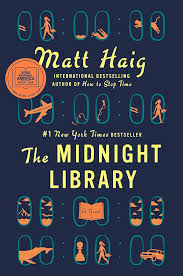
The Midnight Library is about a woman who encounters a library that contains books that allow her to try lives she could’ve lived while she is in between life and death. Nora Seed is a 35-year-old woman dealing with depression. When she attempts suicide, she comes across the Midnight Library, which has every possible book that details the lives she could’ve lived. Faced with the possibility of changing her life for a new one, she must search within herself as she travels through the library to realize what is truly fulfilling, and what makes it worth living in the first place.
Before I get started with this review, I’m aware that author Matt Haig has been open with his mental health struggles. For many people, it’s not easy dealing with that. What am I about to say has nothing to do with him personally.
I want to start off with some good things about the novel. I liked the concepts of the Midnight Library and parallel lives. The institution and who is in charge of it manifest differently depending on the person, which I found to be neat. For Nora, it’s a library because the most influential person in her life was her school librarian Mrs. Elms, thus the “owner.” For minor character Hugo, it’s a video store run by his uncle. Also, I like how Nora went from one life to another simply by opening up a book and how she came back to the library whenever she felt disappointed. Of course, she can’t stay in those lives forever, and this proves more difficult as she continues to explore them.
In addition, I like Mrs. Elm, well, Nora’s perception of her. She is her mentor in this strange place. Mrs. Elms tries to get her to see that life is certainly worth living in spite of the regrets. She can be extremely blunt about this like when she said, “‘Sometimes regrets aren’t based on fact at all. Sometimes regrets are just . . .’ She searched for the appropriate term and found it. ‘A load of bullsh*t.”
With that being said, I felt underwhelmed by the book for two reasons. The first is the mental health aspect. Since this is a stranger-in-a-strange-land kind of story like Alice in Wonderland, The Wizard of Oz, and The Phantom Tollbooth, I understand why Haig made Nora a bit bland, so she could be a vessel for people in similar situations. However, I wish that she wasn’t entirely defined by her depression even though I get why, for this is how she might see herself. I felt invested when she was experiencing her final parallel life with Ash as her husband and Molly as their daughter. I simply wish that Nora had more of a character.
Moreover, the overall message didn’t sit well with me due to its snap-out mentality. I’ve read plenty of books that deal with mental health, and saying that all one needs to do to improve is to have a better outlook on life and to work on relationships will not cut it for everyone. I can certainly see how it can be effective with those with situational depression, yet not others whose mental wellness issues are much deeper. One can’t simply walk on the sunny side of the street right after a suicide attempt. Eleanor Oliphant is Completely Fine also involves opening up to new possibilities, yet it still acknowledges that the road to recovery is a long way for the titular character due to past trauma. With Nora, all she had to do was realize that the perfect life is right in front of her all along. In other words, she has a It’s a Wonderful Life moment, and everything is supposedly hunky dory.
The second main reason why I felt dismayed was because of how predictable it became. The entire premise is about a woman trying out different lives to see what she could’ve done had she made some changes no matter how small they are. And, it goes on like that until the very end. Don’t get me wrong. I felt sorry for her and understood why she wanted to take her own life because she felt that certain relationships were being severed one by one. It didn’t help that most of that happened within 24 hours. But, once the Midnight Library and its mechanics were explained, it became clear that Nora exploring these lives was going to be the entire story, and after a while, I sort of checked out. I came back when Nora was living her life with Ash and Molly, but even then, I knew the outcome before the story ended.
I listened to the audiobook, which is narrated by Carey Mulligan. Mulligan is one of the most famous people who recorded an audiobook I’ve reviewed on this website. For those who aren’t familiar, she is an actress who has been nominated for an Oscar for her performances in An Education, Promising Young Woman, and Maestro. For me, Mulligan is best known as Daisy Buchanan in the Baz Luhrmann adaptation of The Great Gatsby and as Sally Sparrow in “Blink” – one of the most iconic episodes of Doctor Who (the one with the Weeping Angels). I enjoy her work very much, but I felt that her performance narrating The Midnight Library was only solid. I loved her nimble and melancholic tone that remains consistent through the audiobook, but there was barely any distinction between characters. I sometimes had a hard time figuring out which person was speaking. There were times that Mulligan tried adding a wiser and somewhat sassier tone to Mrs. Elms and envisioning Molly like a mature child towards the end. While this was only a solid vocal performance, I would like to see Mulligan cast as Nora in a movie version. Luckily, that is coming soon since that adaptation was announced at CinemaCon last month.
The Midnight Library by Matt Haig is a book that tries to tackle mental health in a way that appeals to everybody, but it doesn’t work. Sure, there are cool concepts that it explores. At the same time, it’s too predictable, and its message is possibly too general for people who may need more than just changing their outlook on life and working on relationships. This is why I hesitate to recommend it. It could be empowering to those dealing with something like situational depression, yet it could potentially be insulting to those who need more. But then again, it also deals with parallel lives, so I could suggest to readers who like that. I’m sure that people can find other books that handle mental health issues in more nuisance ways.
Subscribe below to get notified when I post new updates. Also feel free to email me here for any review suggestions, ideas, or new titles!


One thought on “The Midnight Library Book Review”