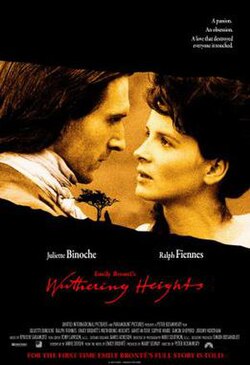
Welcome to Part 7 of looking at various adaptations of Wuthering Heights and seeing if they can capture the spirit of the book by Emily Brontë. Today, I’ll be looking at the 1992 movie starring Ralph Fiennes as Heathcliff and Juliet Binoche as Catherine.
You’re probably wondering, “Emily, why is that movie titled Emily Brontë’s Wuthering Heights instead of just plain Wuthering Heights?”
It’s because Samuel Goldwyn Studio owned the rights to the title due to the copyright on the 1939 flick, which they produced. As a result, Paramount Pictures was forced to use the author’s name when they released this very movie. Funny enough, 1992 was the same year in which the film Bram Stoker’s Dracula was released, and Emily Brontë’s Wuthering Heights came out a month prior.
If I were an English teacher who had to show a version of Wuthering Heights to my students, this is the one I would choose. Not only does it include the second half of the story, but it leans into the gothic horror spirit harder than previous adaptations. I love the cinematography. Mike Southon does a great job with color and light. I especially adore how the moors look grainy and vast with blue skies most of the time. The score by Ryûichi Sakamoto is Celtic-inspired, which provides the movie with its wild and pure spirit. Additionally, I adore how it emphasizes the horror elements. For example, when Mr. Lockwood hears Catherine’s ghost, a tree branch crashes into the windows. It’s a great setup for what follows afterwards. This was Peter Kominsky’s directorial debut, and he sticks the landing with his filmmaking.
Moreover, the performances are very good. I have to single out Janet McTeer and Ralph Fiennes. McTeer is fantastic as Nelly aka Ellen. She radiates kindness to the people around her, but she’s also exacerbated anytime she has to deal with their antics. Given the situations many of the characters find themselves in, I don’t blame her and her Rachel Dratch eyes. Ralph Fiennes steals the whole show. He’s the best Heathcliff since Laurence Olivier. Once again, he’s a white guy playing Heathcliff, but he’s still great. For one thing, he looks different from the other white people in the film. He wears a long, flowy black wig that makes his blue eyes pop. I’ve never seen his eyes look so blue in any of the other films I’ve seen him in. For WASP people, this makes him look exotic because who could ever look like that? Like Olivier, Fiennes combines Heathcliff’s passionate, brooding, and manipulative nature, but he takes it one step further by truly embodying the character’s villainy. This is most apparent in the second half when Heathcliff comes back to indirectly torment everybody who wronged him. I especially love the scene in which Heathcliff locks Catherine and Edgar in the Linton kitchen. Fiennes has a sadistic and joyous look on his face when Edgar tries to wrestle the key away from Catherine. It’s because of this movie that Ralph Fiennes was able to appear in such villainous roles as Amon Goeth in Schindler’s List and He-Who-Shall-Not-Be-Named in the Harry Potter film franchise.
As much as I praise the flick, it’s not perfect. For starters, Juliet Binoche is ok as Catherine. Her demeanor is too soft and ladylike. This is the same problem that I had with Anna Calder-Marshall in the 1970 adaptation, although Binoche fares better as Catherine’s daughter Cathy. I know some reviewers had issues with Binoche’s French accent. I didn’t mind because she looks like she belongs in late 18th-century Northern England, and her dialect only slips out once in a great while. In addition, her chemistry with Fiennes is through the roof. I could feel the love and passion between the two. They certainly felt it too since they appeared in two more films together: the 1996 Oscar-winning romantic drama The English Patient and 2024’s The Return.
Since the movie places a lot of emphasis on the relationship between Catherine and Heathcliff, it reduces the significance of certain characters and scenes. For example, the sequence of Catherine and Heathcliff as kids only lasts for less than 5 minutes, and Mr. Earnshaw is killed off soon after he brings the latter home. This could have been fleshed out more. The 1939 film had similar problems with this, but at least it took the time to show them as children. Additionally, I don’t understand the framing device. It involves Emily Brontë herself exploring an abandoned castle, which supposedly inspires the very story seen on screen. This doesn’t make sense because the novel already has a great framework of Nelly telling Mr. Lockwood the story of how Heathcliff became so bitter. It makes both characters less important to the overall plot. Oh, by the way, Brontë is played by an uncredited Sinéad O’Connor.
Every Wuthering Heights version leads up to Emily Brontë’s Wuthering Heights. It’s faithful to the source material and truly captures the spirit of the novel more so than the previous adaptations. It also displays plenty of wonderful filmmaking, especially the cinematography and music. The performances, especially Ralph Fiennes’s, are the heart and soul of the flick. While it isn’t perfect, it’s the best version of the book so far. I would recommend it to anyone, whether they are actively watching every adaptation of Wuthering Heights or just want a movie to see.
Now, let’s see how this one fits into the ranking.
- Emily Brontë’s Wuthering Heights 1992 Movie
- Wuthering Heights 1939 Movie
- Wuthering Heights 1958 Teleplay
- Wuthering Heights 1967 Series
- Wuthering Heights 1970 Movie
- Wuthering Heights 1950 Teleplay
- Wuthering Heights 2026 Movie
We’ll see how this ranking evolves after I see all the others.
Stay tuned next month when I review the 1998 television movie with Robert Cavanah and Matthew MacFayden.
Subscribe below to get notified when I post new updates. Also feel free to email me here for any review suggestions, ideas, or new titles!


3 thoughts on “Emily Brontë’s Wuthering Heights 1992 Movie Review”