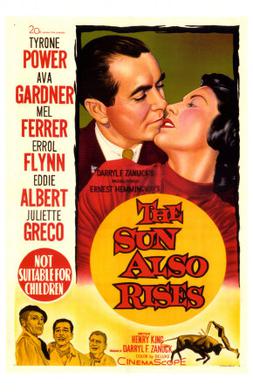
Throughout this past week, I have been celebrating the 100th Anniversary of the publication of The Sun Also Rises by Ernest Hemingway. I reviewed two audiobooks of the story and explored a city that he visited while growing up. Sadly, it has to end, and what better way to do so than to look at its 1957 movie adaptation starring Tyrone Power, Ava Gardner, and Errol Flynn. Even though it has some entertaining scenes, it’s a mediocre film due to its pacing, its use of CinemaScope, and missed opportunities.
Over the years, I’ve reviewed a few adaptations of Hemingway novels, and most of them don’t work. This is no exception. I like to keep an open mind while watching a movie or a television show, but when I saw that the runtime for this one was over two hours, I knew it was going to be a slog. My instincts were correct because the screenplay by Peter Viertel tries to cram as much from the book into the flick, which is a big no, especially when adapting Hemingway. That author is best for keeping things simple. It may not always seem that way, particularly when he includes a lot of filler in his novels. This makes them move at a glacial pace, and The Sun Also Rises is no exception. I noted this in my Audiobook Versus post about the book as well. The only movie adaptation that actively condenses story elements from the novel is the 1932 version of A Farewell to Arms.
Despite its flaws, I’ll give credit to Viertel for cleaning up certain parts of the book. For example, the movie starts off with Jake Barnes talking to a soldier he knew from the Great War (World War I) and the latter asking him if he’s alright. This makes it clear that this is Jake’s story, whereas the book begins with Robert Cohen’s backstory for some reason. In another instance, the reveal of Jake’s problem occurs in the first act of the film through a flashback. It also establishes the prior relationship with Brett. In the novel, this revelation happens halfway through when the group is enjoying their time in Spain. This change for the movie makes it easier for viewers to understand what Jake’s issue is.
The second big problem with this film is the cinematography. When it was released in 1957, a process called CinemaScope was the rage. The movie studio Twentieth Century Fox, who produced this film, developed the technique in 1953. It uses an anamorphic lens to squeeze a wide image onto standard 35mm film during filming and stretch it back out during projection. This wide screen cinematography worked best in biblical and historical epics as well as musicals. Even the Disney animated movies Lady and the Tramp and Sleeping Beauty utilized CinemaScope. This is all to say that it doesn’t work with The Sun Also Rises. The wide shots undermine what is an intimate story about a group of expatriates trying to find their place in a post World-War-I world. Sure, they look great when the characters are experiencing the Fiesta in Spain, but other times, it feels unnecessary. For instance, when Brett dances with some people at a nightclub in Paris in the first act, she’s shot from the waist up. Ava Gardner, who plays that character, is a good dancer, so this made it seem like she wasn’t. Also, when Jake and Brett are having a serious conversation outdoors in the same city, it’s done in a wide shot, where I could see drunk extras off to the side. It was distracting.
The third main issue I had was that there were missed opportunities. One of them was the costumes. Even though the film takes place in the 1920s, after the Lost Generation came of age, much of the clothing reads more 1950s. It took me out of it, especially knowing that Gardner was wearing a cone bra in her first scene. Also, the performances could have been better. I’m not saying that they were bad. They needed to do more. Tyrone Power (best known for films like the original Nightmare Alley (1947) and Witness for the Prosecution (1957)) plays Jake, and he’s stoic and not much else. Gardner (who had previously been in the 1952 adaptation of Hemingway’s short story Snows of Kilimanjaro) is a perfect casting choice as Brett because of how drop-dead gorgeous she is, but she too, could have done more with the role. It doesn’t help that most of the actors are older than their counterparts in the novel. In the book, they are in the 20s and 30s.
In addition, the movie could have explored themes from the novel further. The book is about a group of expatriates traveling, eating, and drinking while trying to figure out what they truly want. Director Henry King (who previously directed the aforementioned Snows of Kilimanjaro) conveys much of this aimlessness by having actors wander in the streets. However, much of the flick emphasizes the Fiesta and the bullfighting event they attend. I complained how the novel feels like a travelogue at times because of the focus on the vacation spots; this applies to the movie as well. This undercuts why the characters feel disillusioned in the first place. At least its missed opportunities weren’t actively insulting in the way the For Whom the Bell Tolls movie was.
Although I have my misgivings, I will say that it was entertaining in certain parts. First, the scenes with the characters exploring the Fiesta and watching bullfighting were fun to see. This is particularly true with the Running of the Bulls event even if parts of it felt like they were from stock footage. Second, Robert Cohen (played by Mel Ferrer) is portrayed more sympathetically than he is in the novel, and viewers are spared from the antisemetic remarks from the other characters. Cohen is still an insecure man who needs to show off and attach himself to those who say nice things to him. Third, Errol Flynn (who is best known for playing the title character in The Adventures of Robin Hood (1938)) is enjoyable as Mike Campbell – Brett’s finance. He captures the character’s pitiful drunkenness, especially how he knows when he’s not wanted. Flynn is most engaging when he and Bill (played by Green Acres star Eddie Albert) run and mess with the bulls. Although his performance was not as dynamic as Vittorio de Sica’s in the 1957 version of A Farewell to Arms (fun fact: both films were released four months apart), it was still entertaining.
The movie version of The Sun Also Rises is not the best adaptation of a Hemingway novel, nor is it the worst. Some of its problems stem from the source material, which could have been resolved had the film condensed the story more. Furthermore, the Cinemascope wasn’t necessary to tell an intimate tale about a group of people trying to find themselves in a post-war environment, and it didn’t take as many chances as it should to really explore the novel’s themes. And yet, I still enjoyed certain parts. I would only recommend it to those who’ve read the book and are traveling. The sun has officially set on this story.
Since this is the fourth Hemingway adaptation I’ve reviewed for this website, here is how I would rank them as of now.
- A Farewell to Arms (1932)
- A Farewell to Arms (1957)
- The Sun Also Rises
- For Whom the Bell Tolls
Subscribe below to get notified when I post new updates. Also feel free to email me here for any review suggestions, ideas, or new titles!

