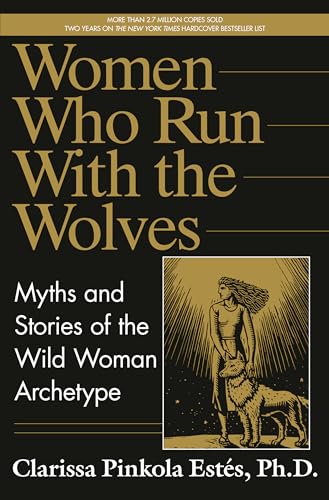
I’ve come across plenty of self-help books over the years, but I’ve rarely read ones that are geared towards women. The only one I can think of is Forget the Fairy Tale and Find Your Happiness by Deb Miller, which covers how the author forged her own fairy tale and happily ever after. Recently, I found a different kind of female empowerment book with Women Who Run with the Wolves: Myths and Stories of the Wild Women Archetype by Clarissa Pinkola Estés, which was published back in 1992. It’s a powerful nonfiction title about how women can get in touch with their inner Wild Woman through the power of stories.
Normally, I would provide my own summary, but the one from Goodreads is so good that I had to provide it here:
“Within every woman there lives a powerful force, filled with good instincts, passionate creativity, and ageless knowing. She is the Wild Woman, who represents the instinctual nature of women. But she is an endangered species. For though the gifts of wildish nature belong to us at birth, society’s attempt to ‘civilize’ us into rigid roles has muffled the deep, life-giving messages of our own souls.
In Women Who Run with the Wolves, Dr. Clarissa Pinkola Estés unfolds rich intercultural myths, fairy tales, folk tales, and stories, many from her own traditions, in order to help women reconnect with the fierce, healthy, visionary attributes of this instinctual nature. Through the stories and commentaries in this remarkable book, we retrieve, examine, love, and understand the Wild Woman, and hold her against our deep psyches as one who is both magic and medicine.
Dr. Estés has created a new lexicon for describing the female psyche. Fertile and life-giving, it is a psychology of women in the truest sense, a knowing of the soul.”
I never knew about this book until a friend of mine recommended it. Even a volunteer who’s about 10 years younger than me was aware of this title. I can see why it has stood the test of time. It speaks to the soul of women and encourages them to embrace the kind of person that they truly want to be regardless of what society dictates. And, what better way to do that is through the power of stories.
Pinkola Estés chooses familiar and obscure fairy and folk tales to get her points across. She analyses stories like The Ugly Duckling (translated from the Hungarian language) to let women know that they’ll find their own family who accepts them as they are, The Red Shoes (from the Hungarian-Germanic version) about self-preservation, and La Llorona for the importance of nourishing one’s creative life. In addition, she utilizes the dark, and sometimes, violent versions of these stories to add to the authenticity as well as ones from all over the world, and not just from Europe.
My favorite chapters involved knowing how to identify a predator (the French-Slavic version of Bluebeard); utilizing intuition (Vasalisa the Wise); retrieving sexuality, as in being a state “of intense sensory awareness that includes, but is not limited to, her sexuality” (p. 334) (The Dirty Goddesses); and setting boundaries with rage and forgiveness (The Crescent Moon Bear from Japan and The Withered Trees from the Middle East). I especially love the last one because I’ve had trouble defining those lines, and Pinkola Estés does a great job with letting readers know that anger will always exist, justified or not, and it’s a matter of when to use it. Additionally, I have even started employing her advice in my everyday life. After reading about returning home with Sealskin, Soulskin, I literally spent a few hours in my childhood house, and it was refreshing.
If I have one complaint about it, it would be that it could’ve been trimmed down. With the bibliography and index, it’s over 500 pages. Without them, it’s still over 400, and I felt it. Pinkola Estés left no stone unturned when analyzing every aspect of the stories chosen for this book. However, she can be repetitive and the ways she dissects the tales are sometimes stretched out. Reading this book has made me understand how some things can be analyzed to death. At the same time, when it works, it’s truly effective.
Women Who Run with the Wolves: Myths and Stories of the Wild Women Archetype by Clarissa Pinkola Estés is a great analysis of that character type. She shows women how they can get in touch with their inner Wild Woman through the meaningful stories she recites. While it can be overanalyzed at times, it’s certainly empowering for female readers whether they need it the most, or are simply curious. I would recommend it for those who like reading about character and story archetypes ala Joseph Campbell. Now, if you’ll excuse me, I got to go sing “She Wolf” by Shakira and howl because that’s what my inner voice is telling me to do.
Before I go, I want to let everyone know that the latest episode of the Adapt Me Podcast will come out this week. Returning guest and host of the JayDays YouTube Channel Jaylan Saylah and I will howl about how we would adapt this tome. Keep an eye out for the link.
Subscribe below to get notified when I post new updates. Also feel free to email me here for any review suggestions, ideas, or new titles!


Emily, This sounds pretty interesting to me. Is it in separate, unrelated chapters?
John F. Blakowski, CPIM, CIRM, Retired, Vincentian 6745 Boulder Pointe Drive Unit #12 Washington, MI 48094 blakowskijohn@gmail.com Cell phone: 248.227.2933
On Mon, Jun 29, 2026 at 9:35 PM Book Reviews by a Chick Who Reads
LikeLiked by 1 person
Yes, the stories are in separate chapters.
LikeLike