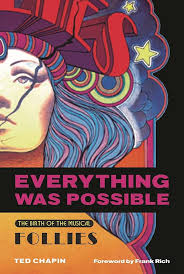
I love musical theatre. I’ve adored musicals since I was little while watching Disney and old Hollywood films. I get excited seeing people sing and dance, whether it’s on Broadway or at the local theatre. It’s also fascinating to learn about how a show comes together, especially how a creative team decides on certain elements and how the actors get along. One of the best books on the making of a musical is Everything Was Possible: The Birth of the Musical Follies by Ted Chapin. It does a great job with demonstrating how a Broadway show was created and mounted in the early 1970s, and it’s a wonderful read even if one is unfamiliar with the specific musical.
Everything Was Possible: The Birth of the Musical Follies is about the making of the musical Follies. In 1971, college student Ted Chapin found himself as a production assistant at the creation of one of the greatest musicals, Follies. Needing college credit to graduate on time, he kept a journal detailing every aspect that he saw and heard while the musical was actually being developed. Years later, Ted decided to fashion his notes into a chronicle. Follies was made by composer and lyricist Stephen Sondheim, producer and director Hal Prince, choreographer Michael Bennett, and book writer James Goldman. These men were giants in the evolution of Broadway and geniuses at the top of their game. Everything Was Possible takes readers on a roller-coaster ride from the uncertainties like casting, drama-filled rehearsals, the care and feeding of one-time movie and television stars, the pressures of a Boston tryout, and the exhilaration of opening night on Broadway.
Stephen Sondheim is one of the greatest Broadway composers ever. I’m familiar with his work, for I’ve seen productions of his shows like West Side Story, A Funny Thing Happened on the Way to the Forum, Company, and Sweeney Todd. I even was in Into the Woods at my high school. Prior to reading this book, I didn’t know a whole lot about Follies – the show Sondheim put on Broadway in 1971 – outside of some songs like “Buddy’s Blues” and its most famous tune, “I’m Still Here.” I listened to its famously truncated original Broadway cast recording to get a better gist of the musical.
While knowing what Follies is helps, the book also focuses on what goes into making a musical. Chapin explains every aspect in a way that anybody can understand. For example, I loved the way he described a technical rehearsal and how vital it is to the show. He was the production assistant aka the gofer. His job was to do what the creative team and actors asked of him. The main one was to type up script and lyrics changes and make carbon copies. Since this was before computers, this took a long time. Along with that, he wrote in his journal of what unfolded on a daily basis. That’s why the chronicle contains so many miniscule details. Some readers might feel the need to skip these parts. I don’t blame them. At the same time, I like a lot of detail, so it was cool to see what was going on minute by minute.
Although Chapin acknowledges that he has his biases (including of certain actors and songs as well as the overall musical), he’s still able to see the forest beyond the trees. To get the bigger picture, he interviewed people who were a part of the show like Prince and Sondheim years after the fact. He also provides both black-and-white and color pictures of rehearsals, performances, magazine covers, and the famous poster to illustrate what he describes in the text. This is truly one of the most objective books I’ve ever read because of the care the author puts in to cover all aspects of the creative process.
The best part was learning about everything that unfolded. The process was full of ups and downs. Members of the creative team clashed with one another on certain story beats, and some actors were jealous that others received more attention than they did. However, these never led to cat fights (sorry for those readers who wanted that). In addition, Chapin escorted actors around during rehearsals leading up to opening night, including Yvonne de Carlo (Lily Munster in the 1960s television show The Munsters). It was amusing finding out that she may have had a thing for him.
Furthermore, songs went in and out. One of the most fascinating things to find out was that “I’m Still Here” was written during the Boston tryout. The original ditty that the character Carlotta (originally played by de Carlo) sang was called “Can That Boy Frox Trot?” However, it wasn’t working in Boston, so Sondheim came up with the former on a whim that tied the story’s flashbacks and current events together. On top of that, the musical received infamously mixed reviews when it premiered in April 1971. Chapin goes into great detail on how the creative team and the cast reacted to them. As a show, Follies remains divisive to viewers to this very day, and those initial assessments reflected that.
Everything Was Possible: The Birth of the Musical Follies by Ted Chapin is a great book of how a famous Broadway musical came together. Even if one doesn’t know much about Follies, it’s still a memorizing read. Chapin excels with covering the show’s development from all angles while adding some personal touches. I would recommend it to anyone who loves musicals and wants to know more of how they get made. Regardless of how one feels about Follies as a show, go pick it up and see how it’s still here.
Before I go, I want to let everyone know that I will record the latest episode of the Adapt Me Podcast soon. Guest Marc Bonani from the Broadway by Ghostlight Youtube Channel will join me to talk about how we would adapt this book. Keep an eye out for the link next week.
Subscribe below to get notified when I post new updates. Also feel free to email me here for any review suggestions, ideas, or new titles!


One thought on “Everything Was Possible: The Birth of the Musical Follies Book Review”