Full disclosure: The author of the book that I am about to review is a patron at a library that I work at. All of the opinions stated in this review are solely mine.
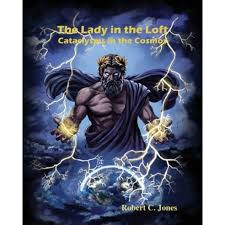
There’s been a renewed interest in Greek mythology ever since the latest movie version of The Odyssey came out back in July. They’re filled with stories that remain relevant to this very day. Authors have taken inspiration from Greek mythology in their original work. Robert C. Jones followed this path by publishing The Lady in the Loft: Cataclysms in the Cosmos back in December 2025, which details the hero’s journey of an ordinary teenage boy becoming extraordinary. It’s a decent book with plenty of information about Greek mythology and nice illustrations even though there’s issues with the dialogue and plot.
The Lady in the Loft: Cataclysms in the Cosmos is the first book in an upcoming series. The Olympians and the Titans are wreaking havoc among themselves and the people on Earth. One teenager finds himself being drawn into these battles when he meets a “Lady in the Loft” at his church who takes him through a portal into various adventures to face these Gods. As the chosen human, he befriends this lady and other animals while on his journey to confront his soul and the gods who may end up destroying each other and all life on Earth. Can he and his friends have an impact on the gods? Can he save himself? How much is myth and how much is real?
There were two things that I liked about this book. The illustrations are good. Even though there’s not much of them, when they do show, they are beautiful, especially when the Titan Rhea emerges in gold and purple. It’s the first time that I’ve seen colored drawings in a book by Jones. He uses bold colors with plenty of blue and yellow. Color plays a vital role in the story as Bob – the teenaged protagonist – has to wear a coat of hues that hold significant symbolism in Greek culture. For example, red means life and death, blue is the sky and sea in the natural and divine worlds, and white is purity, youthfulness, and feminine beauty (p. 36).
Speaking of facts, Jones always wants his readers to learn something while reading his books, and this one is no different. Along with the colors, I learned about the seven qualities of love that the Olympians embodied. They are Eros (passionate, romantic love), Phillia (love of friendship), Storge (love among family members), Agape (selfless, unconditional love), Pragma (practical, enduring love like in long-term relationships), Philautia (self-love), and Xenia (a type of love displaying hostility towards foreigners and travelers) (p. 7). Bob goes through each of these types during his journey, which I thought was cool. These also encourage him to use diplomacy in various ways without resorting to violence.
On the other hand, I had some problems. First, I didn’t find myself wholly invested in the story. It felt like another chosen-one tale. It had the same beats as the typical hero’s journey complete with going into the underworld. In fact, the whole reason why Bob was selected was because of his youth and innocence. That’s like many teenagers. He’s different because he’s trying to find himself and has splitting headaches. Look, I get that it’s using the archetypes familiar to stories going back as far as Greek mythology, but it would’ve been nice to see something more different.
Second, the dialogue needed some work. There were times where I felt that Jones didn’t know how a contemporary teenager talks. Bob sometimes starts off his sentences with “Say…” as if he’s in a 1940s movie, but the story begins and ends in modern times. It wasn’t until I saw the illustrations that I realized that it was set in the present day because of how dated the dialogue was. On the opposite end of the spectrum, the gods occasionally say things that are way too contemporary for them. For example, one of them literally exclaims, “Get real!”
I’m sorry, but this isn’t the 1980s. And yes, I’m aware that this is one of the criticisms of the latest adaptation of The Odyssey.
Additionally, the dialogue can be too on the nose. Various people and gods will recall their backgrounds, prompted and unprompted. I can let that slide because gods have big egos. What I can’t let go is how obvious it is. For instance, when Bob encounters a literal fork in the road, J.J. (aka the Lady in the Loft) explains that it’s…a fork in the road, and there’s an image of it accompanying the page.
The Lady in the Loft: Cataclysms in the Cosmos doesn’t strike lightning like it wants to. Yes, the visuals were pretty neat, and I learned some things about Greek mythology. However, the story and dialogue were lackluster. I would only recommend it to teenagers and grandparents who want to read the “Percy Jackson” series, but can only commit to a shorter story. I hope Jones can improve on these aspects for the sequel since this one was left on a cliffhanger.
Subscribe below to get notified when I post new updates. Also feel free to email me here for any review suggestions, ideas, or new titles!

