Turn of Mind Book Review

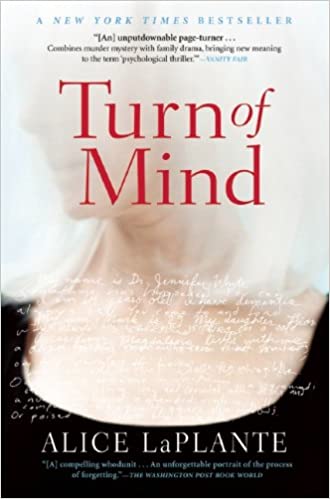
There have been plenty of books that I read that have an unreliable narrator. But in those cases, even though they may not always realize the consequences of their actions, those protagonists are mostly sound of mind. Lately, I read Turn of Mind by Alice LaPlante, whose protagonist has dementia and progresses into the latter stages. I don’t think I’ve encountered a voice like that in literature, but it’s worth it as long as one is patient.

Turn of Mind by Alice LaPlante is about Dr. Jennifer White – a retired orthopedic surgeon struggling with dementia and who’s accused of killing her best friend. When her friend Amanda is found dead with four of her fingers surgically removed, Dr. White is a prime suspect. But she doesn’t know whether she committed the crime. She and Amanda were life-long friends as well as each other’s most formidable adversary. As the investigations progress and White’s relationship with her caretaker and two grown children intensify, a question remains: is her shattered memory preventing her from revealing the truth or helping her to hide it?

One of the first things that I noticed was how disorienting the tone is. This is not a bad thing because the protagonist is experiencing dementia. Disorientation is one of the symptoms, and LaPlante captures this beautifully, especially when readers are introduced to Dr. White’s son Mark. She constantly misremembers his name, and by the time he leaves, she only sees him as a stranger. Viewing this story through Dr. White’s eyes is an ingenious idea. The only other book that I think does this is Still Alice (dang it, that’s the second time I mentioned this novel on this website, and I still haven’t read it yet), but the titular character has the early onset of this disease. Dr. White, on the other hand, is in the more advanced stages of dementia, thus losing more of a grip on reality. She can be loving at one moment and irritable and disowning her children in another. Again, LaPlante captures this authentic tone beautifully.

Apart from disease, Dr. White is a very interesting character. She is a very intelligent person who can come off as cold and egotistical, but loving at the same time. Even with dementia, she still insists on being called Dr. White while others address her like a child with names like Jen and Jenny.

Now, one is probably thinking: what you do think of the murder mystery aspect of this novel? It’s another part that makes the book stand out among others in the neurological fiction genre. While others in that category tends to focus on the consequences of having a certain disease and how it affects family, Turn of Mind adds in the murder to focus on how the disease alters that situation. I will admit that this mystery made me pay more attention to the novel because some of Dr. White’s regular ramblings can digress pretty quickly and get irritating as a result. The murder basically forces the book to have a plot, so things can actually happen. There’s a twist that kind of shocked me regarding the murder. One will have to read the book to find that out.

For those who don’t have relatives who have dementia or Alzheimer’s, it’s best to be attentive and patient with this book. There were times, in which I zoned out while listening to this novel and when I started paying attention again, the book was in a different place than before. It doesn’t follow the linear structure of most novels, so it’s good to pay attention as much as possible.

Jean Reed Bahle – an actress and co-founder of the Actors’ Theatre Grand Rapids in Grand Rapids, MI – narrates the book. She brings a Glenn Close-like energy as Dr. White, which I liked very much. There weren’t many vocal distinctions amongst the male characters, but there were some with the female characters. For example, Bahle voices Amanda with a sophistication and assertive flair that can be sinister at times (think Jane Fonda in Monster-In-Law). Another thing that made the listen interesting was that at the end of every disc, piano music would fadely play out while Bahle was still reading the book. This possibly represents how memory fades in and out with someone with Alzheimer’s. Luckily, at the start of the next disc, the passages that ended the previous one are repeated.

Turn of Mind by Alice LaPlante may not be a book for everyone, yet its authentic voice makes it worth the read. I would recommend this novel for those who like neurological fiction and who want a little more stakes in their murder mysteries. If one chooses to read it, please be patient because the novel can go all over the place.

Subscribe below to get notified when I post new updates. Also feel free to email me here for any review suggestions, ideas, or new titles!
99 Books* Ranked From Worst to Best

*I know that some are movie adaptations, but that’s besides the point.

I can’t believe that I’m now approaching my 100th book review. I’ve encountered so many titles that I don’t think that I would’ve read on my own. In addition, these reviews have also allowed me to interact with various authors. Thank you to all who took the time to read the reviews and to share them with others!

To celebrate this, I will rate each of the 99 books that I have reviewed on this site. These are based on the rates that I gave them on Goodreads.com, but some have changed since their initial postings.

Here is the chart that I used to rate^ them:

* = Bad

** = Meh

*** = Decent

**** = Good

***** = Great

^Note: The books within each rating are only in alphabetical order.

Now, let’s begin!

*

**

***

****

*****

And there you have it! Let me what you think via Facebook, Twitter, Instagram, or email!

For my upcoming book review, let’s just say that it’ll thrill you with a unique perspective!

Subscribe below to get notified when I post new updates. Also feel free to email me here for any review suggestions, ideas, or new titles!

What Am I Reading – Chapter Thirty-Three

Hi Everybody,

I hope May is going well for all of you! It has for me! I’ve been reading a lot this month, and I managed to finish some books recently. As of now, I’m still reading Firekeeper’s Daughter by Angeline Boulley, and I started a new one that I would like to show you today!

Content warning: this review contains brief discussions on sexual acts.

The Paper Palace by Miranda Cowley Heller is about a woman who has to choose between the life she’s had and the one she wants to live. It’s a nice July morning, and Elle, a 50-year-old mother of three, awakens at “The Paper Palace” – the family summer place which she has visited every summer of her life. But this morning is different: she had sex with her dear childhood friend Jonas for the first time behind their spouses’ backs the night before. Now, over the next 24 hours, Elle has to decide between the life she has made with her beloved husband Peter, and the life she always imagined that she would have with Jonas if it weren’t for a tragic event that changed their lives forever.

I’m nearly halfway through the book, and I like it. Elle gives me Laura-Dern vibes. I’m not fully sure why, but maybe it’s in the snarky, but insecure manner that she presents herself. It’s a nice character study so far. It contains plenty of flashbacks to show all of the events that influenced the decision that Elle is supposed to make in the present day. It also pads out the pages because if one takes away said flashbacks, not much happens in the novel in general. This is not a bad thing as plenty of character studies (even the good ones) tend to do this. It all depends on how strong the main characters are, and so far, Elle and her family are compelling.

In addition, the book has given me a roller coaster of emotions. For starters, Elle’s mom revealed early in the books that she used to give blow jobs to her first step-father when she was young. When Elle’s grandmother walked in on them in the act, she slaps her daughter instead of her then husband. This rightfully made me angry. Then, about a chapter later, when Elle is describing her mother’s personality, she calls her an ass and like Margaret Dumont – an actress best known for her work with the Marx Brothers. Those who’ve read my reviews in the past will know how much I love that comedy team. Cowley Heller had me at Margaret Dumont.

Nan McNamara narrates the audiobook. She is an actress who has appeared on screen in television shows like Switched at Birth and Criminal Minds. She has also recorded several audiobooks for fiction titles like A Circle of Wives by Alice LaPlante as well as nonfiction ones like Antitrust by Amy Klobuchar and This is Your Brain on Birth Control by Sarah Hill. McNamara does a very good job so far. Part of what I said about how Elle gives off Laura-Dern vibes is because of how the narrator sounds when she portraying the character, which is extremely suitable. I also enjoyed how McNamara voices Elle’s mom as a very refined and smug. In addition, she does the kid voices well except for Elle’s oldest son Jack, for he’s supposed to be a teenager, and he still sounds like he’s 10.

We have now come to the end of the thirty-third chapter of “What Am I Reading?”

Subscribe below to get notified when I post new updates. Also feel free to email me here for any review suggestions, ideas, or new titles!
Darling Girl: A Novel of Peter Pan Book Review

Full disclosure: I was given an ARC of this book by NetGallery in exchange for an honest review.

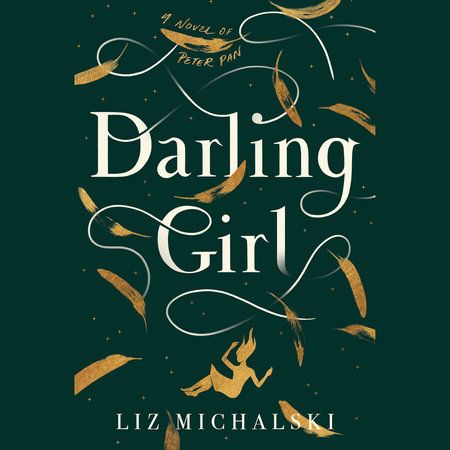
Growing up, I loved watching the animated Disney version of Peter Pan. I enjoyed seeing how he defeats Captain Hook. Also, he could fly! Since then, I realized that there are many ways to reinterpret the text. In fact, there have been plenty of retellings like the ABC TV show Once Upon a Time that explore both popular and obscure aspects of the famed story. Some soar even further like today’s subject Darling Girl: A Novel of Peter Pan by Liz Michalski, and it does so with flying colors.

Darling Girl: A Novel of Peter Pan is a dark and modern reimagining of the beloved story, which involves a woman who has to confront Peter Pan in order to save her daughter. Holly Darling – the granddaughter of Wendy (yes, that Wendy) – runs a successful skincare business. Her son, Jack, is happy and healthy, and she has moved on from the tragedy of her past. Everything seems to be going good until she gets a call that her daughter, Eden, who has been in a coma for nearly 10 years, has vanished from the estate where she’s been tucked away. Holly knows who did this: Peter Pan, who is not only real, but also more dangerous than anyone expects. Eden’s disappearance is bad for many reasons. Eden has a rare condition that makes her age rapidly (the irony of Peter being her father is not lost), which makes her blood all the more valuable. Holly has kept this a secret from Eden’s half-brother, Jack, who knows nothing about his sister or the essential role she plays in his life. She has no one to turn to. That is except her mother Jane, the only other person who knows that the story of the boy who never grew up is more than real, yet she refuses to accept that he’s anything but a hero. Desperate, Holly enlists a notorious ex-soldier named Christopher Cooke in hopes of rescuing Eden before it’s too late, or she may lose both kids.

There are many things that I love about this book. One of those things is how the characters in the original story are interpreted. Captain Hook is now Christopher Cooke, who is an ex-soldier-turned private investigator probably going through PTSD and has his own methods for getting the answers. He reminded me of Once Upon a Time’s portrayal of Captain Hook, just more vengeful. The Lost Boys are boys who are involved with drugs and disappear one by one. Neverland is “a place of shadows and shades,” which has rejected Peter Pan (p. 251).

Tinker Bell is now Tink, a fairy who’s trying to get herself free from Peter Pan’s abuse. 

And of course, we do have to talk about the boy who never grew up. Several modern retellings depict him as a, for a lack of a better word, an asshole. This even includes the upcoming movie Chip ‘n Dale: Rescue Rangers, where they have an overweight middle-aged man who’s supposed to be a clone of Peter Pan as the main antagonist (this has its own implications derived from the sad history of the actor who voiced Peter Pan in the Disney version). Of course, a good chunk of these go no farther than saying, “Look! We made Peter Pan into a bad guy!”

In Darling Girl’s case, Michalski gives Peter a more menacing portrayal. He’s controlling of others, so he can get what he wants. Tink refuses to go by the name Tinker Bell because that’s the name that Peter gave her. In addition, he’s predatory. He’ll prey on anybody who happens to be lonely. Holly was that way after losing her other son Isaac and her husband Robert in a car crash, and Jack was recovering in the hospital. Peter came by, or should I say let himself in without getting consent from Holly, and Eden was the result. It’s also revealed that he sells drugs to teenage boys in the seedier parts of London. In other words, Peter Pan is powerful and dangerous. To top it all off, Peter has grown up, but that doesn’t mean he’s mature. He still wants to feel his youth again. In order to do that, he has to have Eden’s blood.

The most unique part of the book is how it explores one of the most overlooked aspects of the story – motherhood. After all, the original tale involved Peter taking Wendy to Neverland, so she could be a mother figure to the Lost Boys. In this novel, Holly is a scientist and business woman who tries to control basically every part of her life. Various reviewers didn’t like her at first for that reason, but a lot of them eventually warmed up to her. For me, even though I didn’t agree with all of her actions, I understood where she came from, especially with her traumatic backstory. There were several parts, where I even yelled, “Just tell them about Eden already!”

Holly tries to do everything for her children, and yet, she learns like any other mother that one needs to let them fly in order to explore their own sense of self. Personally, if there was a film version of this, I’d like to see Cate Blanchett play Holly. I think she would do a great job.

Moreover, I have to commend the book for its pacing. It soars through like someone sprinkled with pixie dust at times, and I wanted to know what was going to happen next, especially when Holly tries to search for Eden in London. At the same time, it slows down for serious moments when it needs to. This is particularly true when Holly and her mother Jane share their experiences with Peter and how he impacted them.

Furthermore, I love how the book gives little nods to the original story. It mentions stuff like green and silver colors and wings. My favorite was the red feather that was left in Eden’s room in the cottage the night she disappeared. They weren’t in your face per se, yet one could pick them up pretty quickly while moving along with the story.

While the novel is a part of the fantasy genre, those elements are sprinkled in contemporary London. This makes it easier for those who are hard-core fantasy readers, but want to get into that category.

I had certain questions about the story. Some of these were how Neverland works, especially now that not even Peter Pan can get back, and how the disease that Eden has progressed. However, I wouldn’t be surprised if they are explored more in a sequel. 

If I had one nitpick, it would be that I wish Holly was at the final battle against Peter in the clock tower. At the same time, she did so much to protect others that maybe her letting go of the reins was necessary.

Overall, Darling Girl: A Novel of Peter Pan by Liz Michalski is a wonderful retelling of the classic tale. It dives deep into a part of the story not explored by other authors. It helps that the protagonist is a flawed individual, but readers are allowed to understand why she does the things she has to do. The reinterpretations, pacing, and nodes to the original book are also well executed. I would recommend it to those who love Peter Pan in any of its incarnations, dark fantasy novels like Once Upon a River by Diane Setterflied, books that explore motherhood beyond the surface, and retellings of classic stories in general. I loved Darling Girl so much that I’m going to read another Peter Pan reimagining soon. I wonder if that one will deal with another problematic aspect of the tale – the portrayal of the Indigenous people.  

Subscribe below to get notified when I post new updates. Also feel free to email me here for any review suggestions, ideas, or new titles!
What Am I Reading – Chapter Thirty-Two

Hi Everyone,

May is finally here! What are you looking forward to this month? For me, I’m excited for the nicer (and more consistent) weather and to go on vacation to Milwaukee later on! Yes, I’ll be visiting some bookstores there.

In addition, I’m ecstatic to show you the books that I’m reading and writing reviews for this month. This includes the graphic novel that I started reading recently.

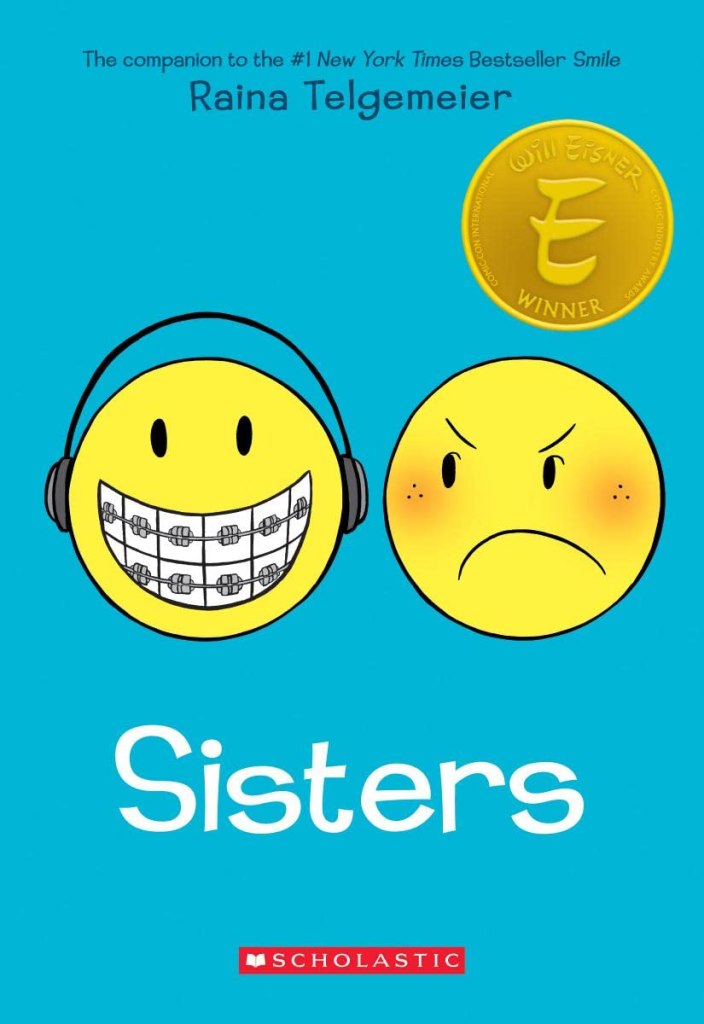
Sisters by Raina Telgemeier is a memoir of the author’s relationship with her sister. When Raina was little, she couldn’t wait to have a sibling. But once her sister Amara comes into the picture, things don’t get off to a great start. Amara is cute, yet she is grouchy, throws temper tantrums at times, and prefers to play by herself. Their relationship doesn’t improve much over the years, but when a baby brother arrives and later, when something feels off with their parents, they realize that they must figure out how to get along. This story evolves over a three-week period during a road trip from San Francisco to a family reunion in Colorado.

This is apparently the second in the “Smile” series, which are based on Telgemeier’s own life while growing up. The first in that series is Smile. Reading Sisters has made me want to read Smile at some point because the former is fantastic!

I’m halfway through the graphic novel, and I love the story. The relationship between Raina and Amara feels 100% real with all of its up and downs. To be fair, I may be biased in this since I had a similar one with my older sister when we were growing up. Though the book is told through Raina’s perspective, it shows both sides of the coin when it comes to her and Amara getting along. When they were younger, Raina offered to do stuff together with Amara like drawing and dancing to music, the latter just flat out refused. At the same time, once Amara becomes interested in drawing animals and going to the zoo, Raina doesn’t seem to care as much.

The other strong point of this graphic novel is Telgemeier’s illustrations. It goes into flashbacks frequently, and this is represented through the sepia tone that’s on those particular pages. I also enjoyed seeing the facial expressions on various characters. It often relies on big emotions because it’s told from the viewpoint of a preteen. For example, when Raina asks Amara what she’s drawing, the latter gives the biggest glare I’ve ever seen in a graphic novel. It helps that the word “glare” is present on that panel for those who have trouble reading facial expressions.

This is my first Telgemeier title, and I can see why she is a leading name in the world of juvenile graphic novels. I can’t wait to continue reading Sisters!

We have now come to the end of the thirty-second chapter of “What Am I Reading?”

Subscribe below to get notified when I post new updates. Also feel free to email me here for any review suggestions, ideas, or new titles!

Maus Book Review

Content Warning: This review discusses nudity as well as depictions of violence, genocide, and suicide.

On January 10, 2022, the McMinn County School Board voted unanimously to remove Maus – a 1986 graphic novel by Art Spiegelman – from its 8th grade curriculum. Their main concerns were the profanity, brief nudity, and depictions of violence and suicide. Since that decision was made public, there has been international attention, most of that was outrage. A lot of the people who were against the removal argue that the graphic novel is most accessible way to teach the Holocaust in its most frank form to students, while those who are for claim that it wasn’t age appropriate for 8th graders. On a personal level, the two books in this series – Maus I and II – have intrigued me for years. Now that I’ve read both, I can definitely say that even though I understand the school board members’ concerns, Maus as a whole need to be read across the country.

Maus recounts the horrors that the author’s father faced during the Holocaust and how he survived with the Jews protrayed as mice and the Nazis as menacing cats. It also weaves in the story of a fraught relationship between the two men and the legacy of generational trauma. 

As I mentioned earlier, I do have personal interest in Maus. When I was in my historiography class in my senior year of college, my professor – the awesome Mrs. Bethany Kilcrease – discussed how certain events in history have been framed to a wider audience. An example she used was indeed Maus to frame Holocaust as a cat and mouse game. While it was controversial for its depictions of Jew people as mice and Nazis as cats, the graphic novel has received alot of acclaim since then, and it has been considered a great example how to depict that horrific event without sugarcoating it. It was even awarded a Pulitzer Prize in 1992. It’s the only graphic novel to get that accolade so far. At the time that I found out about it, it seemed odd to me about portraying certain races as animals, but once I discovered this quote from Hitler himself: “The Jews are undoubtedly a race, but they are not human,” it made a lot of sense. Depicting the Jewish people as animals makes it devastatingly clear how the Nazis and other Germans saw the them and how race played a huge role in identity. In addition, Polish people are depicted as pigs, while the Americans are dogs. These illustrate where they stood in the cat-and-mouse game.

A lot of Holocaust stories tend to emphasize the suffering of the Jewish people during that horrific part of history. While his parents Vladek and Anja experienced hardships during that time, Spiegelman primarily focuses on what they did to survive. In Maus I: A Survivor’s Tale: My Father Bleeds History, he shows how his parents tried to evade capture by the Nazis. They do this by hiding in various places like cellars of those who were willing to take them in and Vladek getting various jobs that allowed him to forge important connections. 

In Maus II: A Survivor’s Tale: And Here My Troubles Began, Spiegelman displays what Vladek did to survive Auschwitz. For example, Vladek helps a Polish officer learn English because the latter knew that the Americans would come, so he figured knowing that language would aid him in the long run. The author doesn’t hold back when showing the horrors done at that concentration camp with every possible opportunity. The black and white images show hung dead mice and even them being burned alive. It’s definitely not for someone who is easily triggered by content like that.

In addition, in one section of Maus II, the author is shown wearing a mouse mask at a desk that’s on top of a bunch of dead mice. Other reviewers have pointed out the symbolism, but it’s worth repeating that it’s a great depiction of one man’s burden to tell the tales of those who vanished in the Holocaust and how being Jewish doesn’t entirely define one’s identity.

Another aspect that I’ve enjoyed both in Maus I and II is that Vladek is portrayed as a flawed individual. He constantly tries to save money in extreme ways and gets into constant arguments with his son about various things. Also, he barks at Art when the latter and Art’s wife Francoise pick up a black dog (uh, I mean man) from the side of the road. Vladek feared that he would steal their groceries. His racism against black people is definitely seen as hypocritical given the persecution he faced as a Jewish person in 1930s and 1940s Europe. In addition, in Maus I, when Art wants to find Anja’s journal to see what she went through during the Holocaust, Vladek refuses to give him a clear answer. It isn’t until the end of the first book that it’s revealed that the latter burned it because he didn’t want to be reminded of her presence. Art calls him a murderer.

To balance all of this darkness out, Spiegelman also infuses plenty of humor. All of this comes naturally (and I would assume based on real life). For example, in Maus II, Vladek wants to return some cereal that’s nearly empty, so he could get a refund and buy more groceries. I know some frugal people in my life, but that’s taking it to a whole new level.

Now, let’s get to the bottom of why I decided to read Maus in the year of 2022. I’m sure many readers have heard about the news of its removal from an 8th grade curriculum by the McMinn County School Board and why. After reading the graphic novel and the meeting minutes, I’ve come to these conclusions:

  1. Many books contain mild swear words like “god damn.” Teachers can easily omit that part while reading certain sections out loud.
  2. The brief nudity that a lot of the members objected to occurs when Anja’s body is discovered in Art’s comic about how he dealt with her suicide in Maus I. It depicts her torso and breasts with nipples along with mentions of razor blade cuts. It’s only in 1 panel. On the other hand, I noticed that there were more panels that showed mouse penises in Maus II during the scenes in Auschwitz even though the latter body part is shown with less detail. It definitely made me raise my eyebrows because reading through the minutes of that meeting, no one ever mentioned the penises. Some may call this sexist. 
  3. Violence and suicide were some of the sad halmarks of the Holocaust. To express discomfort with that means that one will have a hard time learning about that gruesome time in history and teaching it to others later on. While it’s possible to left some details out depending on how young the students are, no one should completely omit those aspects of the Holocaust. In fact, in middle school, I was assigned a book called Under the Persimmon Tree by Suzanne Fisher Staples. That novel took place in Afghanistan and Pakistan in the early 2000s. Its main character – an Afghan girl named Najmah – finds herself alone in the beginning of the book when her father and older brother are conscripted by the Taliban and her mother and newborn brother are killed in an air raid. I specifically remember reading the descriptions of how Najmah views the body of her baby brother. Although the violence depicted in Under the Persimmon Tree is not as graphic as it is in Maus, it’s still a presence in both books. As far as I know, no parent complained about us 7th graders reading it. One can never eliminate those horrific elements of any war-related story. People including children need to be ready to hear them.
  4. Spiegelman never intended for his graphic novel to be read by kids. This is why he was fine with the removal at first. Yet, he found their reasonings to be “deeply troubling” because those elements that the board were uncomfortable with were “crucial to telling his family’s story in a believable way”

Overall, Maus by Art Spiegelman is brutally honest story of how his parents survived the Holocaust and how that affected him. Its black and white images provide stark ways to depict many elements of the story. The visual of the Jewish people as mice and the Germans as cats remains iconic to this very day. At the same time, there’s plenty of humor in it to balance out the horror. I would recommend this to those who like graphic novels and want more non sugarcoated tales about the Holocaust. I’ll even recommend it for 8th graders and up as long as they know exactly what they’re getting into. Stories like these need to be told as authentically as possible.

Subscribe below to get notified when I post new updates. Also feel free to email me here for any review suggestions, ideas, or new titles!

What Am I Reading – Chapter Thirty-One

Hi Everyone!

I hope all of you had a great Easter. Despite being in quarantine (stupid Covid!), I sure did! I finished watching The Crown and did my annual viewing of Monty Python’s Life of Brian. On top of all that, I started a new book that I would love to show you all today.

Sarah’s Still Life by Matthew Kopf is about one woman’s determination to turn her life around. Sarah Hall wasn’t exactly dealt the best hand in the thing called life. With an alcoholic father and mentally ill mother, Sarah had a lot of trials and tribulations. At age 30, Sarah’s stuck in a monotonous routine of working at a tea shop and going to school. She’s afraid that she won’t be able to pursue her dreams at all. That is until the worldly, charismatic Michael Kensington returns to town and reignites a flame that she thought she put out a long time ago. Could Michael be the one to change everything for her and put her life into motion?

I’m enjoying this novel so far. I like the main and supporting characters. All of them are inviting and draw me into the world of the book, even if they feel like stock characters in a Hallmark movie (in a good way). They have their defining traits, especially the regulars at the tea shop.

I really liked Sarah from the moment I was first introduced to her as a character. She’s intelligent, witty, and willing to experiment with different flavors. She’s also frustrated with her stilted life and wants to get it moving without putting other people’s needs first as much. Sarah reminds me of the titular character from Eleanor Oliphant is Completely Fine without being a hermit and socially awkward (for the most part). Both define themselves by their traumas and are held back by their parents in various ways. Eleanor had a bit more of a personality than Sarah does, but since I’m only a third of the way through, that might change.

In addition, while I like Michael due to his charm and worldliness, I hope he’s not there to simply rescue Sarah. I’ve read and watched plenty of stuff, in which the fair prince saves the damsel in distress, and I would like to move on from that. It seems like the book might do that with its subversions of certain romance tropes. For example, when Loretta – Sarah’s boss at the tea shop – and Sarah discuss the latter’s past relationship, the former mentions that “a kind of a handsome, stud of a man might walk through that door” (p. 12).

Soon after, an older man walks through the door to the tea shop, and he’s clearly not her type. Michael appears a bit later. We’ll see where this book takes me.

We have now come to the end of the thirty-first chapter of “What Am I Reading?”

Subscribe below to get notified when I post new updates. Also feel free to email me here for any review suggestions, ideas, or new titles!

Dewey: The Small-Town Library Cat Who Touched the World Book Review

Every now and then, a book will show up at the right place and the right time. When that happens, I’ll know I have to read it right then and there. I had this occurrence recently when I picked up the Dewey: The Small-Town Library Cat Who Touched the World by Vicki Myron with Bret Witter. I had been in need of a cat fix since one of the ones I knew passed away two months before reading this biography, and it helped that National Library Week was last week. Reading this title couldn’t have come at a better time. Not only is it a wonderful fulfillment of my love of cats, but it’s also a loveable and touching story on how one feline changed a community.

Dewey: The Small-Town Library Cat Who Touched the World is about Dewey Readmore Books – the library cat of Spencer, Iowa. At a few weeks old, he was stuffed into a return slot at the Spencer Public Library. He was found the next day by the library director Vicki Myron, who had struggles of her own. Dewey won her and the staff over by nudging each of them in a gesture of thanks and love. For the next 19 years, he charmed the people of Spencer with his enthusiasm, warmth, humility (for a cat), and his sixth sense about who needed him the most. As his fame grew locally, statewide, and then internationally, Dewey became a source of pride in the Heartland farming town pulling its way slowly back from the greatest crisis in its long history.

Within 10 chapters , Dewey charmed me with his lovability and determination to get attention (strategically of course). I mean, look at his face on the cover! Don’t you want to hold him in your arms after looking at him? (If you’re allergic, I totally get it.) It also helps that he was a people’s cat, as in he thrived when people, regardless of who, were around (except meanies).

Of course, Myron makes it clear that it wasn’t all a walk in the park. She hilariously recounts the times where she had to give Dewey a bath with mostly disastrous results. He apparently also had a habit of chewing on rubber bands and possessed a sixth sense of where to find them even in closed drawers.

Of course, along with the joy, it also recounts certain tragedies. Myron recalls the backstories of the town, the staff, and herself in the book as a way to show what kind of lives Dewey touched. She went through an alcoholic husband, breast cancer, the deaths of two brothers, and getting a Master’s Degree in Library Science while working as the library director. While there were times that I wanted to get back into the adventures of Dewey the library cat, the more I read about those backstories, my heart and understanding grew twice as big. I really felt for Myron and her story, especially when she dealt with her alcoholic husband, her distance from her daughter Jodi, and putting Dewey down in 2007.

Overall, Dewey: The Small-Town Library Cat Who Touched the World by Vicki Myron with Bret Witter is a loveable book about a loveable library cat that connected with everyone that crossed paths with him. Sure, the biography goes into a lot of detail on the author’s life, but holistically it makes sense to know what kind of lives Dewey touched. I would definitely recommend this title to those who like reading about small towns, tragic backstories, and above all, those who love cats and libraries! It will melt you like Dewey melting into your lap.

Subscribe below to get notified when I post new updates. Also feel free to email me here for any review suggestions, ideas, or new titles!

What Am I Reading – Chapter Thirty

Hi Everybody,

I hope all of you are having a great spring so far. I have, despite my pleas for warmer weather. I’ve also been going through books like they were slices of pizza recently. As of late, I’m still working on Once Upon a Winter: A Folk and Fairy Tale Anthology and American Shaolin – Flying Kicks, Buddhist Monks, and the Legend of Iron Crotch: An Odyssey in the New China by Matthew Polly. In addition, I’ve started reading two new titles that I’d love to show you all.

Let’s begin with one of the most noted books within the last 2 years!

Firekeeper’s Daughter by Angeline Boulley revolves around a teenager going uncover to help with a criminal investigation. Daunis Fontaine is a biracial, unenrolled tribal member and the product of a scandal. She feels like she could never quite fit in both in her hometown and on the near Ojibwe reservation. She dreams of studying medicine, but when her family is struck by tragedy, she puts her future on hold to care for her fragile mother. Then comes Jamie. Jamie is a charming new recruit for her brother Levi’s hockey team. As she falls for him, Daunis realizes that some things don’t add up and that he’s hiding something. Everything comes to light when she witnesses a murder, which thrusts her into the heart of a criminal investigation. Reluctantly, she agrees to go uncover. At the same time, she conducts her own investigation, utilizing her knowledge of chemistry and traditional medicine to track down criminals. But the deceptions—and deaths—keep piling up and soon the threat strikes too close to home. Now, Daunis must learn what it means to be a strong Anishinaabe kwe (Ojibwe woman) and how far she’ll go to protect her community, even if it tears apart the only world she’s ever known.

Before I go into my initial thoughts about Firekeeper’s Daughter, I want to say that I’ve been looking forward to reading it for a very long time. Its accolades go without saying, and I knew a lot of people who read and loved it. So why read it now? Well reader, I recently attended Spring Institute – a conference for youth librarians in the state of Michigan, and Angeline Boulley was a keynote speaker there. She was funny and wonderful to talk to. I even got a photo with her! In other words, she was the catalyst for me to FINALLY read Firekeeper’s Daughter!

Now, what do I think of it so far? I really like it. I’ve only gotten through the first part (and there’s four of them in the novel), but I love how the book takes it time to establish its setting and most importantly its characters. Boulley’s descriptions of the various locations in Sault Ste. Marie, Michigan and on Sugar Island were clear and precise that I could imagine them right away. They also make me want to go to those places some day.

In addition, I really got the sense of who Daunis is and her relationships within the first 50 pages. She’s a science nerd who’s going through some recent trauma with her uncle’s sudden death. It doesn’t help that she feels that she doesn’t truly belong with either her white or native relatives.

Moreover, other characters feel very real too. I really like Lily – Daunis’s best friend. She is sex-crazy who puts Daunis in her place, especially when the latter gets too science-y. She also has an on-again, off-again relationship with a guy named Travis who went to school with them. I won’t reveal the conclusion to that saga for those who haven’t read the novel yet. Then, there’s Jamie. At first, he is a cool, funny, and charming guy that I can totally see why Daunis develops feelings for. He has his secrets, and he hides them as much as she does. We’ll see how this relationship unfolds.

While some people might complain about the slow beginning, once the murder happens, it moves at a brisk pace, at least it does so far. I’m looking forward to seeing how Daunis assists with the investigation(s) and develops her true self.

Now, let’s move on to second and final title of this chapter.

Sunflower Sisters by Martha Hall Kelly is the third book in the Lilac Girls series. It revolves around Caroline Ferriday’s ancestor Georgeanna Woolsey – a Union nurse who joins the war effort during the Civil War – and how she crosses path with Jemma – a young enslaved girl who is sold off and conscripted into the army – and Ann-May Wilson – a southern plantation mistress whose husband enlists.

Georgeanna “Georgey” Woosley is not one for lavish parties or being demure. So when war ignites, she follows her passion for nursing during a time when doctors considered women a bother on the battlefield. To prove them wrong, She and her sister Eliza travel from New York to Washington D.C. to Gettysburg and witness the horrors of slavery as they become increasingly more involved with the war effort.

In the South, Jemma is enslaved on the Peeler Plantation in Maryland, where she lives with her mother and father. Her sister Patience is enslaved on the plantation next door, and both live in fear of LeBaron – an abusive overseer who tracks their every move. When Jemma gets sold by her cruel plantation mistress Anne-May at the same time the Union Army comes, she sees a path for freedom even if it means leaving behind the family she loves.

Anne-May is left behind to run the Peeler Plantation when her husband joins the Union Army, and her brother enlists in the Confederate one. In charge of the household, she uses the opportunity to follow her own ambitions and is drawn into a secret Southern network of spies. As a result, she exposes herself to the fate she deserves.

So far, I’ve noticed that Sunflower Sisters follows a similar structure to Lilac Girls. Both have multiple perspectives; have an activist, a victim, and a villain as their main characters; and most obviously, have flowers in their titles. I understand that having more than two points of view is unique in the literary world, especially when it comes to historical fiction. I guess Martha Hall Kelly thought that if it worked the first time, it can work a second, uh I mean third, time (I’ve not read Lost Roses yet, but I plan to do that in the future). At the same time, I hope that it doesn’t come off as formulaic. We’ll see as I continue to read it.

I’ve been listening to the audiobook, which is narrated by Saskia Maarleveld, Shayna Small, Jenna Lamia, and Cassandra Campbell. Campbell needs no introduction as she narrated plenty of books like Where the Crawdads Sing and most logically Lilac Girls. She plays Mary – Georgeanna’s other sister – in the prologue. I don’t know if Mary comes back into the story, but if she doesn’t, it would be a waste of Campbell’s talent. Maarleveld has recorded several audiobooks like The Secrets We Kept by Lara Prescott and lots of titles by Kate Quinn. She takes on the role of Georgey, and I like it so far. She gives off an Amy March vibe specifically from the 2019 version of Little Women with a little less selfishness. I haven’t gotten into Small’s nor Lamia’s performances yet, but I look forward to hearing them and more of Maarleveld and Campbell (hopefully).

We have now come to the end of the thirtieth chapter of “What Am I Reading?”

Subscribe below to get notified when I post new updates. Also feel free to email me here for any review suggestions, ideas, or new titles!

For Whom the Bell Tolls Movie Review

Content Warning: this review contains discussions on brown face.

Whenever a novel is adapted into film, there are three ways that it can be approached. One is to take elements from the book loosely. Another is to follow the main plot of the novel, but change certain aspects of it like structure and characters. The third way is to adapt almost everything from the book with little to no alterations. The movie version of For Whom the Bell Tolls falls neatly into the third category. I mentioned a while back that I was reading that novel by Ernest Hemingway, so I could watch the film version from 1943 starring Gary Cooper and Ingrid Bergman for The 300 Passions Podcast. Well reader, I viewed the film very recently, and it desperately wants to be the novel without fully capturing the spirit. I’ll analyze the good, the bad, and the why aspects of the movie in this context.

Let’s begin with the good. In addition, the action scenes were well shot. Cinematographer Ray Rennahan shoots these sections with a variety of angles that often includes lots of closeups of the main characters. These shots are extremely effective since they show those characters’ reactions to what’s happening around them and to others and emphasizes the stakes involved. A case in point is the scene, in which each member of the guerilla group tries to move past the fascists while on horseback as the latter shoots at them. The tension is well placed, and the long and closeup shots are appropriately used. 

Furthermore, the score by Victor Young really suits the atmosphere that the film desperately wants to be. Its sweeping dramatic and romantic melodies along with plenty of Spanish guitars capture the flair of the main location and tries to convince audiences to believe that it’s a grand epic. If it was a silent movie, I’d buy into that. It also helps that it’s pleasant to listen while cleaning the bathrooms during the overture and intermission.

In addition, I like the look of the flick. It’s not necessarily ugly, but it’s de-glamorized. Knowing how Hemingway’s novels contained a lot of realism, it makes sense to make the environment – high up in the mountains of Spain – as naturalistic as possible. This includes a color palette of white, tan, black, purple, blue, green, and brown – lots and lots of brown (we’ll get to that when we get the why section of this review). Even Ingrid Bergman as Maria, who always looks beautiful, is de-glammed with her short hair and formless shirt and pair of pants. Also, the film shows plenty of sweat and blood, especially during the action scenes. All of these elements make it look visually effective. This marks the end of the good elements of the film.

Now, let’s move to the bad, or more specifically the dull. Where to start…oh yes, there’s a lot of talking. There’s nothing wrong with that since that can be effectively used to get points across in filmmaking, but movies are still a visual medium. In other words, people go to the cinema to watch flicks, not to listen to them. Many scenes in For Whom the Bell Tolls contain scenes with heavy dialogue with little to no variety. For those not familiar with the book, these can be painfully boring to them and make it harder for them to follow along. 

To be fair, this isn’t entirely the film’s fault. The book consists of a lot of dialogue as well. The main problem with the movie is that the filmmakers involved, including director Sam Wood and screenwriter Dudley Nichols, felt that they needed to include almost everything in the book. Given that the novel is unnecessarily long, this makes the flick just the same. As mentioned earlier, the film even has overture music and an intermission. Yes, it’s almost Gone With the Wind long. Speaking of that movie, Sam Wood was briefly involved with that one, so I have a feeling that he wanted to make his own epic based on a popular book. For Whom the Bell Tolls the book sold over half a million copies when it was originally published in 1940. According to the recent Ken Burns documentary on Hemingway, the only novel that sold more at that time was in fact Gone With the Wind. In other words, by making For Whom the Bell Tolls a cinematic epic, Wood was making Oscar bait.

Speaking of translating the book to the screen, whatever nuance the novel had got eliminated or watered down in the movie. This essence mainly lied in the politics surrounding the Spanish Civil War and the trauma some of the characters face. For example, in the book, one of the guerilla members asks Robert if he’s anti-fascist. He says yes, and the guy who pondered that automatically assumes that he’s pro-communist. Robert quickly clarifies that he’s both anti-communist and anti-fascist (beliefs that Gary Cooper himself held in real life I may add). The screenplay depoliticized the story so much that outside of a few lines of dialogue, there’s barely any indication of which side the guerilla group is fighting on. I understand doing that while the United States still held its isolationist stance until 1941. Additionally, Robert himself was only involved with the Spanish Civil War to fight for democracy; he didn’t care much about the politics surrounding it. However, the film was released in 1943, and the US was fully involved in a war fighting against you guessed it – fascists! I have a feeling that Sam Wood’s staunch anti-communist beliefs played a part in that (I’m not saying that he was a fascist). 

In addition, the book talks a lot about trauma. A little of this is retained since Marie’s short hair is the result of the forceful actions of fascist thugs. However, the novel explores this more along with Robert’s family history. Robert has inner monologues about what it means to be a man, and he recalls how he wanted to be like his grandfather, who fought in the American Civil War and lived, because his own father took his own life. I’ll let that one slide because Hollywood wasn’t (and still is to a degree) exactly comfortable talking about mental wellness issues at the time.

Also in the book, Robert monologues to himself about whether or not he’s willing to die for the cause since he feels that all hope is lost on the anti-fascist side. This theme is echoed throughout the book. For example, when El Sordo and his men are fighting on top of the hill, the fascist officer at the bottom of the base wants one of his soldiers to climb up to see if they are dead. That man refuses because he doesn’t want to die. In addition, this theme comes full circle when Robert is dying by a tree after his leg gets crushed by the horse he was riding. He spots another fascist soldier and gets his gun ready, and the book abruptly ends. At first, I thought that was odd, but the more I thought about it, the more I realized that Hemingway purposely made it ambiguous to let how Robert deals with that soldier up to the reader. In the movie, a lot of that discussion on whether or not it’s worth dying for the cause is primarily contained in the El Sordo fighting scene. Missing that aspect throughout the film makes the ending less justified in its abruptness and adds more annoyance to the viewers.

What about the performances? I found a majority of them to be dull. I normally enjoy Gary Cooper and Ingrid Bergman, yet their performances were bland. Granted, their characters in the book are already mostly boring to begin with, but great actors can bring depth and dimension even to characters who are not known for those things. I’m not saying Gary Cooper and Ingrid Bergman are not good actors (the latter had finished shooting Casablanca, which contains one of her finest performances on screen, when she accepted the role of Maria). What I am claiming is that they could’ve done more with those characters. Cooper is doing his usual strong silent type with no real variation, while Ingrid is a little too happy playing a woman who recently had a traumatic experience. With the latter, she seemed more concerned with her hair than with dealing with the trauma that is associated with the short tresses. In fact, everytime she appears on screen, Bergman touches her hair at some point, even when Maria becomes more comfortable around Robert. It’s as if all of her trauma would go away if her hair grew.

Now, let’s discuss Katrina Paxinou. She won an Oscar for Best Supporting Actress for her part as Pilar in the film (the sole award that the film won out of 9 nominations). Film critics have decreed it as one of the worst Best Supporting Actress wins, and I can’t say that I disagree with them. Paxinou’s performance is basically “I’m a strong, confident, and ugly woman, hear me roar! Roar, roar, roar!”
Granted in the book, her character doesn’t have a whole lot to do besides show off how much of a better leader she is than her husband Pablo is. Additionally, The 300 Passions Podcast host Zita Short was right when she said that as Pilar, Paxinou moves and talks with purpose and always has a goal. Nevertheless, the issues that I have with Cooper and Bergman apply with her too. She doesn’t elevate the role outside of what the script calls for. It’s a shame because I was really looking forward to seeing how Pilar would be depicted on film after reading the book.

And last but not least, we must discuss the why. What is the why in this case? I’m glad you ask: it’s the brown face. All of the guerilla members that aren’t Robert are caked with brown face to make them look more “Spanish.”

Now, of course, I understand that there are some people, especially Americans, that don’t realize that a lot of Spaniards actually have a variety of skin colors, including pale. This is mainly because of the notion that white people have that Spanish-speaking people have brown skin. I easily comprehend this ignorance on Wood’s end for that decision, yet I’m not letting him off the hook. However, half of the blame for that problematic element is Hemingway himself. Throughout the novel, he describes the supporting characters as having brown skin even though he went to Spain as a foreign correspondent to cover the Spanish Civil War, so he knew what Spainards looked like. And yet, he still chose to depict the Spanish characters with brown skin. It doesn’t help that the movie has the more flawed supporting characters with darker brown skin as opposed to Marie, who is nice and beautiful and possesses a lighter hue. 

It’s because of this decision that I couldn’t take the performances of the supporting cast seriously. This is especially true of Paxinou, who won an Oscar for that role! In addition, while I was watching the film, I noticed that there was a clear line of where the brown makeup ended on her neck, and I could see a bit of her naturally pale skin below that. It frustrates me to know that the film wanted these characters with pancaked brown skin to be taken seriously. However, not only is that makeup extremely uncomfortable, but it’s also a bad job.

See the bad and obviously problematic makeup in its full glory!

Given all of my criticisms, For Whom the Bell Tolls is not the worst movie adaptation of an Ernest Hemingway work. That distinction goes to the film version of Hemingway’s short story The Snows of Kilimanjaro starring Gregory Peck, Ava Gardner, and Susan Hayward. That one is a dirge with a capital D with uninteresting visuals and characters that I didn’t care about for one second. At least, the former tried to make me care about the people involved in blowing up the bridge, and that was successful…sometimes.

Overall, the movie version of For Whom the Bell Tolls is dull with a capital D. It has some good visuals and music, but they don’t save it from its length, the amount of talking, the lack of nuance the book had, the bland performances, and the brown face. At face value, I wouldn’t recommend this movie, but if someone wants to watch it for Oscar season or for curiosity’s sake, I’m not going to stop them. If anything, the film is a good example of why filmmakers shouldn’t try to include everything that happens in the novel they’re adapting.

If you haven’t already, go listen to The 300 Passions Podcast, where I discuss the film in more detail with Zita Short!

Subscribe below to get notified when I post new updates. Also feel free to email me here for any review suggestions, ideas, or new titles!