A Life Well Bred, A Life Well Led: A Personal Memoir in Eight Psychosocial Development Stages Book Review

Full disclosure: The author of the book that I am about to review is a patron at a library that I work at. All of the opinions stated in this review are solely mine.

When I read Buy My Book, Not Because You Should, But Because I’d Like Some Money by John Marszalkowski about two years ago, it blew my mind because a. It was a memoir that was written by a “non-celebrity” and b. It was written in a non-linear structure to reveal his ADHD mindset and to give it more personality. I thought about this book recently when I read another book called A Life Well Bred, A Life Well Led: A Personal Memoir in Eight Psychosocial Development Stages by Robert Jones – author of the Richville series. That too was about an average person’s life, but it was told in a linear and predictable way even though it had a unique framework. There’s nothing wrong with these narratives, yet some things prevented me from connecting to it. 

The title A Life Well Bred, A Life Well Led: A Personal Memoir in Eight Psychosocial Development Stages describes what readers need to know about the book. Specifically, Jones looks at his life through the lense of Erik Erikson’s Eight Stages of Psychosocial Development. This theory asserts that personality “develops in a predetermined order through eight stages of psychosocial development, from infancy to adulthood. During each stage, the person experiences a psychosocial crisis which could have a positive or negative outcome for personality development.”

The reason why I included the information about the theory itself is that Jones doesn’t. It’s even weirder that the second chapter has the title “Erik Erikson’s Eight Stages of Psychosocial Development – Explanation” and that most of the chapter titles are the said stages.

Before I dive too deep into what bothered me, I will go over what I liked about the memoir first. I really liked the parts where Jones includes his articles from the “Senior Living” section of the Macomb Daily. With these, he goes into detail about his life, and it also promotes his work as a writer. My favorite is when he talks about his first date with his now wife of 50 years. He sets it to the tune of “I Remember It Well” from the movie Gigi. I can easily imagine Jones being Maurice Chevalier in that scene. Also, lots of autobiographies and memoirs include pictures and other visual content, but not as extensively as Jones does here. It feels like a scrapbook at times. Imagine if it was one. In addition, it was nice to read about his impact on his community. For example, he initiated a summer recreation program for special needs students. It really showed how much he cares about other people.

Now, let’s get to the nitty gritty. There were some choices that Jones makes in the memoir that simply baffled me. The first of these was including “Literature Background Notes.” These contained short story definitions, elements of a short story, the meaning of conflict and its types, the Aristotelian plot structure, general terms for literature, how readers get to know the characters, and the different kinds of genre. I don’t know why he included them other than to emphasize how to create a framework around one’s story that he stresses in the first chapter. What’s more confusing is that it’s in the “Erik Erikson’s Eight Stages of Psychosocial Development – Explanation” chapter.

The next problem was the lack of conflict. Don’t get me wrong. There was drama so to speak, but it only popped up once in a blue moon, and it was immediately resolved by the end of the page or by the next one. For instance, on his very first day of school when he was 5, a car ran into him, which resulted in a tear in his pants and a bruised kneecap. He lied to his mother about the injury saying that he fell on a sidewalk by some stones. I wondered how he was affected by the situation, like if he developed some phobia in which he had to look both ways before crossing the street in order to combat it, or if he became so good at lying that he would even lie to himself. Nope, he just moved on, and recounted the other adventures while walking to school. And, that was that. Readers never get to hear that story and its impact again. I’m not saying that Jones needed to have some traumatic event that shaped his life for good or worse. John Marszalkowski’s life is just about as average as Jones’, but his memoir/set of informal essays is full of inner turmoil like whether or not he wants to have kids and the need to belong. It’s as if he doesn’t want to show more conflict than needed, or else it would not fit the framework that he devised to tell his story, and that’s a big no no. A good structure rises from the narrative itself, not imposed onto it.

My biggest peeve with this memoir is that it’s in third person. All of the other autobiographies and memoirs were in first person as a way for the readers to connect to their story and to get into the author’s mindset. Starting from the opening pages where Jones talks about how to tell one’s story, it felt like a 1950s instructional video in book form. If one ever gets their hands on a copy, try reading it out loud in that voice. It’s very uncanny. I couldn’t connect to it for that very reason. I wanted to hear more about how he felt about the important moments and people in his life and how he developed his opinions, but that point of view prevented me from doing that. In other words, I would’ve gotten to know him more if the memoir was in first person.

Oh, and another quick thing: the table of contents shows 11 chapters in the book. In reality, there’s 12. Did the editor see that? This is not me throwing shade; I’m only asking.

Overall, A Life Well Bred, A Life Well Led: A Personal Memoir in Eight Psychosocial Development Stages by Robert Jones should’ve had the more accurate title A Life Too Well Bred, A Life Too Well Led: A Personal Memoir in Eight Psychosocial Development Stages That Demonstrate How Well Robert Jones Lived His Life. There’s a reason why people gravitate towards memoirs and autobiographies that are so gut wrenching and heartbreaking, but are triumphant in the end. I’m not saying that Jones should’ve lived a less perfect life, but with what conflict there is in the memoir, it’s basically saying that he lived a good and fairly average one. I personally didn’t mind the Psychosocial Development Stages framework; it needed to be more clear for more like myself who are seeing that theory for the first time. It also doesn’t help with the third person voice. The only way that I will recommend this memoir is to those who love reading materials from local authors and to those who taken psychology and child development classes. 

Subscribe below to get notified when I post new updates. Also feel free to email me here for any review suggestions, ideas, or new titles!

Miracle Creek Book Review

When certain novels get popular, there’s a risk that they can be overhyped to the point that it might ruin their appeal. Once readers finally have a chance to read about the titles in question, they might ask, “What did people see in this book?” 

Miracle Creek – the debut novel of Angie Kim – was popular when it first came out. I remember looking at the May 2019 issue of Book Pages magazine and seeing the book cover on it. That was how I knew it made it. And given the plot, I knew I had to read it. And reader, the hype was worth it.

Miracle Creek takes place over a course of four days and follows a murder trial after a hyperbaric oxygen therapy (HBOT) chamber explodes and kills two people including an autistic child in a small town in Virginia. A showdown unfolds among various characters who may or may not be keeping secrets in regards to what happened.

It’s a pure coincidence that I posted this review the week after the movie version of Where the Crawdads Sing – another book that received a lot of hype upon its release. Miracle Creek has a lot of things going for it as I will explain in this evaluation, which certainly appeals to a wide range of readers, but there’s a big difference between the two novels. While Where the Crawdads Sing contains a lot of familiar tropes, it doesn’t do anything new with them, which is not necessarily a bad thing. On the other hand, Miracle Creek brings nuance to its themes, which have more of a long-lasting impact.

The novel is told through 7 characters. Normally, I would think that there’s way too many perspectives because how can one remember who’s saying what? Fortunately, this book doesn’t have that problem. Each one of them is layered, has their own motives and conflicts, and is sympathetic (to some degree), but not completely innocent when it comes to the crime. In other words, although all of them have good intentions, they are unreliable as narrators. For instance, Elizabeth is the mother of Henry – the dead autistic child, and she’s on trial for the murders. She wanted her son to be normal and would go to great lengths to ensure that he could behave like neurotypical children. However, what she does can be seen as child abuse like making him drink bleach. Did she really start the fire? One will have to read the book to find out. I didn’t like her because of what she does to Henry, but she has a realization that how he acts is not always because of his diagnosis. He’s simply being a kid. Overall, I can easily see where she’s coming from. And this is coming from someone who has a complicated relationship with the spectrum.

In addition, it helps that they interact with the other characters constantly. These relationships inadvertently play several roles in the explosion. For example, Matt – a doctor who was getting HBOT for his infertility – was sharing cigarettes with the teenaged Mary and doing “other things” with her. When his wife Janine finds out about it, she confronts Mary by calling her nasty names and throwing a cigarette pack and some matches at her. Did this lead to the fire? One will have to read the novel to find out. In addition, prior to the incident, Elizabeth and Theresa – a mother of a daughter with cerebral palsy – talked about the trials and tribulations of having special needs children and how sometimes they think of what would have happened if their children didn’t exist. They would be relieved since they would have time for themselves. Yet, at the same time, they always felt guilty for thinking that because of the devastation. Did this play into the fire? For the last time, read the book!

Along with disability and taking care of special needs children, Miracle Creek also deals with immigration, the Asian-American experience, how far people are willing to go to aid and protect their families. Kim handles these themes well, for she explores them pretty deeply. The Yoo family came from Seoul, South Korea years prior to the explosion for a better life. Young and Mary came to America first, while Young’s husband Pak stayed behind for sometime to raise some more money for Mary’s education. Because of this, he’s called a “goose father” (a common expression in South Korea used for fathers who stay behind while their families are in an English-speaking country). At the same time, Young had to work long hours at the store their host family owned, and as a result, she didn’t see her daughter all that often. This resulted in a strained relationship between them. 

For the Asian-American experience, Janine reflects on how she wanted to become a doctor just to spite her family who wanted her brother to train as one. She also comments on how her family reacted to her dating a white guy. At one point, she ruminates about how there’s an Asian fetish, but not a blond one. I personally never thought about that until now. Meanwhile, when Young confronts Pak about his involvement with the explosion, he wants to keep silent on the new details, so they can get the insurance money for Mary’s college funds. Refusing to stand by this any longer, Young insists on telling their lawyer, so they wouldn’t hold the truth in anymore. Throughout the book, Young is a dutiful and obedient wife and loves her family despite the strains, but once she discovers the truth, she realizes that she must speak up even at the expense of said family.

Since this book is a suspense novel, I have to talk about the twists and turns. There were so many of them, especially in the second half. A lot of these occur at the very end of the chapters to leave readers hanging. It’s like the revelation on an episode of Law and Order: Special Victims Unit occurring right before the commercial break. Cheesy as it may sound, but they worked because they were out of left field. For example, when Young finds some cigarettes in the barn by their house. She questions this, for Pak promised her that he quitted smoking. And then, she finds a pamphlet containing apartment listings in Seoul dated a week prior to the explosion. I was like, “What?????”

Kim also handles the trial scenes effectively as she explores the ins and outs of how one is conducted throughout this book. This makes sense as she is a former trial lawyer. In the novel, both the defense attorney and the prosecutor prefer spinning the truth to adhere to their narratives that they initially conducted as opposed to exposing the actual stories as they come out. These scenes contain a lot of twists and turns that I didn’t see coming for the most part. This would make John Grisham proud.

Overall, Miracle Creek by Angie Kim is worth the read. It’s a wonderful mystery/suspense novel about a murder trial involving a HBOT explosion, and it explores a variety of characters and themes with plenty of depth as well as their involvement with the incident. This nuance along with the twists and turns got me hooked from start to finish. I would recommend it to those who love books involving trials, the Asian-American experience, caring for disabled loved ones, and slow burner mysteries like Where the Crawdads Sing. I get why it became popular, and it deserves to be remembered.

Subscribe below to get notified when I post new updates. Also feel free to email me here for any review suggestions, ideas, or new titles!

News!!!!!!!

Hi Everybody,

I want to let you all know that I’ll be launching a podcast called “Adapt Me Podcast.” It’ll be about novels that have never been adapted into movies, television shows, etc… very soon, so mark it in your book(s)!

I’m looking for guests from all backgrounds who love books! If you want to be one, feel free to email me here!

I’m really looking forward to this new adventure!

Where the Crawdads Sing Movie Review

Content warning: this review briefly discusses the Delia Owens controversy and sexual assault.

When the novel Where the Crawdads Sing by Delia Owens was published in 2018, it became one of the biggest and best selling books in recent years. Of course, it was only a matter of when it was going to get a movie adaptation. Our prayers were answered when the film version of the popular novel was developed and released on July 15, 2022. Since I reviewed the book over a year ago, I knew I had to do the same with the flick. And what do I think? Well…I find the controversy surrounding Owens to be a lot more interesting than the movie itself, but I still liked it.

Before I get into the review proper, let’s explore more of the elephant in the room. For the last few weeks, various outlets have talked about the controversy surrounding the author. For those who don’t know, Delia Owens was summoned by the country of Zambia to testify as a witness about a murder of a poacher that occurred in 1996 when she and her then husband Mark lived there. According to The Atlantic, that nation has no statute of limitations when it comes to homicide. 

As a result, many people have flat out mentioned that they didn’t want to see the movie because of this situation. They say this because they don’t want to pay money to someone who was potentially involved in a murder. 

In addition, it seems that many reviews divulge into the Delia Owens situation whenever they discuss the film, but why? None of the people participating in the movie were involved. Owens herself had no part in the making of the movie except for a cameo, yet she’s getting royalties out of it. I can certainly think of other things like how the main character Kya is the author’s self-insert who is also accused of a murder. However, there’s one aspect that will probably be overlooked: the film is so average that there’s not much to talk about.

But, because I’m a reviewer, I’m going to take a crack at evaluating Where the Crawdads Sing the movie. Ok, where to begin? Oh yes, the film is a faithful adaptation of the novel albeit with a few changes. The first one involves the black characters Jumpin’ and Mabel (played by Sterling Macer Jr. and Michael Hyatt). The novel tries to relate Kya’s struggles to theirs since it takes place in the 1950s and 1960s North Carolina. There’s even a scene, in which she throws rocks at some white boys after they call Jumpin’ the n word. Screenwriter Lucy Alibar wisely cut this out because of the white-savior narrative implications even though it still retains various white people reminding Jumpin’ and Mabel of their place in society. As a result, their involvement is reduced, but they still have the limited role of the helpful black people.

The second one involves the structure. The book switches timeline from the murder investigation to Kya’s life up until that point and vice versa almost constantly. The flick knew that it had to make a simpler structure, so it decided to condense the investigation and focus on Kya. Specifically, it emphasizes how she’s treated by the other people in Barkley Cove as well as the love triangle among her, Tate, and soon-to-be-dead-man Chase. It does this by having Kya (played by Daisy Edgar-Jones) tell her story to her lawyer Tom Milton (played by David Strathairn) before and during the trial. There are times that the movie focuses so much on the romance aspect that I almost forgot that there was a murder trial happening. At the same time, this makes sense because it was one of the two things about the novel that made it marketable (the other involving detailed nature descriptions wasn’t going to translate to the screen as well). This was a smart move overall because anybody who has read the book will know how the trial turns out. 

Speaking of the predictable, let’s talk about the ending as much as possible. It’s still foreseeable, but how Tate discovers the truth of Chase’s death is more on the nose in the movie. In the novel, Tate uncovers some poetry that Kya wrote under a pseudonym that explains her involvement in Chase’s murder. In the flick, Tate finds a book that Kya was working on, which contains descriptions and drawings of that dead person. Despite how on the nose it is, this makes more sense as this is more in line with Kya’s character as she had written nature books with lots of drawings of the animals that lived in the marsh.

Oh, the acting was fairly good. Macer and Hyatt bring dignity (and plenty of side-eyeing) to characters that, according to various book reviewers, were denied that in the novel despite how small their roles were. Edgar-Jones embodies Kya with her whispers and her hunched back, but she’s able to be loud and vulnerable when the script calls for it. The chemistry between her and Taylor John Smith (Tate) and later Harris Dickinson (Chase) was fine. I certainly cared for her when the movie wanted me to. The standout was clearly Strathairn as the defense lawyer. I was delighted whenever he came on screen since he clearly conveyed how much his character cared for Kya’s wellbeing. The compassion and determination to have Kya go free was on the same level as Gregory Peck as Atticus Finch in the movie version of To Kill a Mockingbird without impersonating the latter.

Despite its positives, the whole reason that the movie feels average is how marketable and predictable it is. Now, this is not entirely the film’s fault. The book contains many familiar tropes like the false accusation, an abandoned child, girls and women in awful situations, the coming-of-age story of an outsider, etc, and they are presented with a neat and sometimes fanciful blow on top. Director Olivia Newman replicates that almost to a tee with gorgeous wide shots of the evergreen marsh (when I mean green, it’s very green), lovely close-ups of various animals like the herons and egrets, shots of Kya running away from something and/or crying, the physical differences between the good and evil characters, and having Kya look pretty good with her bed hair and occasionally dirty feet even though she spent her entire life in the marsh. There’s even a song by Taylor Swift called “Carolina” that’s in it too (quick review of that: it’s what one excepts Swift to do for a movie during her folk era, and she emulates Lana del Ray at various points. It’s definitely been growing on me because of the instrumental and the main melody and how well suited they are to the film). All the major scenes in the book are in with very little surprises. Those who haven’t read it will probably be able to predict what will happen next. It felt so dull at times that I struggled to stay awake during the first half while watching it in the movie theater. 

However, that’s not to say it was entirely uninspired. Along with the acting, there’s a scene in which Kya confronts Chase about his engagement that was well handled. At one point, he violates her. When that happens, the colors get muted, and the sound gets fuzzy before she hits him over the head with a rock. This made me more invested in the movie during the second half.

All in all, Where the Crawdads Sing the movie is what one expects a film adaptation of Where the Crawdads Sing to be. The scenes are played out in a way that’s predictable and deliberately marketed to a wider audience. A lot of the “problems” with it stem from the source material, which uses a lot of cliches. At the same time, it’s well made and acted. A C+ is the most accurate rating that I could give the movie. I would mainly recommend it for those who loved the novel. I wouldn’t necessarily advise others to see it not because of the Delia Owens controversy, but because of how average it is. I’ve said this once, and I’ll say it again: I find that case to be a lot more interesting than the film, but I still liked it.

Subscribe below to get notified when I post new updates. Also feel free to email me here for any review suggestions, ideas, or new titles!

What Am I Reading – Chapter Thirty-Five

Hi Everybody!

I hope all of you had a great 4th of July! I sure did, despite what’s been happening in the the country lately. I got to spend time with friends and family, eat some delicious food, slip on an inflatable water slide!

I also started some new books! Before I show you what those titles are, I want to let you all know that from the last chapter, I’m still reading No-Mod: Book 1 of the Mute-Cat Chronicles by Derek Porterfield and The Fountainhead by Ayn Rand. With the latter, I’ve read 490 pages so far, so if anyone betted that I would give up between 260 and 490, they lost.

Now, onto the new books!

I Let You Fall: A Romantic Drama by Sara Downing is about a woman trying to connect with her loved ones after a terrible accident. On a summer night, art teacher Eve Chapman witnesses a surgery of a patient with a horrific head injury. She’s even more shocked to find out that it’s her own body on the operating table. Trapped in a coma, Eve struggles to communicate with her family and friends because they can’t see nor hear her. But then, she meets Luca Diaz, a handsome and comatose lawyer who can see her. He teaches her to use her new abilities to comfort the living. Weeks go by, and Eve desperately tries to find a way back to her body and to Nathan, the man she loves. However, the more time she spends with Luca, the more she doubts about returning to her old life.

I like the book so far. Eve is a likeable character, and I really want her to emerge from her coma. At the same time, it’s a little hard to get emotionally invested when the main character is comatose. Talk about being passive, eh? I’m sure Downing expected this, for she includes flashbacks prior to the accident, so readers can see what Eve and her relationships were like before her current state. I’m at the point where Luca is showing her the ropes of using her special gifts to comfort the living. I like Luca. He’s a nice and thoughtful guy, and I see why she might have feelings for him despite her love for the sophisticated, but unreliable Nathan. At the same time, I hope he’s more than a Maniac Pixie Dream Boy. We’ll see what happens as I continue to read it.

Now, let’s move onto another story that involves reconnecting with loved ones!

Empire of Wild by Cherie Dimaline is a story inspired by the traditional Métis tale of the Rogarou – a werewolf-like creature that haunts the roads and woods of Métis communities. Joan has been searching for her husband, Victor, for nearly a year after they had their first serious argument. One day, when she’s hungover in a Walmart parking lot in Georgian Bay, she’s drawn to a revival tent where the local Métis have been going to hear a charismatic preacher named Eugene Wolff (hmm that’s not suspicious at all). She comes in when the service over. But as she’s about to leave, she hears an unmistakeable voice. It’s Victor! The same face, same eyes, same hands. However, he has has short hair and wears a suit. On top of that, he doesn’t know who Joan is. In fact, he thinks she’s delusional and insists that he’s the Reverend Wolff and his mission is to bring people to Jesus. Except, as Joan soon discovers, that’s not all the enigmatic Wolff is doing. With the help of Ajean, a foul-mouthed euchre shark with a knowledge of the old ways, and Zeus, her 12-year-old-Johnny-Cash-loving nephew, Joan must find a way to remind Reverend Wolff of who he is if he’s really Victor.

I find the premise to the extremely interesting and want to root for Joan to find her husband. Also, it makes me want to look into the original Rogarou tale and other stories that the Métis have. At the same time, it’s slowly paced, yet it has been picking up once she first encounters the wolf (the reverend I mean).

In addition, by looking at the blurb, certain readers might think that all of the interesting stuff happens in the first 20-30 pages. While I can see an issue with this (Final Jeopardy by Linda Fairstein has a similar one), it seems that there’s more to come judging by how the book’s unfolding.

Finally, let’s transition from one woman trying to find her husband and repair her marriage to a woman trying to leave an abusive one.

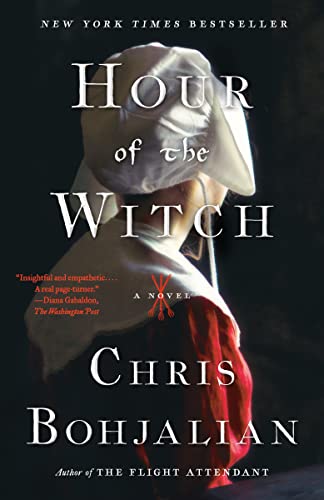
Hour of the Witch by Chris Bohjalian is about a young Puritan woman who’s trying to leave her cruel husband. Mary Deerfield is 24 years old and beautiful. In England, she would’ve gotten a lot of suitors, but in 1662 Boston, she’s the second wife of Thomas Deerfield – an abusive and powerful man. When Thomas, prone to drunken rage, purposely drives a three-tined fork into the back of Mary’s hand, she believes that enough is enough and that she must divorce him to save her life. However, in a world where every neighbor is watching for signs of the devil, a woman like Mary – a woman who harbors secret desires and finds it difficult to tolerate the hypocrisy of so many men in the colony – soon finds herself the object of suspicion and rumor. When tainted objects are discovered buried in the ground, when a boy whom Mary has been treating with herbs and simple dies, and when the boy’s sister – a servant in the Deerfield household – runs out of the home screaming, Mary must not only escapes her marriage, but also the gallows.

To prepare for this book, I watched this video.

I like this one as well. Much like Bohjalian’s other female protagonists, Mary is a three-dimensional character with desires, but she is forced by the Puritan society to maintain her duty as a wife despite the circumstances. In a way, Mary reminds me of Cassie from The Flight Attendant. Even though Mary is a more respectable person, both are trying to clear their names from crimes they didn’t commit. I wouldn’t be surprised if Bohjalian made that decision after the success of the first season of The Flight Attendant television show.

In addition, I enjoy the world building. Since the book takes place in the Puritan Massachusetts colony, it constantly reminds readers of the values that they held dear as a community like moral and religious earnestness as well as predestination. This context aides them in understanding why the characters would’ve had major concerns over Mary’s attempt to divorce her husband. Also, it doesn’t help that accusations of witchcraft were becoming prevalent when the novel begins.

Another thing that I want to note is how the book, so far, is structured like the Greek play Antigone. I’m only in the first third, yet I noticed how a good chunk of it involves lot of exposition. Then, after Mary leaves her husband, a bunch of people come to her parents’ home and beg her to reconsider. This reminded me of how the characters in Antigone like the advisors and the son Haemon tell Creon that he should change his mind and bury Antigone’s brother Polynices who fought against Thebes. I hope there’s more to it than that.

I’m listening to the audiobook now, and it’s good. Grace Experience narrates it along with a full cast although the latter are relegated to reading official documents, and they do an effective job in embodying the main characters while sounding accurate to the Puritan era. That’s why I’m not listing everyone who’s on the audiobook as of now. In addition, I don’t know if those records are real or made up for the story; I’ll have to do more research. Experience (Bohjalian’s daughter) needs no introduction as she did part of the narration for The Flight Attendant. She blends a contemporary and period voice well. At first, I wasn’t sure about this take because it felt a little too modern, but I realized that she’s portraying a third-person narrator. This gives more leeway in how she interprets the story. My only complaint is that a lot of the characters sound similar, but it’s still a solid performance.

We have now come to the end of the thirty-fifth chapter of “What Am I Reading?”

But, before I go, I want to let you know that I will be seeing the movie version of “Where the Crawdads Sing” this coming week! Stay tuned for the review! In the meantime, go check out my evaluation of the book!

Subscribe below to get notified when I post new updates. Also feel free to email me here for any review suggestions, ideas, or new titles!

Confessions of a Bad, Ugly Singer Book Review

Full disclosure: I was given a free PDF copy of this book in exchange for an honest review.

I’ve read plenty of biographies and memoirs, but there’s only two that truly shocked me because I couldn’t believe what had happened. One of them was Educated by Tara Westover, and the other was Confessions of a Bad, Ugly Singer by Collette McLafferty. The latter was a well-written and accessible story of something unbelievable happening to a woman that made her more adamant on standing up for and on loving herself.

Confessions of a Bad, Ugly Singer details a two-year period, in which the author had to go through the legal system. In April 2014, McLafferty was playing a P!NK cover band when she found herself named in a 112-page complaint. The person who sued was a personal injury lawyer, played drums for Michael Bolton, and had a dispute with the band leader claiming he stole the lawyer’s idea to form the first P!NK cover band in Long Island. Oh, and he was suing them for $10,000,000. Knowing that she was going to be involved for years to come, she took her case to the press. She made a call to the New York Post in hopes of leaving a message. However, she later discovered the headline “Singer Sued for Being Too Old and Too Ugly for P!NK Cover band” in the paper. His sensationalized headline told a story of a singer who was so “old, ugly and untalented” that her one-night performance prompted the lawyer to sue. This version of the events went viral worldwide and threatened to put an end to her 20-year professional history in the music business. The headlines alleged she “ruined” the P!NK cover band with her inferior looks and singing, triggering a deep depression. Determined to find justice, McLafferty fought the case and eventually introduced “Collette’s Law” with the help of The Lawsuit Reform Alliance of New York and Assemblyman Luis Sepulveda.

Much like everyone else reading this, I was shocked to learn that this actually happened. All of what went down felt too strange to be true, but as I mentioned before, truth is stranger than fiction. Even McLafferty herself couldn’t believe it either, which made it all the more bizarre. It was good seeing the author trying to make sense of it all like Alice in her own version of Wonderland. She reached out to various news outlets to set the record straight and even tried to get in contact to P!NK herself to get some support (sadly to no avail). She also made a music video of her cover of “Perfect” to show her journey and to display how she wasn’t bad nor ugly. Moreover, she tried to get the state legislature in New York to pass a law – Colette’s Law – to require those who sue without merit to pay the other party’s legal cost and increase sanctions for those who file inane lawsuits. (Just a quick side note: even though the law was introduced in the New York State Assembly in 2017, I have a feeling that it was never passed because I couldn’t find any other information about it after 2016). 

However, it was not all one smooth road. During the two years battling the lawsuit, McLafferty drank to the point that she could be considered an alcoholic and spent some time in therapy. I will admit that these sections were a little tough to get through, yet the framing of how she dealt with it (as opposed to wailing in her suffering) made it endurable.

McLafferty writes what occurred several years after the fact, which is the most logical thing to do when writing about something deeply traumatic. This allows her to process all of the events in the most objective way possible. Heck, she makes jokes about certain people and moments. That’s how one knows someone has moved from a tragedy. In addition, she’s able to see people with their own thoughts and feelings. For example, when she finally meets and confronts the man who sued her, he tells her that he was bullied as a kid for his weight. She empathizes with him because of her own experiences with bullies (including ones that called her “Collette Germs”), yet she doesn’t excuse him for his actions and his misreadings of the relationship between her and the band leader. The same goes with said band leader. She had some nice things to say about him, but she was wary of him after seeing his social media posts bashing certain individuals. 

Besides the story itself, what stood out to me was the commentary on ageism. I don’t think I’ve ever read a book that dealt with that subject so openly. McLafferty comments on how the music industry basically bars women over the age of 30 from singing, or if they do, not having successful careers. She’s a living example of defiance because she’s still putting out new music and hopefully going to be releasing a solo album called 42 soon (before Adele gets to that title first). 

Overall, Confessions of a Bad, Ugly Singer by Collette McLafferty is shocking in a good way. I never knew that this happened, and I feel bad for her. Luckily, her uplifting, funny, and very real style of writing are what make the memoir rootable. I would recommend it to those who like reading nonfiction that deals with events that are stranger than fiction, lawsuits, ageism, and the music industry. I’m glad that she was able to write about this event and eventually heal from it because this book is perfect to me.

Subscribe below to get notified when I post new updates. Also feel free to email me here for any review suggestions, ideas, or new titles!

What Am I Reading – Chapter Thirty-Four

Hi Everyone!

It’s been awhile since the last chapter, but I have a whole new slate of book to show you that I’ve been reading for about a month now!

There’s no time to lose! Let’s begin!

No-Mod: Book 1 of the Mute-Cat Chronicles by Derek Porterfield is about a human and the techno-religious city of Aberthene. In that place, every one is augmented by biomedical modifications. As a result, they are part-human and part-machine. The church rules the state and controls everything. Addeleigh Simmons cleans out suicide booths during the day and goes to classes and studies at night. She’s working towards obtaining those modifications since she’s only human, which makes her an outcast. Her existence is upended when an armed group of Red Guards storms her dormitory, and she escapes from the third floor window with her cat Bruce. This begins a journey that will expand her world.

I’ve haven’t read much science fiction, so I don’t know how widely used the techno-religious environment is in that genre. Nevertheless, I think it’s a unique atmosphere. While it’s nothing new to have stories about religion controlling every aspect of life, I think this book presents that concept in a distinct way, especially how religion encourages people to augment the body parts that God had created. It almost feels that they do this to be closer to that deity.

Addeleigh (or Addie for short) is a typical outcast. Her life is miserable because she can’t afford to have any biomedical modifications, and that’s her quest. She does have some witty dialogue with some men who perform surgery on her when she breaks her leg after she jumped from her third-story window. We’ll see how much more character development she gets.

While the main story is about Addie and her pursuit to live a better life, the book splits between her exploits and that of a gang trying to find out who their boss is. The group is consisted of what one expect like the leader; the dumb, but tough one; the smart one; and the female. Even though I’m rooting for all of them, I’d like for them and Addie to interact at some point.

Also, I find it interesting that the book stops a third of the way in to explain the origins of the person who created the religion that currently controls Aberthene. Nonetheless, it was definitely necessary since they are the clear antagonist in the story.

Overall, No-Mod is good so far, and I look forward to finishing it soon. I hope to read the second book in the series Godless at some point too.

Now, let’s move on to another journey of a lifetime.

Sisters of the Neversea by Cynthia Leitich Smith is another modern retelling of Peter Pan. Instead of focusing on the boy who never grew up, it tells the story of Native American Lily and English Wendy. Lily and Wendy have been best friends since they became stepsisters. However, their parents plan to spend the summer apart, which puts the family as well as Lily and Wendy’s relationship into limbo. One night, a boy comes through the window and intends to take them away along with their brother Michael from their home to a place called Neverland. Will Lily and Wendy find a way to get back to the family they love?

This is the third novel that I’ve read from Cynthia Leitich Smith, and it’s the first one that I’ve read since starting this series. I like it so far. It emphasizes an aspect of the Peter Pan story that is easily the most problematic: the depiction of the indigenous people. In the original story by J.M. Barrie and in subsequent adaptations, they play a limited role with Peter saving Tiger Lily from Captain Hook and peace scene afterwards (which sometimes results in a racist song). Then, they disappear from the rest of the plot. Sisters of the Neversea effectively brings that aspect to the forefront not only with including multiple native children from various tribes on Neverland, but also with Lily being indigenous herself (she is from the Muscogee Creek Nation).

The portrayal of Peter Pan in here is not much different from the one in Darling Girl. However, since this is a juvenile/YA novel, it makes him to just to be controlling and insensitive to both girls and indigenous people. Both Lily and Wendy express concern over this, and yet, under his “spell,” they fly away to Neverland.

Speaking of flying, I like how the book expresses that logic and its byproducts. Along with thinking happy thoughts, the more pixie dust one is given, the more one’s personality gets magnified. So if one is naturally prideful, they get even more so when they get sprinkled with that magic. In this way, whoever gets the dust doesn’t feel like themselves when they fly, hence the reason why Peter Pan is able to convince many to join him in Neverland.

The only thing that I have nitpick is how the narrator goes “You may be wondering…” or “If only they knew…” on various occasions. I don’t know if that’s from the original novel, but I roll my eyes over those parts because it feels condescending. But then again, I’m older than the intended audience, so I don’t know how they would react to that.

Nevertheless, I still like it, and I can’t wait to see if Lily, Wendy, and Michael are able to get back home.

Let’s soar from a familiar tale to a more unknown one.

Salt to the Sea by Ruta Sepetys is a historical fiction tale about the real life stinking of the MV Wilhelm Gustloff – a German cruise liner that was supposed to ferry wartime personnel and refugees to safety from the advancing Red Army. It was sunk on January 30, 1945 by a Soviet submarine, and more than 9,000 people lost their lives. The book itself tells the stories of four fictionalized people on the ship – Joana, a Lithuanian with nursing experience; Florian, a Prussian soldier fleeing the Nazis with stolen treasure; Emilia, a delicate, but brave Polish girl close to the end of her pregnancy; and Alfred, a Nazi servant with delusions of grandeur who works on the Gustloff decks.

First off, I never knew about this sinking prior to reading this YA novel, but now, it makes me want to learn more. It apparently had the largest loss of life resulting of the sinking of a single vessel in maritime history.

As for the story, it goes into different perspectives constantly, which, in other circumstances, would make me connect less to the characters. This is much the case in the movie Dunkirk. Unlike that film, Sepetys does put all (or at least most of the people) in the same location, so one gets to read how each of them feels about the same situation. This is especially true when Joana tries to save Ingrid – her blind friend – from drowning, despite putting herself in more danger according to Florian.

Another aspect that I like about the book is how it acknowledges both Nazi and Russian discriminations against Polish people and the language barrier. Although Emilia has blond hair and blue eyes, she’s still in danger if she ever speaks Polish. At the same time, she was violated by a Russian soldier. When Joana, Florian, and the rest of her group get on the ship, they tell the officers that Emilia is Latvian to avoid any detections. In addition, whenever she speaks to other characters, they note that she speaks in broken German, so it’s hard for them to understand her at times.

Alfred is clearly the most antagonistic of the speakers, but I wouldn’t call him the antagonist right now. So far, he hasn’t done anything besides writing letters to his girlfriend, boasting about his “good deeds,” taking orders from the higher-ups, spewing out sexist stuff and Nazi propaganda, and trying to hit on Joana. We’ll see how this unfolds.

So far, I’m at the point where they are boarding the Gustloff, so I’m curious to see how Sepetys handles the sinking.

I’m listening to the audiobook now, and it’s really good. I love how each of the 4 main characters sound distinct in their own ways. Jorjeana Marie, according to her website, is an award-winning television writer and actress. She has done both in Mickey Mouse FunHouse. In addition, she has recorded several audiobooks like the Nancy Drew Diaries series. Marie voices Joana as determined to help others to heal the guilt that she feels for not doing enough.

Will Damron takes on the role of Florian. He has recorded lots of audiobooks like Beneath a Scarlet Sky by Mark Sullivan, and he is even an author himself since he published The Tercentennial Baron (the first in The Bellirolt Chronicles series) in 2018. Damron sounds a little older for a character who’s supposed to be in his late teens/early twenties, but then again, I don’t know a whole lot about Florian himself. We’ll see how I feel at the end of the book. Nevertheless, Damron sounds great whenever Florian is frustrated and secretive and can play up the character’s softer side well.

Cassandra Morris is Emilia. Morris is a voice actress whose roles include Alice and then Yubel in Yu-Gi-Oh! GX as well as Suguha Kirigaya/Leafa in Sword Art Online. She too has narrated lots of audiobooks including A Snicker of Magic by Natalie Lloyd. Morris gives Emilia strength in her character, while maintaining her vulnerability and delicateness.

Finally, Michael Crouch voices Alfred. He too is a voice actor whose credits include characters in Pokemon and Yu-Gi-Oh! and has recorded several audiobooks that span many genres like Alice Through the Looking-Glass by Lewis Carroll and The Proving Trail by Louis L’Amour. I’m not surprised that Crouch has done work in animes because his voice definitely suits an antagonist putting on the airs (like Alfred does in the book). I couldn’t have imagined Alfred’s voice as anything other.

At last, but not least, a book that I’ve been giving a lot of attention to as of late.

The Fountainhead by Ayn Rand tells the tale of Howard Roark, the extremely uncompromising young architect; of Dominique Francon, an exquisitely beautiful woman who marries his worst enemy despite loving Howard passionately; and of the society who tries to bring him down. This novel sowed the seeds of Rand’s famous Objectivism philosophy and presented the idea that man’s ego is the fountainhead of human progress.

For those who want to know how I feel about Objectivism, I don’t think this is right place to express my thoughts on it. However, I certainly have some, so expect them when I do my full-on review of the novel.

I’m about 260 pages in, so whoever betted on me giving up prior has already lost.

For the content itself, it definitely would’ve benefited from an editor. It seems like every character, no matter how important they are to the story, have a speech of some sorts that goes on and on. Granted, there are times where the detailed descriptions are tolerated. For example, since architecture is an integral part of the novel, Rand describes almost every characteristic of the buildings that are mentioned. Also, Rand didn’t like her work being reduced, especially when it came to the 1949 movie adaptation.

Speaking of that film, I’ll be talking about that with Zita Short on her The 300 Passions Podcast, so stay tuned for the movie review and that episode!

Going back to the book, if there’s one thing I like so far, it’s Dominique. I like how cold, distant, and witty she is, and how she uses that to shield her deep love of various things, including Howard, to prevent them from ruining her.

We have now come to the end of the thirty-fourth chapter of “What Am I Reading?”

Subscribe below to get notified when I post new updates. Also feel free to email me here for any review suggestions, ideas, or new titles!

The Suspect Book Review

I’ve enjoyed and poked fun at the Kate Water series by Fiona Barton for the last few years. When I heard that there was a new title in the series creatively called The Suspect, I knew I had to read it in order to continue the story. So, how does it hold up against the other titles? Well, I liked it, but it’s not my favorite in the series.

The Suspect is the third installment of the Kate Waters series. After two teenagers disappear during their gap year in Thailand, their families are thrown into the international spotlight. As a reporter, Kate Waters tries to get to the story first. As she digs into it more, she thinks of her son who’s been traveling for the last two years. All will soon discover that no matter how far away they are, danger can lie closer to home than one might think.

Those who’ve followed this website long enough will be familiar with the running gag of me making fun of Fiona Barton’s titles to her novel. This is no exception as this one is the most basic. However, the more I read it, the clearer it is of who the suspect is, so I’ll give credit to her for making the title personal as well as more specific than I initially thought.

Like the previous novel, Kate is front and center of this plot and reports the case with gusto, but there’s something extra. She’s now entangled in that story as her son Jake is considered a suspect in the case. Having this development makes her more flawed as a character. For example, when one of the other reporters tells her of Jake’s school records and how he dropped out of the university, Kate is livid and is in full denial because she never would think that he would do something like that. But once that reporter provides full evidence, that’s when she realizes that maybe she doesn’t know her son as well as she thinks she does. In addition, even though it makes sense from a maternal standpoint, Kate does something very drastic at the end that makes me question her ethics and doubt if I can ever look at her the same way ever again.

Additionally, there’s a mix of old and new characters. For the former, Detective Bob Sparkes is back. He hasn’t really been present since The Widow. Sadly, he’s not been given a whole lot to do besides assist in the investigation and worry over his wife who’s going through chemotherapy. I’m not sure if the subplot with his wife was all that necessary since it doesn’t really tie into overall themes of the story. As for the new characters, we have Alex – one of the missing teenagers – and her mom Lesley. I really like Alex. She wants almost everything to go according to plan and be safe in the best way possible while vacationing. However, her travel partner Rosie flushes that down the toilet. She spends a good chunk of her time partying, drinking, and sleeping with any guy that lays eyes on her. This reasonably bothers Alex as she wants to spend time going to various places and not staying at the hostel they’re at. Her segments were the most interesting because I wanted to see what led up to their deaths and how she felt about everything around her. 

Lesley, on the other hand, was just another worried mom. The difference between her and Angela from The Child was that the former wants to be brave in face of what was happening and even advocates for the perpetrator to be tried in Thailand for the crimes committed. Oh and before I forget, Rosie’s parents are awful. Her dad is a philanderer, and her mom is reasonably angry at him for that, However, she also gets mad at the slightest things like not being informed of some development before her now ex-husband. That sort of got on my nerves. These characters are a bit of a let down compared to the ones in The Child.

Barton employs a similar structure to her other titles with slight changes. First, it’s not a child that’s missing, but it’s two teenagers in Thailand. It’s a great touch that readers get to see Alex’s perspective beyond the Facebook posts. Second, the novel contains a multiple-narrator structure, and it’s used in a similar way to that of The Child. It also helps to display similar emotions that Kate and Lesley feel about their children and how they didn’t really know them as well as they should have.

Third and last, I’ve also mentioned how predictable Barton’s work has been in the past in terms of endings, and this novel is no different. It gets revealed too early. However, there was one that caught me absolutely off guard. I won’t spoil it, but it made the book more enjoyable and engaging as well as slightly less predictable. I kept going back and forth between two characters of which one murdered Alex and Rosie and burned down the hostel. Maybe Barton has been reading some Lisa Gardner in her downtime.

Another thing that I was surprised that Barton didn’t do was have the perspective of the horrible male character who committed the crime. I guess that even she realized the limit of using that gimmick. Plus, eliminating that aspect actually makes the book a little more unpredictable as it made me less sure of who the culprit was.

As mentioned earlier, I listened to the audiobook recently, and overall, I couldn’t really get into it. I don’t know what it was. It was an interesting story, yet the voices didn’t really come alive in the way the previous audiobooks in the series did. Susan Duerden – an actress who’s best known for playing Carole Littleton on Lost and has recorded many books on tape – plays Waters. Mandy Williams previously narrated as her, so I’m confused as to why the role was recast. She did a great job portraying her with determination and empathy in The Widow and The Child, whereas Duerden feels a little more tired, but maybe that’s to signify how much Kate has aged. I really don’t know.

When I wrote about the audiobook in the “What Am I Reading” series, I made a mistake. I mentioned that Fiona Hardingham voiced Alex, while Katharine Lee McEwan voiced Leslie. It’s supposed to be Hardingham voicing the latter, and McEwan voicing the former.

Katharine Lee McEwan is back and takes on the role of Alex. I like how she strikes a balance between a juvenile and a mature voice for a teenager who plans so much in advance, and yet everything goes wrong the moment she and her friend land in Thailand. I mentioned in The Child review that she sounded too young to play Angela – the grieving mom, so I’m glad she got a role more appropriate to her vocal tone. McEwan was definitely the strongest narrator out of this group.

Fiona Hardingham plays Lesley. She had previously acted in roles such as a News Anchor in Godzilla: King of the Monsters and an Arrival Video Narrator in Pokemon Detective Pikachu as well as narrated several other audiobooks. She’s fine. That’s it.

Another actor who’s back is Nicholas Guy Smith, and he voices Detective Bob Sparkes. It’s nice to hear Smith inject frustration and sadness into Sparkes. I just love hearing Smith’s voice even if it’s not reaching its full potential. If one is going to read it, I would suggest getting the physical copy or an ebook as opposed to the audiobook.

Overall, The Suspect by Fiona Barton is a fine book that has its pros and cons. I like The Child more, but this title did some things differently from the two. And, that’s pretty commendable. I would recommend this title to those who like Fiona Barton, international missing cases, and mysteries with an emphasis on the reporting/journalism side of things. As far as I know, there are no new titles in that series, but Barton published a new book called Local Gone Missing in last week! I look forward to reading it. At least that title is more unique.

Subscribe below to get notified when I post new updates. Also feel free to email me here for any review suggestions, ideas, or new titles!

Literary Travel – Milwaukee* Edition

*Ok, my literary travel was technically in East Troy, Wisconsin, but it’s still part of Metro Milkwaukee.

Hi Everyone!!

My husband and I went on vacation last month to Milwaukee, Wisconsin for a couple of reasons. He wanted to go to Road America in Elkhart Lake to drive the latest cars, while I wanted to see a relative who lived in a village called East Troy – a 35-minute drive from the heart of the Cream City.

While I was chilling in East Troy, I wanted to check out the bookstore they have in the downtown village square as well as the local library. My relative and I checked them out on my last day in the area. All of the photos used were ones that I took.

First up is InkLinks Books!

According to the Milwaukee Journal Sentinel, InkLink Books is an independent book store that opened in 2017 inside a restored historic brick building. The bookshop contains wooden floors, black-painted wood bookshelves, tall round windows, and upscale lighting. Owner Kayleen Rohrer and her family did the restoration work on the place itself.

The aesthetics that stood out the most were the fireplace and the murals of four Goddesses of Wisdom from Greek, Norse, Egyptian, and Hindu mythology.

In that same article, Rohrer mentioned that books evoke a feeling, as she claimed, “The objects make you feel a certain way. Your feelings lead to your thoughts…Thoughts lead to your behavior, that leads to who you become.”

This explains the homely nature of InkLinks. The store certainly made me want to curl up by the fireplace and read a good book. Another aspect that invoke the cozy-like atmosphere was the music. The bookshop played a lot of classical music – a good choice I may add, to encourage people to focus on what they want to read. One of selections was called “Inferno Violin” – a piece that I recognized as the music for the YouTube channel Musical Hell (check out her stuff, it’s great!).

Of course, I can’t go without mentioning some of the more quirkier decor like a sliding ladder, a green rabbit statue, and leftover Christmas items.

The bookshop offers a variety of items. These include books in various genres, that cover almost every topic imaginable, and for all ages. They also have puzzles, gift wrap paper, cards, candles, and glasses.

It consists of two levels. The lower one contains adult fiction, young adult novels, and juvenile titles. The upper one, which only takes a few steps to get to, primarily consists of adult nonfiction ones.

While InkLinks is a small store, it was easy to walk around. Everything was spaced out just enough, so customers like me could navigate it without accidentally bumping into books or another person (sorry Arcadian Books & Prints).

While there, I bought the juvenile graphic novel The First Cat in Space Ate Pizza by Mac Barnett. It looks very silly, and I like me some silly books. I can’t wait to read it!

All in all, InLinks Books is a bookstore that evokes the homely environment perfectly. Everyone knows everyone there, and I even got to know some of the regulars. It’ll make customers want to snuggle up on the couch by the fireplace and read a book with classical music playing in the background. Along with their website, you can find them on Facebook and Instagram!

And now, the second and last spot of the trip: the East Troy Lions Public Library!

The East Troy Lions Public Library is about 10 minutes from the downtown village square. It’s located in a building that was once owned by the local Lions Club – a humanitarian organization. In the past, it housed a youth center. The Lions Club later donated the building to the village, and the village turned it into a library.

According to the staff, it’s not much of a browsing library since it’s a small building. This explains why there were only a few chairs that people can sit in. A lot of patrons like to primarily place holds and pick up them up. It has a neat system for doing that. The workers at the front desk place covers of new books on the back wall to show patrons what’s new every month.

The library offers the things one expects to have for patrons to borrow like books, DVDs, music CDs, audiobooks, video games, magazines, and newspapers.

They also have their Summer Reading program going on now, and they got some cool prizes!

Tami Bartoli – the director – also took me down to show me the lower level, where they shelve the extra library books and DVDs as well as items they’re looking to discard. They keep them along the walls and in an extra room by the doors. It’s a roomy space, where they have meetings and storytimes at. In addition, it’s sparsely decorated with various paintings from the Picturing America series.

I also want to point out that they have a physical card catalog!

Every library has something that allows people to give back to the library. This is no different from the East Troy Lions Public Library, as they include a basket, which people can put their Piggly Wiggly receipts in. One percent of their grocery bills goes to the library. That’s a neat idea! It helps that it’s located next to the doors to the library’s main level.

Overall, the East Troy Lions Public Library is a nice and small library that allows patrons to get what they want with ease. It may not be in the most stunning building, but it gets the job done. I was able to maneuver through the library with no problems, and everything was labeled clearly. Along with their website, you can find them on Facebook and Twitter!

And that concludes of the second installment of “Literary Travel!” I hope all of you had a fun time on this trip. There will be another one possibly coming later on this year!

Subscribe below to get notified when I post new updates. Also feel free to email me here for any review suggestions, ideas, or new titles!
Turn of Mind Book Review

There have been plenty of books that I read that have an unreliable narrator. But in those cases, even though they may not always realize the consequences of their actions, those protagonists are mostly sound of mind. Lately, I read Turn of Mind by Alice LaPlante, whose protagonist has dementia and progresses into the latter stages. I don’t think I’ve encountered a voice like that in literature, but it’s worth it as long as one is patient.

Turn of Mind by Alice LaPlante is about Dr. Jennifer White – a retired orthopedic surgeon struggling with dementia and who’s accused of killing her best friend. When her friend Amanda is found dead with four of her fingers surgically removed, Dr. White is a prime suspect. But she doesn’t know whether she committed the crime. She and Amanda were life-long friends as well as each other’s most formidable adversary. As the investigations progress and White’s relationship with her caretaker and two grown children intensify, a question remains: is her shattered memory preventing her from revealing the truth or helping her to hide it?

One of the first things that I noticed was how disorienting the tone is. This is not a bad thing because the protagonist is experiencing dementia. Disorientation is one of the symptoms, and LaPlante captures this beautifully, especially when readers are introduced to Dr. White’s son Mark. She constantly misremembers his name, and by the time he leaves, she only sees him as a stranger. Viewing this story through Dr. White’s eyes is an ingenious idea. The only other book that I think does this is Still Alice (dang it, that’s the second time I mentioned this novel on this website, and I still haven’t read it yet), but the titular character has the early onset of this disease. Dr. White, on the other hand, is in the more advanced stages of dementia, thus losing more of a grip on reality. She can be loving at one moment and irritable and disowning her children in another. Again, LaPlante captures this authentic tone beautifully.

Apart from disease, Dr. White is a very interesting character. She is a very intelligent person who can come off as cold and egotistical, but loving at the same time. Even with dementia, she still insists on being called Dr. White while others address her like a child with names like Jen and Jenny.

Now, one is probably thinking: what you do think of the murder mystery aspect of this novel? It’s another part that makes the book stand out among others in the neurological fiction genre. While others in that category tends to focus on the consequences of having a certain disease and how it affects family, Turn of Mind adds in the murder to focus on how the disease alters that situation. I will admit that this mystery made me pay more attention to the novel because some of Dr. White’s regular ramblings can digress pretty quickly and get irritating as a result. The murder basically forces the book to have a plot, so things can actually happen. There’s a twist that kind of shocked me regarding the murder. One will have to read the book to find that out.

For those who don’t have relatives who have dementia or Alzheimer’s, it’s best to be attentive and patient with this book. There were times, in which I zoned out while listening to this novel and when I started paying attention again, the book was in a different place than before. It doesn’t follow the linear structure of most novels, so it’s good to pay attention as much as possible.

Jean Reed Bahle – an actress and co-founder of the Actors’ Theatre Grand Rapids in Grand Rapids, MI – narrates the book. She brings a Glenn Close-like energy as Dr. White, which I liked very much. There weren’t many vocal distinctions amongst the male characters, but there were some with the female characters. For example, Bahle voices Amanda with a sophistication and assertive flair that can be sinister at times (think Jane Fonda in Monster-In-Law). Another thing that made the listen interesting was that at the end of every disc, piano music would fadely play out while Bahle was still reading the book. This possibly represents how memory fades in and out with someone with Alzheimer’s. Luckily, at the start of the next disc, the passages that ended the previous one are repeated.

Turn of Mind by Alice LaPlante may not be a book for everyone, yet its authentic voice makes it worth the read. I would recommend this novel for those who like neurological fiction and who want a little more stakes in their murder mysteries. If one chooses to read it, please be patient because the novel can go all over the place.

Subscribe below to get notified when I post new updates. Also feel free to email me here for any review suggestions, ideas, or new titles!