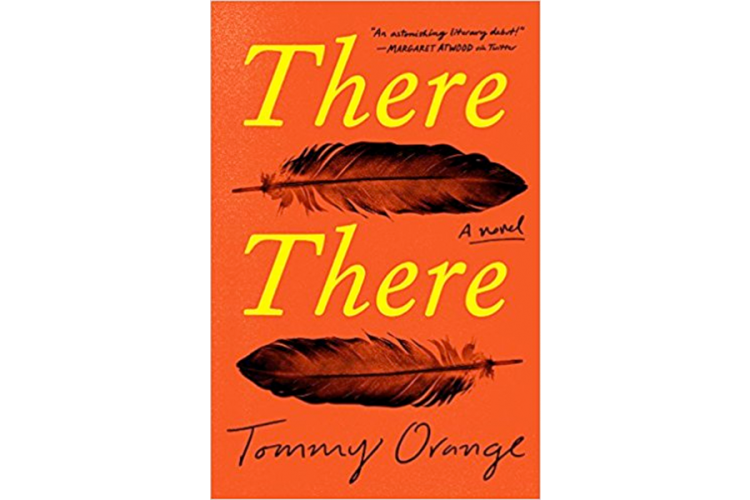
I’ve read plenty of books by indigenous authors, but none of them dealt with the lives of urban Native Americans. Plus, I will be honest and say that I didn’t really know that group even existed. This gap was the reason why Tommy Orange – an enrolled member of the Cheyenne and Arapaho Tribes of Oklahoma – wanted to write about them in the first place. And he did with his debut novel 2018’s There There. Although not everything works in the book, I admire its ambitions.
There There follows twelve people from various Native communities as they travel to the Big Oakland Powwow in Oakland, California. They’re all connected in ways they may not yet realize. These voices tell the story of the urban Native American, grappling with its complex and painful history, beauty, spirituality, communion, sacrifice, and heroism.
The title refers not to the phrase that people say to quell someone’s sadness and suffering, but to a quote from Gertrude Stein. Specifically, as someone who had lived in Oakland, she said this:
“…what was the use of my having come from Oakland it was not natural to have come from there yes write about it if I like or any- thing if I like but not there, there is no there there” (Everybody’s Autobiography, p. 298).
Stein was lamenting how she couldn’t find her childhood home when she was on a lecture tour in 1935 and how the land around it was completely changed. In the context of the book There There, the quote is used to reflect a hard truth of how indigenous people were so displaced that they couldn’t recognize their ancestral lands anymore. It’s even referred to by a character named Dene Oxendene, a filmmaker who receives a grant and and describes himself as “ambiguously nonwhite” (p. 28, p. 38-39).
A common word to describe There There is ambitious, and I completely agree. Orange sets the standards high by having a prologue that details how white people conquered the indigenous as well as the origins of the urban Native American. This happens right before the first section entitled “Remain.” Then, in the Interlude in the second part labeled “Reclaim,” he describes the meaning of powwows, how last names were bestowed onto the indigenous, and how they continue the fight to be seen in the present tense. There’s also a third and final section called “Return.” These provide a proper context of the inner conflicts each of the twelve characters go through, which unifies them as the story unfolds. The “Interlude” section comes a bit out of nowhere, but it felt necessary as everyone gears up to go to the Big Oakland Powwow at that point of the story.
On the other hand, not all of Orange’s ambitious ideas work as effectively as they should. Each chapter is devoted to one character and how they deal with being an urban Native American. All of them have their reasons for going to the powwow. However, it’s a little hard to connect to them since once I’m into one person, the book switches to another perspective. At various times, I had to go back to the beginning to see which character was who. It didn’t help that the plot is told through a third point of view. The characters I gravitated to the most were Edwin Black and Jacquie Red Feather. Edwin is an overweight half-indigenous and half-white man who still lives with his mom and has issues with her boyfriend. He wants to begin his life again by working and finding his biological Native father. Jacquie is a Cherokee woman who copes with her trauma of being raped while drunk as a teenager at Alcatraz in 1970. And yet, she longs to see her grandchildren again, who are currently staying with her half-sister Opal.
At the same time, I enjoyed how the novel reveals how each of the characters are related. It does this gradually, and it’s very effective. Even though I was reading this while in bed, it made me actively try to piece together how each is connected.
Another reason why I had a somewhat difficult time reading it was the pacing. It was very slow for the first half because the book needed to explain each of the character’s situations. This was why each chapter was about 15-20 pages. I understand that this was done to represent their reflections on their individual and group past traumas, which is highly important to the story being told, yet it strongly affected the pacing. Fortunately, once those exposition dumps were out of the way, the pacing picked up. This is exemplified by the shorter chapters. Some of them weren’t even a page long. This approach makes sense, for something drastic happens at the powwow, which frazzles many characters’ minds.
Overall, There There by Tommy Orange is an undoubtedly ambitious debut novel that aims to tell the multiple stories of various urban Native Americans. Even though not all of the book’s ideas work, I admire Orange’s commitment to them as each character has their own yarn to weave. I would recommend this book to those who want to read more books by indigenous authors as well as about the reckoning of Native American identity. I hope there are more tales about native people living in urban areas because this needs to be explored more. Thank you Tommy for helping to fill in this gap! I also look forward to reading his next book Wandering Stars, which is going to be published next year.
Subscribe below to get notified when I post new updates. Also feel free to email me here for any review suggestions, ideas, or new titles!





 Book Reviews by a Chick Who Reads Everything