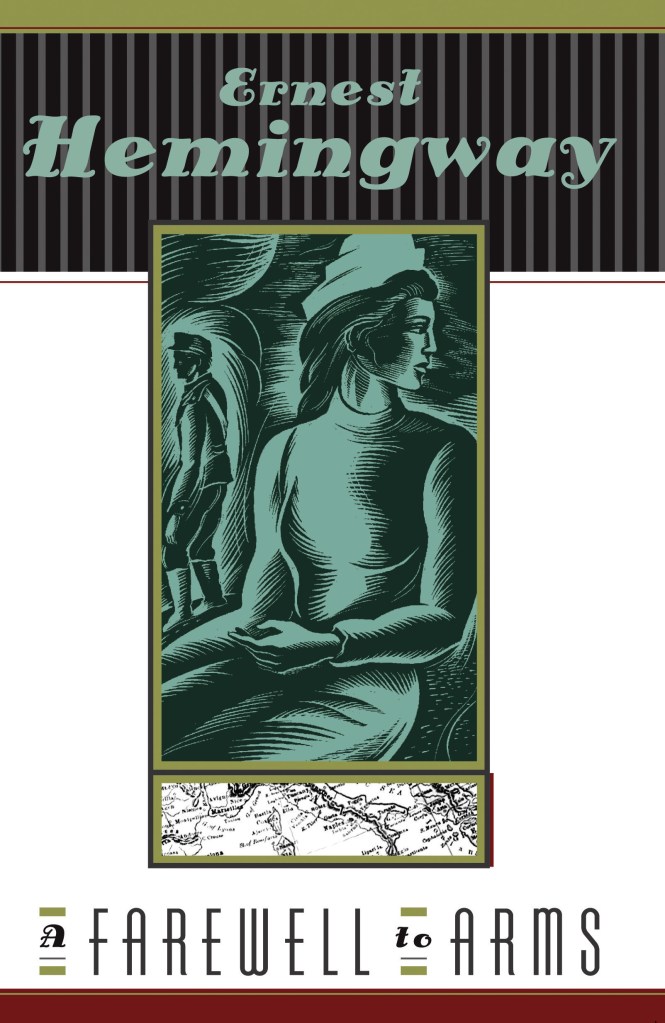
About a month ago, news broke that Tom Blyth, who recently starred in The Hunger Games: The Ballad of Songbirds & Snakes, was cast in an upcoming adaptation of A Farewell to Arms directed by Michael Winterbottom.
My first reaction to it was simply this.

Why? I’ve already reviewed two adaptations of the novel by Ernest Hemingway already on this website. They were the 1932 movie starring Gary Cooper and Helen Hayes and the 1957 one with Rock Hudson and Jennifer Jones.
Neither were that good. The former was decent, but could’ve been better if director Frank Borzage didn’t show off his skill for the sake of showing off, and the latter was all over the place.
But, the more I thought about it, the more I understood why A Farewell to Arms would be adapted in the 2020s. First off, there hasn’t been a new version of the story in nearly 60 years. Along with the two aforementioned versions, there has been a 1930 play and a 1966 BBC mini series starring George Hamilton and Vanessa Redgrave, but the latter most likely lost its life to the great BBC wipeout. And if one counts In Love and War – the 1996 film starring Sandra Bullock and Chris O’Donnell that dramatizes the real-life events that inspired the book in the first place, then it would be nearly 30 years since there has been A Farewell to Arms-related content (not counting the numerous references to it like on shows like South Park and Family Guy). Therefore, the time seems right for another adaptation (even if I say this begrudgingly).
Second, there have been an influx of war-related movies that have come out within the last 10 years. These include 1917 and the 2022 Netflix adaptation of All Quiet on the Western Front. In fact, the 1932 version of A Farewell to Arms was released two years after the latter original film. So if we have another adaptation of All Quiet on the Western Front in the future, then another one of A Farewell to Arms is bound to happen.
Third, of all the novels that Hemingway wrote, A Farewell to Arms is one of his best known. Say what you want about the man, the myth, the guy who shoves his masculinity down your throat, he knew how to write stories like a timeless wartime romance. It’s not perfect by any means, yet it taps into the doom of the relationship, the power dynamics, and how war can be boring. The fact that it still resonates with people today enough to make another adaptation certainly demonstrates its cultural footprint in literature and in Hollywood. On top of that, another movie based on a Hemingway novel Across the River and into the Trees starring Liev Schreiber premiered at the Sun Valley Film Festival in 2022 with an anticipated release in the United States this year. With that being said, we might see a revival of Hemingway adaptations this decade if both A Farewell to Arms and Across the River and into the Trees do well.
Since the Michael Winterbottom version is set to start filming in Italy later this year, there are some things that I would like to see in order to make it truly work. To begin with, there has to be a constant reminder of war while the romance between Frederick and Katherine blossoms. In both the 1932 and 1957 versions, there was always a separation between the two with the love being at one place while the battles at another physical location. At times, this makes them feel like two separate flicks combined into one. The best wartime romances blend the two aspects together. Look at Casablanca as an example. The affair between Humphrey Bogart and Ingrid Bergman only occurs when the latter’s character comes to Casablanca with her husband in order to fly safely to Lisbon and escape the Nazis. The Nazis are everywhere in Casablanca from the streets to the cafe that Bogart’s character runs. If the Michael Winterbottom adaptation is able to achieve the marriage between love and war, then it will be on the right track.
Another element that I would love to see happen is the mundanity of war. Hemingway includes several descriptions of the Italian landscapes and what Frederick does to show how the character distracts himself from how bored he feels while on the front. Most importantly, Frederick sustains his injury while eating cheese. If that’s not the least inspiring way to get hurt, then I don’t know what is. Combined with newfound love for Katherine and the sense of danger while he’s in the war, this eventually propels him to desert the war entirely. The 1932 version does a better job demonstrating this than the 1957 one with showing Gary Cooper looking disinterested while in the ambulance in the opening scene and how it depicts the bit in which Frederick gets blown up albeit in a cheesy way.
Given the war movies and video games that have come in the last 10 years, they have made battle look cool and fun. I’m afraid that this version might fall into that trap to appeal to the aesthetics of similar portrayals. Granted, many of those depictions are realistic with the amount of blood and dirt on the soldiers’ faces as well as limbs being blown off, but the point of A Farewell to Arms was to display the less exciting side of war that’s full of waiting and strategizing.
One other facet that should be present in this version is the chemistry between the leads. Blyth and whoever is cast as Katherine should have chemistry because the romance between their characters is the core relationship in the novel. If they do, then it will sell the movie. This was present between Cooper and Hayes in the 1932 film, but not between Hudson and Jones in the 1957 one.
The final feature that I would love to see is not including everything that happens in the book. This is a problem specifically to adaptations of novels by authors who tend to add fluff to a bare bones story. Some screenwriters have been under the impression that they need to include every word no matter how pointless it is to the plot. This is especially egregious when it comes to adapting any Hemingway story (I’m looking at you For Whom the Bell Tolls the movie). That author even coined the phrase “iceberg theory” to show how a writer has to keep it simple. In the articles I’ve read about the new version, Winterbottom makes comments about that theory and how he wants to pare it down to the bare bones to capture the Hemingway spirit. Let’s hope he put those words into action.
The 1932 version of A Farewell to Arms does this best by condensing everything around the romance. If Winterbottom maintains the base of that flick while working on his version, it will work. Also, I’ll give him brownie points if he includes a reference to the weird puppet transition that occurs in the older one.
All in all, while I’m not crazy about a new adaptation of A Farewell to Arms, it can be effective as long as it follows the four aspects I’ve pointed out in this essay. It needs to blend the war and romance in a realistic manner, depict war in a more humdrum manner, have chemistry between its leads, and above all, condense the story. If it does all that, then it might be the best adaptation of a Hemingway novel ever. This would be a monstrous feat because his books still overshadow their film versions to this day. I wish the cast and crew of this adaptation the best of luck.
Subscribe below to get notified when I post new updates. Also feel free to email me here for any review suggestions, ideas, or new titles!
 Book Reviews by a Chick Who Reads Everything
It’s Catherine not Katherine
LikeLike
Thanks for the catch!
LikeLike