What Am I Reading – Chapter Eighteen

Hi Everybody,

It’s been awhile since we’ve had this series, and I’m still reading Miracle Creek by Angie Kim and Confessions of a Bad Ugly Singer by Collette McLafferty.

Today, I’ve got two new books to talk about, so let’s get started!

Dalva by Jim Harrison is about a woman who gave up her son for adoption years ago. At age 45, the title character embarks on a journey that will take her back to the bosom of her family, the half-Sioux man whom she loved when she was a teenager, and her great-grandfather whose journals recounts the annihilation of the Plains Indians. She discovers a story that stretches all across the country, and finds a way to heal her wounded soul.

I’ve gotten to about 20 pages, and it’s interesting so far. From what I’ve read of his past titles, Harrison tends to have a masculine style of writing, but it’s nice to see him depicting women beyond one defining character trait. The book was published in 1988, nine years after Legends of the Fall, so it’s an improvement so far. He’s still digressing, yet it’s only with certain characters, so at least he knows when and when not to use it. I look forward to reading it more.

And now, let’s go to the second and final book of this latest installment…

A Heartbreaking Work of Staggering Genius by Dave Eggers is his extraordinary memoir. At age 21, both of his parents died within five weeks of each other, and he became the legal guardian of his 8-year-old brother Toph. Along with their older siblings, Dave and Toph move to California, and they get an apartment. This is the story of how he raises his brother and of the love that holds his family together.

I was prepared for some sadness with this book, but I wasn’t expecting the funny bits. Even though Dave can come off like an egotist at times, his fantasies of how he would murder all of his enemies were surprisingly hilarious.

This was mainly because of the audiobook narrator Dion Graham. There’s a reason why Graham is one of the most prolific ones around. He’s gotten a lot of accolades for his works, and they are pretty versatile. He has recorded audiobooks for young adult novels like Concrete Rose by Angie Thomas to Death by Black Hole by Neil deGrasse Tyson. Graham has also worked on audiobooks by authors like Dave Eggers, and I can see why. He embodies whatever he’s saying. Even when Eggers digresses (he tends to do this a lot), Graham gives a reason to why those happen with appropriate tones. Also, his choking sounds left me in pieces. I look forward hearing his voice more on this audiobook.

We have now come to the end of the eighteenth chapter of “What Am I Reading?”

Subscribe below to get notified when I post new updates. Also feel free to email me here for any review suggestions, ideas, or new titles!

Richville: A Silver Lining in Richville-Hopes Springs Eternal-Good vs. Evil, the Struggle Continues Book Review

Full disclosure: The author of the book that I am about to review is a patron at a library that I work at. All of the opinions stated in this review are solely mine.

I’ve noticed that I’m the only person who has reviewed titles in the Richville series by Robert C. Jones. This includes the latest entry Richville: A Silver Lining in Richville-Hope Springs Eternal-Good Vs. Evil, the Struggles Continues and other ones in the future. So once again, get ready for the very first review of the 4th book in the Hallmark-movie-for-older-people series. In a nutshell, I like this one the best compared to the 2nd and 3rd ones.

Richville: A Silver Lining in Richville-Hope Springs Eternal-Good Vs. Evil, the Struggles Continues takes readers back to Richville (as they do) and its wide-ranging characters. With the teapot now found and preserved in the local museum, the cast is now on the lookout for the 1794 silver coin, but there are some outsiders who are looking for it too. Will any of them find it?

Like with the other two entries that I reviewed, the novel is more character-driven. It has two new characters – Reverend Huether and Sam Darling. The reverend is the minister at Richville’s Lutheran Church, and he mainly preaches from the Old Testament, specifically from the Book of Joel, to warn people of the darkness to come. He also expresses concern for the townsfolk, whom he thinks that they’re becoming more selfish and turning away from God. He especially despises Mandy Menage, who’s been teaching the members of the Effervescent Rose Society Chakra – a set of focus points used in ancient meditation practices in Hinduism. I like that he’s the counter narrative even though not many people agree with him. He doesn’t have much to do besides spewing his beliefs and getting involved with the coin at one point. I wish he was portrayed in a more positive light. Maybe he will be more developed in the future.

And then we have Sam Darling. Darling belongs to a numismatic society and a financing group both from Philadelphia. He’s basically the villain of this story. He’s after the coin by any means necessary, and he acts like he knows everything. He’s so evil that he uses rabbits in experiments to slow down the aging process. Obviously, people are suspicious of him, and SPOILERS: he gets caught.

What surprised me while reading this book is the development of some of the recurring characters like Dana McElvy and Malcolm’s great-granddaughters. Dana McElvy is so consumed with finding the coin that it’s taking a toll on her mental health. In the previous entries, she never did much because she was always moping and wanting someone to give her a sign. Here, readers see the harmful effects of her obsessing over the valuable item. She drinks herself to the point of passing out (something that Eleanor Oliphant can relate to). At the end, she decides to get her life back together by practicing Chakra principles. I look forward to seeing her get better.

Meanwhile, in previous titles, Malcolm’s great-granddaughters – Hope, Faith, and Destiny, were rambunctious and mischievous with no real distinct characteristics to tell them apart. In this novel, I could tell them apart. Hope is the leader of the group. Faith is the nice one, and Destiny is the impatient one. The leather-cladded trio are still devious as they’re still after the coin, but they all want to settle down, get married, and have kids. In other words, this task is their last hurrah as thieves. Also, one of their tactics to find the coin surprisingly helps them to save a life, and they kick some grade-A ass during the rescue.

The point that I made in the previous Richville book reviews still stands (the melodrama, idealism, and rose-colored narrative), but I wasn’t bothered by it as much, thus making this one the best in the series. This was mainly because there was much more character development than I expected. Also, unlike in the 3rd novel, it wasn’t mainly people moping and whining because they took action!

There are only three things that I have to complain about. The first is that there were some grammar issues like putting a period before the sentence is supposed to end and being verbose while talking about the Knudsons’ Swedish heritage. The second is that I finally realized that the author mainly knows how to write for an older person, but not so much for a younger one. This became apparent when one of Malcolm’s great-granddaughters first talks about wanting to settle down, and she mentions procreating. My mind went, “What kind of woman talks like that?”

Hope, Faith, and Destiny are supposed to be in the late 30s, and I’ve never heard any woman use that kind of wording. Now, you might say, “Well, the Amish or some other religious people might discuss it that way.”

That’s true, but these characters are not religious at all. That’s why I found it so jarring. 

The third is the title. I’ve complained about vague ones in the past, but sometimes, they can be too verbose. It’s like the author threw some phrases together that could explain the essence of the story, but it’s all a bit too much. The title could have been something like Richville: A Silver Lining, and it would’ve been enough.

Overall, Richville: A Silver Lining in Richville-Hope Springs Eternal-Good Vs. Evil, the Struggles Continues by Robert C. Jones is the best book in the Richville series that I’ve read so far. It has different perspectives and more development in the recurring characters. If you’ve been following these book reviews, you’ll know who I will recommend this novel to. If there’s a fifth book, I’ll definitely look forward to it!

Subscribe below to get notified when I post new updates. Also feel free to email me here for any review suggestions, ideas, or new titles!

White Fragility: Why It’s So Hard for White People to Talk About Racism Book Review

You know how there’s always that one book that has a cult around it? For example, if someone tries to criticize it, fans will dismiss them as ignorant of the novel’s true message and insist on reading the title in order to understand or in other words, “drink the Kool-Aid.” That’s the vibe that I get when I read White Fragility: Why It’s So Hard for White People to Talk About Racism by Robin DiAngelo and its reviews. What the book is about is all in the title. As Goodreads reviewer Lady H puts it, it’s basically Racism 101 for White Folks (like myself), yet it doesn’t always work.

Like other titles that I’m mixed on, I’ll focus on the positive aspects first and negative ones second. Readers, especially those who want to explore the concept of racism further, will naturally gravitate towards this book. I mean, this title has been on the New York Times Best Sellers Paperback Nonfiction list for 151 weeks as of this week! So, I can’t say that it doesn’t have an audience.

In addition, DiAngelo definitely has good intentions. There are people who will get defensive whenever others discuss racism or racial discrimination, but why? DiAngelo basically describes white fragility as the result of white people being “insulated from racial stress …. [and feeling] entitled to and deserving of [their advantage] since they ‘haven’t had to build [their] racial stamina’” (p. 1-2). 

In other words, since society tends to view the white race as neutral, white people never had to see themselves in terms of race, and therefore be biased, as often as other ethnicities.

Moreover, I got two things out of this book. One of those things is the good/bad binary. In Chapter 5, the author claims that this was created after the civil rights movement when people (mainly white Northerners) started labelling racists as “mean, ignorant, old, uneducated, Southern whites” (p. 71). Everything opposite of that meant one was not racist. I absolutely agree that this binary needs to go into the trash. I have an uncle who hated black people for a very long time, but in all my years of knowing him, I never thought that he was a bad person. It also doesn’t help that when Hollywood releases a period piece about race, the racists are usually mean, white people who wear their hatred like a badge. To help dismantle this notion, DiAngelo mentions that she “likes to think of [herself] on a continuum.” Even though she asserts that she will never get herself out of this in her lifetime, she can “continually seek to move further along it” (p. 87). What does she mean by this? Simply put, she means that by placing herself in this continuum, she is judging her actions not on whether or not she is a racist, but on if she is consciously combatting racism in the given context and how. I think that’s some good advice.

The other good thing that I got out of this is my gained confidence in knowing how I may have been insensitive to certain people of color that I knew in the past. In the final chapter, DiAngelo recounts a time, in which she made an inconsiderate remark about her black co-worker’s hair to Angela – a black web developer. Once she was told about how offended the developer was, she took the time to apologize and see how she could do better. Then, she found out she unintentionally offended Angela by pushing a survey that she wrote. Angela said this, “And I have spent my life justifying my intelligence to white people” (p. 139-140). 

This helped me to put into perspective of how sometimes people, especially those of color, have to really prove themselves that they are intelligent, so they won’t be seen as stupid. I usually saw people bragging about their intelligence as simply being egotistical, but listening to others reveals more inner motives.

Now let’s move onto the negative aspects. For starters, I wish DiAngelo would have used more concrete examples. She relies on books and articles for mostly historical context as well as personal experiences from her seminars. I think the examples of white fragility could have been stronger if there was more research to support that notion.

I also have an issue with how DiAngelo insists that white people should not rely on people of color for their racial education. She claims that the latter are expected to speak about racial issues because they’re not “racially innocent” and have to do so on white terms (p. 62). Instead, she insists on seeking that information out in books (like this one haha), websites, film, and other available sources (p. 146). In other words, white people must seek materials on racial issues on people of color’s terms. There was something that felt off about that. Luckily, John McWhorter – a contributing writer for The Atlantic and a professor at Columbia University – articulated the problem. In his article critiquing White Fragility, McWhorter claims that if one solely relied on sources about racial issues, one “will be accused of holding actual Black people at a remove, reading the wrong sources, or drawing the wrong lessons from them.” That’s why it’s important to balance out the physical sources with listening to people of color and their experiences with racism.

Another problem is that all of this book can be summarized like this: 1. Don’t be so defensive when race is being discussed, 2. Listen to people of color, and 3. Don’t be an idiot. Normally, I wouldn’t have an issue with repetition, but the fact that these three outcomes are repeated over and over in 155 pages made it kind of irritating.

My biggest criticism of this book is the fact that the author herself is white. Before you call me a racist, let me explain. I understand that DiAngelo is a diversity consultant, but because she’s white, she most likely doesn’t have the personal experiences of being discriminated against. I’m not saying she, as a white person, shouldn’t have written this book. In fact, I’m ok with white people writing books about various topics that are primarily associated with the BIPOC community. For example, Amy Stanley (who’s white) got accolades with her nonfiction title Stranger in the Shogun’s City: A Japanese Woman and Her World – a book about a Japanese woman living in early nineteenth-century Japan, and I can see why. She has the utmost respect for her subject and location and doesn’t act like she knows everything about it. When I read White Fragility, I got the feeling that DiAngelo thinks she knows everything about racism because she’s a diversity consultant. Again, I have nothing against the book itself. I simply wish that this book was written by someone of color to give it more authenticity and credibility.

Overall, White Fragility: Why It’s So Hard for White People to Talk About Racism by Robin DiAngelo is alright. I wish the author was not white, so it could be more authentic, or at least have her get off her high horse every now and then. In fact, her whiteness resulted in many of my issues with the book. Despite those aspects, I still managed to get some things out that will stick with me for a long time. For those who are looking to read this manual as part of their racial education, I will recommend this title only if they supplement it with other books, preferably ones written by people of color like How to Be an Antiracist by Ibram X. Kendi and Caste by Isabel Wilkerson. Whatever you do: don’t treat this like it’s the Bible of racial education because it’s simply not.

Subscribe below to get notified when I post new updates. Also feel free to email me here for any review suggestions, ideas, or new titles!

The Gown: A Novel of the Royal Wedding Book Review

I love looking at wedding dresses, and I enjoy reading historical fiction. I’m also getting married this year. It just so happens that all of these things collided when I read The Gown: A Novel of the Royal Wedding by Jennifer Robson – a very good novel that contains more substance than people would normally expect.

The Gown: A Novel of the Royal Wedding mainly takes place in 1947 London, and it’s about two embroiderers,  Ann Hughes and Miriam Dassin, who work for the famed designer Norman Hartnell. They forge an unlikely friendship, yet their hopes for a brighter future are tested when they are chosen to take part in creating Princess Elizabeth’s wedding gown. Meanwhile, in 2016 Toronto, Heather Mackenzie tries to unravel a mystery of a set of embroidered flowers that her late grandmother, who never spoke of her time in Great Britain, possessed. It just so happens that they resemble quite closely to the ones seen on Queen Elizabeth II’s wedding dress. 

First things first, I know some people don’t like how basic the title is, but I love it! I adore how it signifies the importance of a specific dress and how excited people get when looking forward to seeing it, especially in a time when people had to ration. Also, I enjoy saying “The Gown” like an artistic movie director describing their mindsets while filming. And, this is coming from someone who would normally make fun of those vague titles (see The Child for reference).

As I mentioned in my “What Am I Reading” section on this book, I had a hunch that it was going to be more than just pretty dresses, and I was right. The book doesn’t talk much about the gown itself (luckily, one can easily search for photos of it.) It focuses more on the relationship between Ann – a British woman who lost a brother during the war – and Miriam – a French Jewish woman who was in French Resistance and later in the Ravenbruck concentration camp. During the course of the novel, Ann and Miriam become sincere friends. As loners in the world, they help each other get through some tough times. For Miriam, Ann sees her as an artist before she realizes that herself and accepts her for who she is. For Ann, Miriam completely understands what happens to her after a man who she was seeing abuses her, and she imparts some advice on how to move on. I felt invested in this friendship because of the ones that I’ve forged over the years as well as the hope it instills into readers. As a result, the book is pretty pleasant read despite one disturbing rape scene.

As much as I enjoyed reading The Gown, I had two complaints. One is that I felt the author spent a little too much time with Heather – Ann’s granddaughter. I noticed that each of the chapters is devoted to Ann, Miriam, and Heather in that order. In the beginning, I was not all that into Heather’s story since I didn’t want to hear that she got laid off, and I wanted the novel to go back to 1947. It got a little better once Heather flew to England and met Miriam and her grandson Daniel because it was more integrated with the main story. I still wished that she would have brought her mother along just so she could see Ann’s work on the dress. The other critique is that I didn’t understand why Ann didn’t tell her daughter and granddaughter about her work with that wedding dress as well as why she and Miriam lost contact after the former moved to Canada. I get that she wanted to get away from the guy who took advantage of her, and it may take a long time for someone to move on from trauma, yet the book makes it seems that she had mostly a good time working on the gown. Also, she could have mailed a letter with her new address to Miriam, and they could have corresponded that way. However, I can see how both wanted to move on with their lives, and maybe being reminded of the other would trigger something in their past, yet their sudden distance felt abrupt. I guess if Ann did those things, we wouldn’t have the Heather subplot.

American-born English actress Marisa Calin narrates the audiobook. She has been nominated and won some awards for her work, both in an ensemble and solo, and she does a fairly good job. She maintains English, French, Canadian, and Irish accents and their distinct flairs well. The only thing I have to complain about is that the men sound very similar. 

Overall, The Gown: A Novel of the Royal Wedding by Jennifer Robson is a pretty good historical fiction book. Despite some flawed details, the main characters and their friendship will win readers as they demonstrate hope and resilience in tough times. I would definitely recommend it to those who love historical fiction, especially ones that take place before, during, or after World War II; fashion; and books about members of the royal family. It’s amazing to think that one wedding dress not only inspired a nation, but also a wonderful historical fiction book.

Subscribe below to get notified when I post new updates. Also feel free to email me here for any review suggestions, ideas, or new titles!

What Am I Reading – Chapter Seventeen

Hi Everybody!!

As promised from last time, I have a nearly new batch of titles that I can’t wait to show you, so let’s get started!

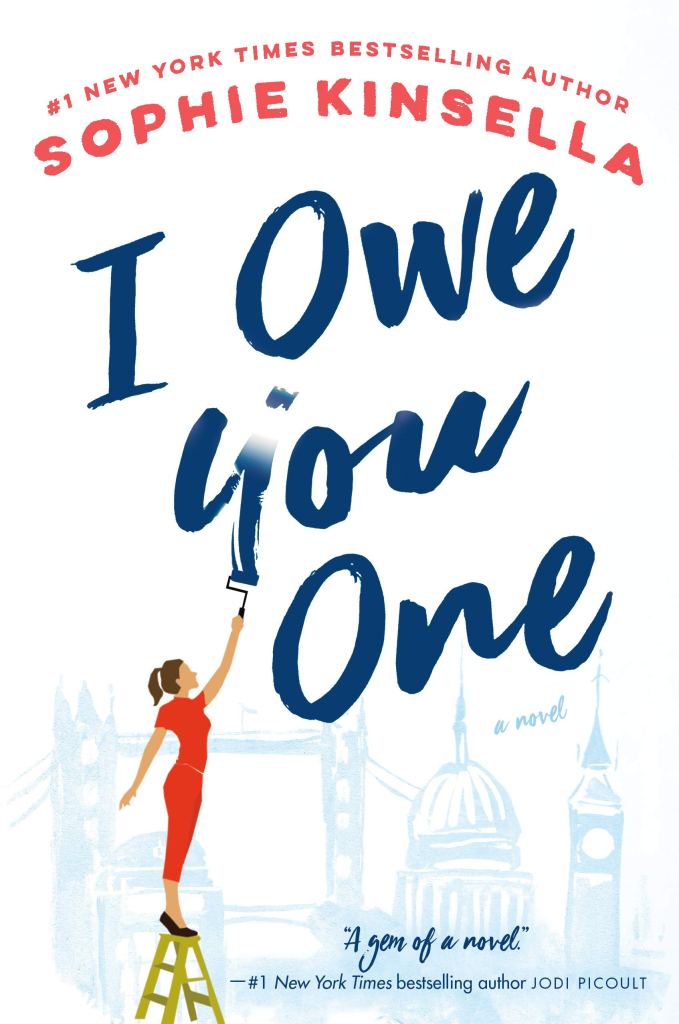
I Owe You One by Sophie Kinsella is about a woman with a complicated family, a handsome guy, and an IOU that changes everything. Fixie Farr likes to fix things. That’s her nature, even if it means picking up the slack from her siblings instead of striking out on her own when running the family housewares store. Then one day at a coffee shop, a handsome stranger asks her to watch his laptop. Not only does she agree, but she also saves it from certain disaster. It turns out that the stranger – Sebastian – is an investment manager. He scribbles an IOU on a coffee sleeve and attaches his business card. Fixie would never claim that. Would she? And then, her childhood crush Ryan comes back in her life, and she tries to convince Sebastian to give him a job. As a result, Fixie and Sebastian pass a series of IOUs to each other. It gets to the point where she is torn between her family and the life she wants to live. Will she take a stand and grab the life and love she really wants?

Before going into this novel, the only thing that I knew was that the author Sophie Kinsella had written Confessions of a Shopaholic. I never read that book, but from what I’m reading so far, I get the feeling that she likes to write quirky female protagonists with a “fatal” flaw. There’s nothing wrong with that; it’s only something that I’ve noticed.

In fact, I’m enjoying the light read so far. I like Fixie and her OCD-like tendency to fix everything in sight even though she’s a hot mess. I want her to think of herself more, especially when other people like her self-centered siblings Jake and Nicole walk all over her. It feels like a Cinderella story, but with a less than perfect main character. But then again, one can say that a lot of romance and chick-lit are basically Cinderella tales. I look forward to seeing if Fixie gets to live the life and have the love that she really wants.

Now let’s go a little darker for our second title…

The Suspect by Fiona Barton is the third installment of the Kate Waters series. After two teenagers disappear during their gap year in Thailand, their families are thrown into the international spotlight. As a reporter, Kate Waters tries to get to the story first. As she digs into it more, the more she thinks of her son who’s been traveling for the last two years. All will soon discover that no matter how far away they are, danger can lie closer to home than one might think.

Those who’ve followed this website long enough will be familiar with the running gag of me making fun of Fiona Barton’s titles to her novel. This is no exception as this one is the most basic. However, the more I read it, the more clear it is of who the suspect is, so I’ll give credit to her for making the title personal as well as more specific than I initially thought.

I’ve also mentioned how predictable Barton’s work has been in the past, and this novel is no different. I figured out who the suspect was within the first audiobook disc.

Speaking of the audiobook, I’m listening to that right now. Susan Duerden – an actress who’s best known for playing Carole Littleton on Lost and has recorded many books on tape – plays Waters. Mandy Williams previously narrated as her, so I’m confused as to why the role was recast. She did a great job portraying her with determination and empathy in The Widow and The Child, whereas Duerden feels little more tired, but maybe that’s to signify how much Kate has aged. I really don’t know.

Fiona Hardingham takes on the role of Alex – one of the missing teenagers. She had previously acted in roles such as a News Anchor in Godzilla: King of the Monsters and an Arrival Video Narrator in Pokemon Detective Pikachu as well as narrated several other audiobooks. I like how she strikes a balance between a juvenile and a mature voice for a teenager who plans so much in advance, and yet everything goes wrong the moment she and her friend land in Thailand. Too bad there’s not a whole lot for Hardingham to do beside read Alex’s Facebook posts.

Katharine Lee McEwan is back and plays Leslie – Alex’s mother. She’s fine, but it’s similar role to Angela in The Child. To be fair, Leslie and Angela are similar characters as both are heartbroken for their missing children.

Another actor who’s back is Nicholas Guy Smith, and he voices Detective Bob Sparkes. It’s nice to hear Smith inject frustration and sadness into Sparkes since that character hasn’t been really been present since The Widow. In this book, Sparkes’s wife is going through chemotherapy while he helps Kate with the investigation whenever he can. I hope he has more to do, so I can listen to Smith’s voice more.

And now, let’s go to the third and final book of this latest installment…

Miracle Creek by Angie Kim follows a murder trial after a hyperbaric chamber in a small town in Virginia explodes and kills two people including an autistic child. A showdown unfolds among various characters who may or may not be keeping secrets in regards to what happened.

I just started this novel a few days ago, and it got me hooked right from the start. The moment where the author describes the explosion and how the characters Young Yoo and her daughter Mary witness it shook me. I’m looking forward to seeing how the rest of the trial pans out and who the culprit is.

We have now come to the end of the seventeenth chapter of “What Am I Reading?”

Subscribe below to get notified when I post new updates. Also feel free to email me here for any review suggestions, ideas, or new titles!

Where the Crawdads Sing Book Review

I did it! After nearly two years of putting it aside, I finally read Where the Crawdads Sing by Delia Owens!!!! The book had been on the New York Times Best Sellers list for over 100 weeks! Yes, you heard right, OVER 100 WEEKS! It’s like “Old Town Road” but in book form because of how long it’s been on the charts. Enough of that digression, people who view this website will probably want to know if the novel was worth the hype. Well readers, it was to a certain degree.

Now, I know that a lot of readers have already checked out this book, so I will give a very brief summary of it. Here it goes: a woman named Kya who lives alone in the marsh in mid-twentieth century North Carolina becomes a suspect in a murder case, but she is not what the villagers say.

To understand the hype around this novel, one must have at least some understanding of why it became and remained popular. Regular readers as well as the New York Times have articulated that it appeals to a whole range of people. For those who like murder-mysteries, there’s that as the main story. For those who love nature, Owens – a retired biologist – provides exquisite descriptions of the marsh and the surrounding area that makes one feel that they are right there with Kya. There’s also romance, for Kya has relationships with two boys from the nearby village. And so and so forth. 

I would also like to add that us readers like checking  out books that involve girls and women in awful situations and seeing how they get out of them. Some of the bestsellers within the last 10 years have titles like The Girl on the Train and The Woman in the Window. We even read these kinds of stories in fairy tales. But at the end of the day, it’s a coming of age story that a lot of people like me identify with, specifically how an “outsider” comes to understand the world around them. 

In other words, I find the hype more fascinating than the book itself, BUT that doesn’t mean I disliked the book. I liked it actually. I enjoyed witnessing Kya’s journey to how she learns to understand the world around her with all of its ups and downs. I also found her to be believable in what she does even if I didn’t always agree with them. In addition, I liked how the novel is more focused on how Kya handles situations as opposed to simply saying, “Poor Kya” (though it gets dangerously close when it discusses her time at school). 

And let’s talk about that ending. I know some readers didn’t see it coming, but I sadly knew ahead of time that others were disappointed by it. I found it sort of predictable because of how Kya watches the female fireflies and how she reacts when the police initially come to arrest her.

Cassandra Campbell reads Where the Crawdads Sing. As I was doing research for this review, I realized that she narrated two books that I enjoyed and also dealt with women being in horrible situations. They were Small Great Things by Jodi Picoult and Lilac Girls by Martha Hall Kelly. In the former, she voices Kennedy McQuarrie – the protagonist’s public defender – with a Julia Roberts-playing-Erin-Brockovich flair, which was perfect for that story. With the latter, I discussed her very good vocal performance on this website. Also, Campbell has narrated a wide variety of books from The Immortal Life of Henrietta Lacks to the Llama Llama series. She’s like the Renaissance woman of audiobooks. This is all a long way to say that her performance was mostly positive for me. She does a great job bringing the descriptions, especially of the marsh, to life, and I felt a lot of emotions while listening to Kya’s journey. However, most of the men and women sounded very similar with the same vague Southern accent. It also didn’t help that Campbell makes Kya sound too juvenile once the protagonist evolves into an adult. While it was a good performance, I was a little disappointed once I discovered the narrator’s credentials.

All in all, even though I’m more fascinated with the hype surrounding Where the Crawdads Sing by Delia Owens, I still like the book. It certainly grabbed my attention with wonderful nature descriptions and an interesting journey for Kya that allows readers to see what she is going to do. I’m sure that people who read these reviews have already read this novel, but if one hasn’t, I would recommend it for all of the reasons listed.

Subscribe below to get notified when I post new updates. Also feel free to email me here for any review suggestions, ideas, or new titles!

What Am I Reading – Chapter Sixteen

Hi Everybody,

I hope all of my American readers had a great 4th of July! I know I did with some water sliding, fireworks, and three rounds of desserts!

Since the last chapter, I actually finished two books – the ones from Chapter 14. I will also be done with Legends of the Fall by Jim Harrison and Rolls-Royce Motor Cars: Making a Legend by Simon Van Booy and Harvey Briggs very very soon.

By the next chapter of this series, I will have a nearly new batch of titles including this one:

Love, Pride, Virtue, and Fate by Bharat Krishnan is a collection of 25 tales in Hindu mythology that explores the traits mentioned in the title.

The author strives to make connections between these stories to those in other mythologies. For example, much like the Greek gods taking sides in the Trojan War in “The Iliad,” the Hindu ones fought alongside both the Pandavas and Kauravas during the Kurukshetra War in the epic poem “Mahabharata.”

As someone who knows very little about Hinduism, I find the book very accessible so far. Most of the tales are no more than 5 pages long, and the language feels elevated while also believable, as in anyone from the present day would say them, hence making them timeless. Each of the stories always end with Krishnan explaining why he included it in the collection. This is easily my favorite part because of not only how he connects these to those in other mythologies, especially the Christian one, but also because he thoughtfully explains how each of them reflect a part of the Hinduism mentality and its values.

My favorite tale so far is the one that involves Shiva – the Hindu god of destruction – cutting off the head of his son Ganesha after the latter prevents entry to the former. It didn’t help that the former didn’t know that he had a son. As a result, his wife the goddess Parvathi refuses to speak to him until he finds their son. Luckily, Shiva is able to find an elephant and place that on Ganesha’s head, and makes him the remover of obstacles.

Occasionally, Krishnan will mention some thing politics-related due to his experiences in that field, but he does it in a way that doesn’t distract the reader from the overall themes.

I look forward to reading more of this title!

We have now come to the end of the sixteenth chapter of “What Am I Reading?”

For any Hindu readers out there, have fun with Puri Ratha Yatra and Guru Purnima!!

Subscribe below to get notified when I post new updates. Also feel free to email me here for any review suggestions, ideas, or new titles!

The Curious Charms of Arthur Pepper Book Review

For nearly two years, I’ve read a few curmudgeon novels, and they tend to follow similar patterns. They’re usually about a stubborn person who has a certain way of living. Then, they go on a journey (physically and emotionally) to discover more about themselves and that they grow to appreciate the people around them, thus resulting in them opening up. The Curious Charms of Arthur Pepper by Phaedra Patrick fits into this category like a bracelet on a wrist. Despite some flaws, it stands out in a couple of ways.

In The Curious Charms of Arthur Pepper, the 69-year-old title character has a strict routine, which involves getting up at 7:30am, wearing the same pair of pants and vest, watering his plant named Frederica, and gardening. On the one-year anniversary of Miriam’s – his wife – death, he discovers a charm bracelet that he’s never seen before. Each of the charms tells a different story of her life before she met him. To feed his curiosity, Arthur goes on a journey to various places like London, Paris, and even India to find out his wife’s past life, and in the process, he discovers hope, healing, and more about himself.

The other curmudgeon novels that I’ve read in the past were A Man Called Ove by Fredrik Backman and Eleanor Oliphant is Completely Fine by Gail Honeyman. At first, I wondered how The Curious Charms of Arthur Pepper was going to stand out. Luckily, unlike the titular characters of those two books, Arthur is a parent who spent a lot of time traveling for work. This made him emotionally distant from his two now adult children and not being attentive to his wife’s needs. I like how the novel shows the consequences of behaving this way and how it affects his kids, especially his daughter Lucy. 

Another thing that makes Arthur Pepper stand out from this bunch is the lighter tone. While both A Man Called Ove and Eleanor Oliphant can be quirky and fun at times, they are both balanced by a consistent dark tone. In the example of the former, Ove’s tragic backstory is revealed through stream-of-consciousness and how it resulted in him not trusting people. He also tries to end his own life multiple times. In the case of the latter, Eleanor struggles to come to terms with what happened during her childhood. Besides one scene where the main character tries to take his own life, Arthur Pepper is much peppier because he doesn’t have as much baggage as the other curmudgeons. This is good for readers who want something light.

Also, some of the characters that Arthur meets along the way are pretty colorful. These include his seemingly obnoxious, but caring neighbor Bernadette, the tiger loving Lord Graystock, and Mike – a caring homeless man. While these characters were memorable, they all seem to follow a pattern. Arthur meets or stumbles upon them, and they reveal their backstories before telling him how they know of the charm that he has questions about. After a while, it starts to get predictable, and don’t get me started on how inconceivable some of these situations are and how willing these people are to tell their stories. For example, when trying to get into Lord Graystock’s house, Arthur climbs over the fence and almost gets mauled by a tiger. If someone did that onto my property, I would be more likely to call the cops then tell them my backstory. The only time that someone was reluctant to tell Arthur their story about one of the charms was when Sonny Yardley initially refused to speak about Miriam, even when he came to the college that she worked at. She was this way because of a family tragedy that involved Miriam decades ago, and this was the only part that truly stuck with me because of this conflict.

I’m also convinced that Patrick was watching the Nudge, Nudge sketch from Monty Python when she was writing the scene, in which a random guy approaches Arthur in a café to discuss which girl he should marry. I couldn’t take this scene as seriously as the author wanted me to because I added “Nudge, nudge” every time the stranger talked. After the coyness went away and the man explained his dilemma, it began to feel realistic again. This was when I was pulled back into the story.

I listened to the audiobook, which is narrated by James Langton. I understand that readers who listened to the audiobook loved his narrations, and I can see why. He has a refined English voice that definitely carries the story. Since the book mostly takes place in York, England, he does a good Yorkshire accent for the male characters with enough differences to make each character distinct. However, the flaw with his voicing is with most of the female characters. They all sound dangerously close to Eric Idle impersonating a Yorkshire grandmother. I tolerated this when Langton voiced older women like Bernadette, but not younger ones like Lucy, even when he delivers the right emotions for them. And I can’t quite put my finger on it, but his French accent for Sylvie was off. I really want to enjoy his performance, but how he voiced most of the women really threw me off.

All in all, The Curious Charms of Arthur Pepper by Phaedra Patrick is a light curmudgeon novel that stands out from the other titles in that category. Along with the tone, the main character is a parent, which adds a dimension to this subgenre. Yes, it does have its issues, but if readers are willing to suspend their disbelief, they’ll enjoy it more. I recommend this book to those who like this particular type of novel, those who enjoy reading about self-discovery, and those who simply want a light read. It’s available in regular and large print and as an audiobook; one can also find it on Hoopla and Overdrive/Libby.

Subscribe below to get notified when I post new updates. Also feel free to email me here for any review suggestions, ideas, or new titles!
What Am I Reading – Chapter Fifteen

Hello Everybody!!!

I hope everybody had great Flag and Juneteenth Days! I sure did!

I’m currently reading four titles right now – the two I introduced in Chapter 14 as well as Legends of the Fall by Jim Harrison and Rolls-Royce Motor Cars: Making a Legend by Simon Van Booy and Harvey Briggs. So the most logical thing to do was add another book to that list.

And, here it is!

Confessions of a Bad, Ugly Singer by Collette McLafferty details a two-year period, in which the author had to go through the legal system. In April 2014, McLafferty was playing a P!NK cover band when she found herself named in a 112-page complaint. The person who sued was a personal injury lawyer, played drums for Michael Bolton, and had a dispute with the band leader claiming he stole the lawyer’s idea to form the first P!NK cover band in Long Island. Oh, and he was suing them for $10,000,000. Knowing that she was going to be involved for years to come, she took her case to the press. She made a call to The New York Post in hopes of leaving a message. However, she later discovered the headline “Singer Sued for Being Too Old and Too Ugly for P!NK Cover band” in the paper. he sensationalized headline told a story of a singer who was so “old, ugly and untalented” that her one-night performance prompted the lawyer to sue. This version of the events went viral worldwide and threatened to put an end to her 20-year professional history in the music business. The headlines alleged she “ruined” the P!NK cover band with her inferior looks and singing, triggering a deep depression. Determined to find justice, McLafferty fought the case and eventually introduced “Collette’s Law” with the help of The Lawsuit Reform Alliance of New York and Assemblyman Luis Sepulveda.

Much like everyone else reading this, I was shocked to learn that this actually happened. All of what went down felt too strange to be true, but as the saying goes, truth is stranger than fiction.

What makes the book interesting so far is that McLafferty writes what occurred several years after the fact. This allows her to process all of the events in the most objective way possible. Heck, she makes jokes about certain people and moments. That’s how one knows someone has moved from a tragedy. I can’t wait to read more of it!

We have now come to the end of the fifteenth chapter of “What Am I Reading?”

Subscribe below to get notified when I post new updates. Also feel free to email me here for any review suggestions, ideas, or new titles!

A Polar Bear in Love Manga Series Review

As a person who has watched anime in the past, it never occurred to me to read a manga, especially since a lot of those shows are based off of those Japanese graphic novels. Recently, I read my very first manga series, A Polar Bear in Love by Koromo, and it’s a cute story that’s great for beginner readers, but it’s best to take it with a grain of salt.

A Polar Bear in Love manga series is about Seal – a lost baby harp seal – who finds himself in the company of Polar Bear. Instead of eating it (like most polar bears would), the latter falls madly in love with the former. However, the fearful seal constantly misinterprets the polar bear’s romantic advances as a strong desire to eat him. 

This is the main premise and the story for the first volume. The second one deals with them encountering rivals to each other’s affections like another polar bear and an adult female harp seal. The third introduces Kathy the penguin, who counsels Polar Bear and Seal on their relationship, and her “boyfriend” Orca. In the fourth and so far last one, Seal finally learns how to swim, but Polar Bear isn’t ready to say good-bye to him just yet. Orca also tells Polar Bear his own love story.

All of the volumes are a super quick read with super cute visual moments like when Polar Bear encounters Seal for the first time and the latter rapping about his gender (I know that’s weird, but in the world of cartoons, it could be more off-kilter). The black and white designs are very simple, but so expressive like all the times Polar Bear having a blank stare on his face and Seal fearing for his life. The only complaint is that there are times, in which I could not figure out who was talking, because I wasn’t sure where the bubble was pointing at. Nevertheless, the series is a great comforting contrast to something dark like Vita Nostra. 

Another thing that I like about this manga is that the main romance is between two different species of the same gender. At first, Seal is concerned about this, but Polar Bear doesn’t mind because love is love regardless of whom one falls in love with. This is a very positive message, especially for those who are still exploring who they are and who they love.

Apart from the main characters, the supporting ones stand out too. Kathy the penguin, who is actually male, acts as a romance counselor for Polar Bear and Seal. She is head over heels for her “boyfriend” Orca, whom she calls sweetie. I only put boyfriend in quotation marks because he doesn’t feel the same way about her. He’s like Squidward, for he can be grumpy and relatable.

After I read the first volume, I looked at the reviews, and two common themes emerged: how creepy Polar Bear was in trying to get Seal to love him back and how the former didn’t understand how terrified the latter was. The whole series is about a predator falling in love with its prey, so understandably, Seal is terrified.

I’m going to be honest and say that I really didn’t pick up on the problematic elements of the plot when reading the first volume because I was so infatuated with its cuteness. Knowing this now, yes, I can see where people are coming from. During the first volume, Seal struggles to voice his concerns against Polar Bear. Luckily, during the second one, Seal speaks up more, and Polar Bear gets the hints more as they encounter rivals to each other’s affections. In the following volumes, Seal continues to speak up, but it seems like no one’s listening to him. Even in the fourth one, Orca asks Polar Bear if he has ever considered Seal’s feelings. But because the former is depicted as a grouch for a good chunk of it, it seems that readers are supposed to root for the latter.

The best way that I can describe this is like the song Boy in Luv by BTS, which is about a teenage boy falling in love externally (especially in the music video, in which the members show their affections towards a girl in forceful manners). If English readers are able to read Volume 5, I hope that Polar Bear considers Seal’s feelings more, and maybe his love for him would become more internal like how BTS’s Boy With Luv is. In a way, the series wants readers to think that his love is internal, but he fell in love with Seal after he spotted his white baby fur. I hope that Polar Bear will still be able to love Seal when the latter sheds his baby fur. In other words, the title may be A Polar Bear in Love, but the series would be more worth it if it evolved into A Polar Bear With Love.

All in all, A Polar Bear in Love by Koromo is a cute shoujo manga series (ones that aim at young female teens) that explores how love is love is love. The characters are memorable, and the designs are simple and effective while telling the story. It’s best to take the plot with a grain of salt as it’s still a continuing series. I hope the fifth volume comes out soon, but I’m not sure when that will happen. If one feels highly uncomfortable with it, then they have every right not to read it. For those who want to, I recommend it to those who love shoujo mangas and arctic/antarctic animals as well as those looking to get into the genre. It’s great for beginner manga readers.