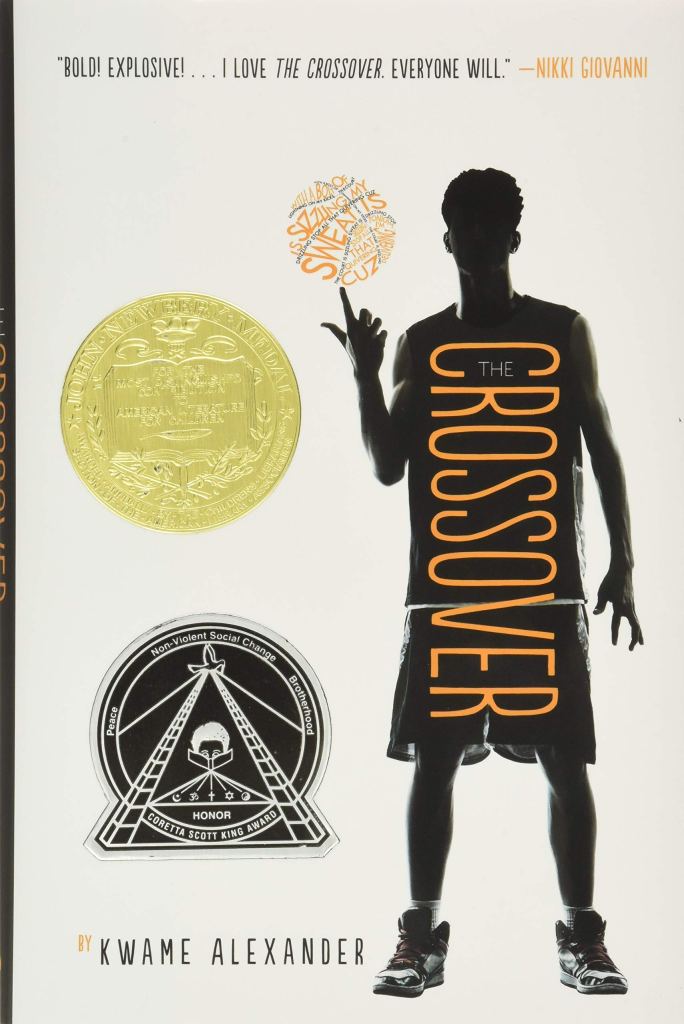
As a Children’s Librarian, one of the tasks that I have to do every year is host Battle of the Books for 5th graders. For 2022, The Crossover by Kwame Alexander was one of the titles that we picked for a multitude of reasons. It won the Newbery Medal in 2015, and it’s the only one of the batch that’s written in verse. Additionally, Disney+ will produce a series based on the novel. I can easily see why; it’s fun, honest, and heartbreaking.
The Crossover tells the story of Josh and Jordan (aka JB) Bell – twin 13-year-olds who love playing basketball and excel at it too. But once JB falls in love with the new girl at school, Josh can’t help but feel left out, and their bond starts to unravel. The twins must come to terms with growing up on and off the court. This is especially true when they realize that breaking the rules comes at a price.
I was hooked on the first page. Josh and JB act like real brothers. They play basketball, but they have their differences. Josh, who goes by the nickname Filthy McNasty on the court, loves his dreads, English, and language. He is a good dunker too, but he sometimes thinks that the world revolves around him. JB has a bald head, and he loves to place bets. He’s also good at free throws. In addition, how they interact once their bond starts unraveling feels real. Josh tries to tell JB that he’s sorry only to be given the cold shoulder many times. How they make up feels natural without being overly sentimental. I also love the supporting characters like Chuck – their dad. He’s a former basketball player who loves jazz, especially Horace Silver, but he has some health issues that the brothers have different reactions to when things take a turn for the worse.
As I mentioned before, the book is told in verse. Not all of it is in rhyme, which may appeal to those might not like poetry for that reason. Additionally, the poems themselves have a wonderful flow to them. The ways that they are written, especially when Josh tells readers his play-by-plays on the court, are how they should be spoken, and they are a blast to read out loud! I would love to see how those sections are translated in the show.
Other aspects that makes the book unique is the way that it includes basketball lessons and definitions of various words (I assume these words are part of the vocabulary test that Josh and JB have to take). Every now and then, a lesson will show up in the book, but it’s not slapdash. They’re strategically placed at certain moments to reflect the plot at that time. For instance, when Josh is feeling down about all that’s going on around him, including JB not speaking to him, he relays this basketball lesson: “Rebounding/is the art/of anticipating,/of always being prepared/to grab it./But you can’t/drop the ball.”
As for the definitions, Josh would define a word, and then put it into various sentences, including one that ties into the story at that particular moment. For example, Josh describes hypertension – the illness the dad has – including how to pronounce it. He then puts it into a variety of examples, including “As in: I think/my grandfather/died of hypertension?”
It can be sugar coated in some places; that’s only because the mom doesn’t want the twins to worry too much about their dad. What is revealed about their dad’s failing health is handled in genuine ways. When the dad goes into a coma after playing some one-on-one with Josh, Josh goes into the “what if this happened instead” mode as he blames himself for stressing his father out too much.
All in all, The Crossover by Kwame Alexander is an excellent book that anybody from a tween to an adult can enjoy. Its characters and their relationships are highly believable, and despite their flaws, readers can still root for them. Also, did I mention this is in non-rhyming verse? I would recommend this title to those who love sports, especially the obvious; coming of age stories; and reading about siblings. I can’t wait to see how it does as a series on Disney+.
Subscribe below to get notified when I post new updates. Also feel free to email me here for any review suggestions, ideas, or new titles!
I hope everyone’s having a great Valentine’s Day! I sure am!
I have a new book to show you all. Sadly, it’s not a romantic book, but it’s very interesting.
Win by Harlan Coben is the first book in the Windsor Horne Lockwood III series. Over 20 years ago, Patricia Lockwood was kidnapped during a robbery of her family’s estate. For many months, she was locked up in an isolated cabin. She managed to escape, but so did her captors, and the stolen items were never recovered. In the present day on the Upper West Side, a recluse is found dead in his penthouse apartment, alongside two objects of note: a stolen Vermeer painting and a leather suitcase bearing the initials WHLIII. Now, the police have a lead on not one, but two cases – Patricia’s kidnapping and a FBI cold case. Windsor Horne Lockwood III or Win doesn’t know how those items ended up there. However, his interest increases when the FBI tells him that the man who kidnapped his cousin was also behind an act of domestic terrorism – and that the conspirators may still be at large. The two cases have baffled the FBI for decades, but Win has three things the FBI doesn’t: a personal connection to the case; an ungodly fortune; and his own unique brand of justice.
So far, the mystery/suspense aspects of this novel feel typical, but what makes it stand out is Win himself. Win tells readers right away that he’s very rich, and he’s not afraid to flaunt it. Some might like him because of his quick wit and how he executes his version of justice. Others might not like him as much because of how arrogant he can be and how he insults almost everyone that comes in contact with him (even if they deserve it). For me, Win is like what would’ve happened if Groucho Marx got reincarnated into Aaron Eckhart’s body, was extremely rich, and became aware of the pop culture happenings of the last 50 years. So yes, I’m enjoying this from that point of view.
I’m listening to the audiobook right now, and it’s narrated by Steven Weber. Weber is best known for roles like Brian Hackett on Wings and Jack Torrance in the TV miniseries version of The Shining. He’s also recorded various audiobooks for authors like Stephen King and Harlan Coben. I’m not surprised that Coben likes having Weber narrate his books. Weber gives Win an effortless suave, confident manly voice. He’s also really good at distinguishing other characters even if they can come off as over the top. Sadie – Win’s assistant – is voiced with a no-nonsense feminist tone, but it’s doesn’t come off like a caricature. On the other hand, a drunk at a local bar is voiced like WC Fields’s less dignified drunk brother. That one sounded like as if Weber was recalling drunk people that he’d seen on TV as opposed to real life. Despite that, it’s still a good vocal performance that I look forward to hearing more of.
We have now come to the end of the twenty-seventh chapter of “What Am I Reading?”
Subscribe below to get notified when I post new updates. Also feel free to email me here for any review suggestions, ideas, or new titles!
Warning: This book review contains references to sexual assault.
Within the last two years, there’s been a call to reexamine how the United States views its racist past, slavery in particular. Many authors – mainly black – have published these kinds of narratives, especially within the last 50 years. They show up as both nonfiction and fiction, but as I’ve said on this website, the latter helps readers to better understand the feelings of the people involved in that point in history. With that being said, The Water Dancer by Ta-Nehisi Coates stands out from these kinds of stories through certain elements.
The Water Dancer is about a slave named Hiram Walker. When he was a boy, his mother was sold away, and he was robbed of all memory of her. However, he was gifted with a mysterious power. That same gift saves his life years later when he almost drowns in a river. This brush with death empowers him to perform a daring scheme: to run away from the only home he’s ever known. Hiram goes on an unexpected journey that takes him far and wide. Even as he’s enlisted in the underground war between slavers and the enslaved, Hiram’s resolve to rescue the family he left behind endures.
Every slave narrative includes some form of suffering to show how horrible it was to be a slave. A lesser book would try to have whippings and beatings up the wazoo, but that’s not much of the case here. Sure, the physical suffering is acknowledged, yet Coates focuses more on the emotional and mental kind. For example, Hiram grew up on a Virginia plantation called Lockless as the black son of the plantation’s owner. He spends a good chunk of the novel looking back on how he wanted to be loved by the only parent he had left. However, that could never happen simply because of the color of his skin. As a child, he was reminded that the people who raised him on the plantation like Thena were more like family than his biological one even when he spent days learning alongside his white half-brother Maynard.
Another thing that this book does well is that it focuses on the actions of its characters. In other words, it’s less poor Hiram and more what he’s going to do and how he’s going to accomplish it. For instance, when he is caught by Ryland’s Hounds – the slave catchers, he spends three weeks in their jail and goes through some horrendously awful things, including the white men touching him in places where they shouldn’t have. Hiram tries to keep his mind at blank while that kind of torture occurs, a similar tactic he used when his mother was taken away.
Coates uses terms like “Tasked” and “Quality” to further support the emphasis on the action. The “tasked” are the slaves since they are tasked to do things on the plantation, and the “Quality” are the masters in various capacities because they are able to live a quality life because of their skin color.
The supporting characters – both black and white – are pretty compelling. Sophia – Hiram’s love interest – is the special property of Nathanial Walker – Hiram’s uncle. When living on Lockless, Hiram has to take her to Nathanial’s plantation on the weekends, yet Sophia wants to be free as much as he wants to, especially after it’s revealed that Nathanial had raped her. At one point, she makes it very clear her yearning for her own agency when telling Hiram “But what you must get, is that for me to be yours, I must never be yours.”
Another supporting character that stood out was Corrine Quinn. On the surface, she is a refined white Southern lady who wears makeup and attends social gatherings like any other white person at that time would. But deep down, she’s an abolitionist who works for the Virginia Underground. Her plantation is a station for those who are a part of that organization. She’s highly intelligent, and contributes significantly. At the same time, she wants control and rules with zeal, much like other “Quality.” Hiram points this out to her at the end of the novel. Additionally, she and the other high-ranking members (both black and white) of the Virginia Underground don’t fully think through the obstacles that they put Hiram through. He calls them out on this as well.
In addition, unlike most historical fiction novels, I found it interesting that the book refuses to specify the time in which the events occurred. For a while I was trying to listen for clues, but besides one supporting character being a well-known name in the Underground and the mentionings of women wearing hoop skirts, I didn’t find anything that would clearly specify which years the story took place. However, the more I thought about it, the more I realized that I didn’t care. The point was that there was slavery, and some slaves were trying to escape, and Coates probably wanted to find a creative way that they could do that.
Now, readers will want me to talk about the magic realism part of the book, and so I will. This is the aspect that obviously stands out the most. It involves water as a conductor (ha, get it!) and memory to propel one to great distances. There’s a poignant part of the story, where Moses (who also goes by the name Harriet) demonstrates this power by conducting herself, her family, and Hiram to one of the Underground stations. It turns out that Hiram possesses that ability, but for him to travel far, he has to dive into (pun totally intended) his deep memories. This lays out the main conflict in the story. He’s great at remembering things like other people’s stories, yet he cannot remember his mother, and his most profound ones involve her.
If I have to complain about something in this novel, it’s that I couldn’t really connect to it. I know I’ve said that before, but I sincerely wanted to enjoy this novel. The more I like something, the more I remember it. And yet for some reason, I wasn’t able to do that a whole lot. Even after reading it over seven months ago, I had to remind myself of certain elements in the story. One reason was because as much as Coates’s writing is intelligent and detailed, he can go off into tangents at times, and it lost me at those points. Another reason was a personal one. I wasn’t really able to relate because my life experiences as a white woman are not as simliar as those of a mixed race man in slavery. Again, I like it; I wanted to enjoy it more.
However, what kept me going with the novel was the audiobook narration done by Joe Morton. Morton has appeared in movies like Terminator 2: Judgment Day and Speed. He even won an Emmy for his role as Eli Pope – Olivia’s father – on Scandal. He is no stranger to audiobooks as he has recorded over 20 of them, including that of Invisible Man by Ralph Ellison. His narration on this novel is pretty good. He makes clear distinctions among various black and white characters. Also, when he has to sing as Hiram, he gives it his all like his life depends on it, and it helps that he has a beautiful singing voice. In fact, he gives all of his characters life and a wide range of emotions, especially when Thena explains why she can’t go to her now freed daughter.
Overall, The Water Dancer by Ta-Nehisi Coates is a well-written book that stands out among its slave-centric stories. It utilizes the power of memory in a pretty creative way, and it contains compelling characters. Most importantly, it focuses more on their actions as opposed to their suffering. I would recommend this to those who like reading about slavery, fantasy, and books by Coates as well as to those who want to read more novels by authors of color. While I did like it, I’m sure there are more people who will connect to it more than I did, and there’s nothing wrong with that.
Subscribe below to get notified when I post new updates. Also feel free to email me here for any review suggestions, ideas, or new titles!
It’s been a few weeks since the last chapter, but I’ve been reading two new books that I’d love to share with you!
Let’s begin with our first title!
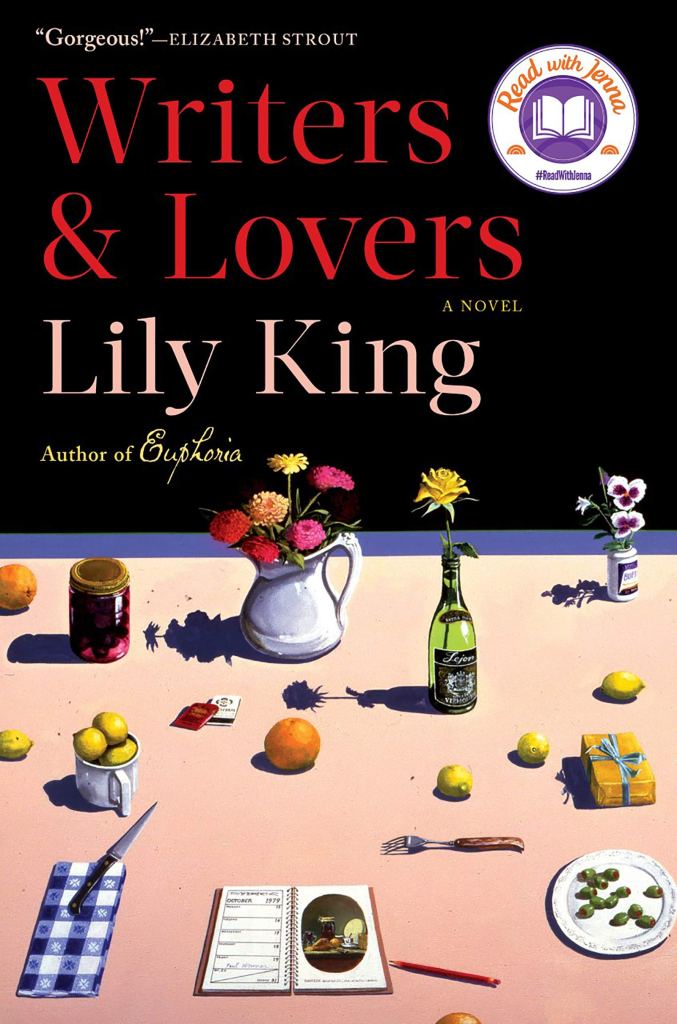
Writers & Lovers by Lily King is about Casey Peabody – a 31-year-old struggling writer. After the sudden death of her mother and end of her most recent relationship, Casey arrives in her home state of Massachusetts in the summer of 1997 without a plan. A former child golf prodigy, she now waits tables and rents a tiny, moldy room at the side of a garage while trying to pen a novel that she’s been working on for the last 6 years. At her age, Casey holds on to what her old friends have let go of: the determination to live a creative life. When she falls in love with two different men, her world falls apart even more. Casey’s fight to fulfill her creative ambitions and balance the conflicting demands of art and life is challenged in ways that push her to the brink.
So far, this is a compelling character study. Even though not much happens throughout a good chunk of the book, I find Casey to be an interesting character. At age 31, she’s still trying to figure things out, while everything falls apart around her. This explains why she’s stuck in a rut. I think some readers might be annoyed with her since she doesn’t do much. At the same time, she’s experiencing a big writer’s block, so it’s understandable why she’s incapable of doing a whole lot outside of work. Also, she can be snarky and cynical, but these are mainly defense mechanisms from getting too vulnerable with others.
Also, the two men that Casey falls in love with couldn’t be more opposite from one another. In one corner, Oscar is a successful author with two sons, and he adores her. In the other, Silas is of Casey’s age and is too trying to figure out life. However, he is full of mixed signals. This is especially apparent when he drives across the country on the day of what was supposed to be their first date. There would be a clear choice, but Oscar has been showing more of his true colors to Casey lately, and she’s not really liking it. I can’t wait to see what happens, even if she doesn’t end up with either of them.
I’ve been listening to the audiobook, which is narrated by Stacey Glemboski. Glemboski is a professional audiobook narrator who has recorded books from a variety of genres. In 2020, she was a Sovas finalist for Audiobook narration–fiction–best voiceover for this title, and I can see why. From the moment I heard Glemboski speak, I immediately imagined Casey being Charlize Theron in the movie “Young Adult.” This is very fitting since that movie also tackles with the struggles of trying to figure out one’s life while in their thirties. Additionally, this vocal performance provides Casey’s snarky and vulnerable sides effectively. As for the other characters, Glemboski does a fine job distinguishing among them like Harry – Casey’s gay friend from work – with a posh British accent, Oscar with a Pierce Brosnan charm without the dialect, and Silas with a slightly slower and rougher tone. I can see why Lily King recruited her again for the audiobook of her 2021 collection of short stories Five Tuesdays in Winter. Overall, it’s the strongest vocal performance I’ve heard in awhile.
And now, we’ve come to the second and final title in this chapter.
The War That Saved My Life by Kimberly Brubaker Bradley is about Ada – an eleven-year-old girl who lives with a clubfoot during World War 2. She has never left her family’s one-room apartment. Her mother is far too humiliated by Ada’s disability to let her outside. When her brother Jamie is shipped out to London to escape the war, Ada takes the chance and leaves too. The siblings end up with Susan Smith – a woman who initially didn’t want to have children, yet she takes them in anyway. As Ada teaches herself to ride a pony, learns to read, and watches for German spies, she begins to trust Susan, and Susan begins to love Ada and Jamie. But in the end, will their bond be enough to hold them together through wartime? Or will Ada and her brother fall back into the cruel hands of their mother?
This book is a 2016 Newbery Honor Book, and it’s easy to see why. Its protagonist is disabled, yet the novel only feels sorry for her when it needs to. For the rest of the time, it highlights what Ada does to become more independent and trusting of others. It also shows her as a flawed child. At times, I was frustrated by her because it was clear that the people around her wanted to help, but she would have none of it. However, I understood why she felt that way due to the trauma inflicted by her mother and the environment she lived in prior to residing with Susan.
I also want to point out that there are parts that can be tough to get through. For example, the scenes in the apartment can be intense. This is especially true when Ada uses rather cruel methods to keep Jamie in the apartment, and when their mother stuffs her in the cabinet. Fortunately, that’s mainly in the two chapters. In addition, there are moments, in which Ada has panic attacks. Luckily, from where I’m at in the story, it’s slowly getting better for her. I look forward to seeing what the outcome is.
We have now come to the end of the twenty-sixth chapter of “What Am I Reading?”
Subscribe below to get notified when I post new updates. Also feel free to email me here for any review suggestions, ideas, or new titles!
As a librarian and overall literary nerd, one of the things that I had to do in New Orleans was check out some bookshops to see what they had. My husband and I went into four unique antiquarian & second-hand bookstores. All of them were conveniently located in the French Quarter, which made it easy for us to locate them on foot. The photos used were ones that I took unless noted.
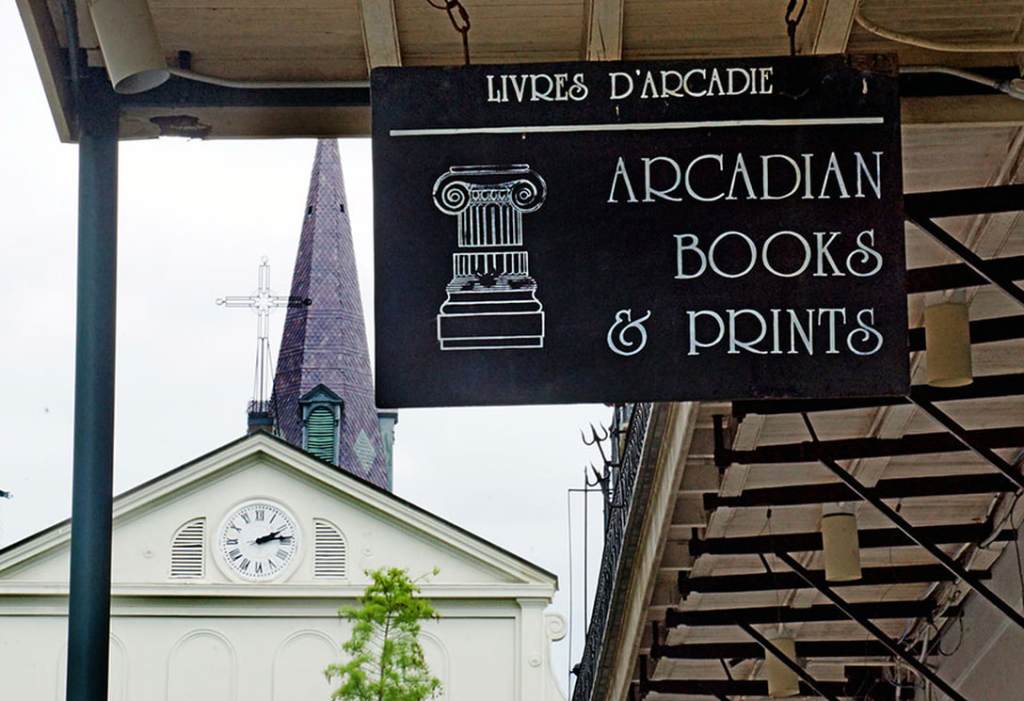
First up is Arcadian Books & Prints.
Photo Credit: Ellis Anderson for the French Quarter Journal
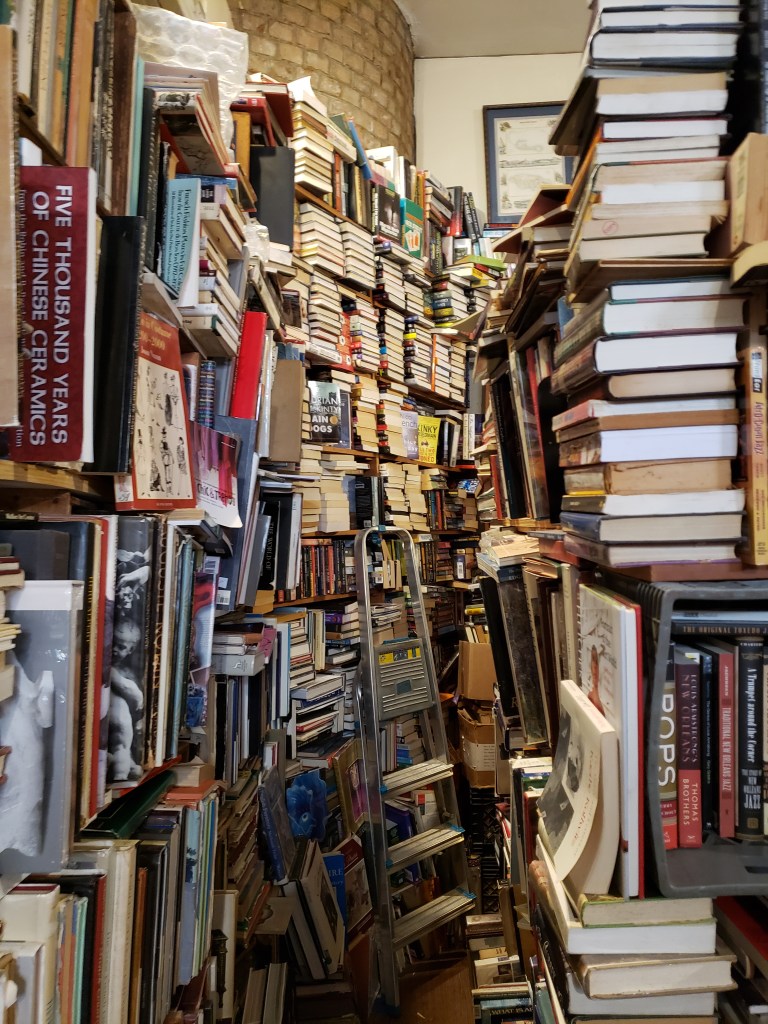
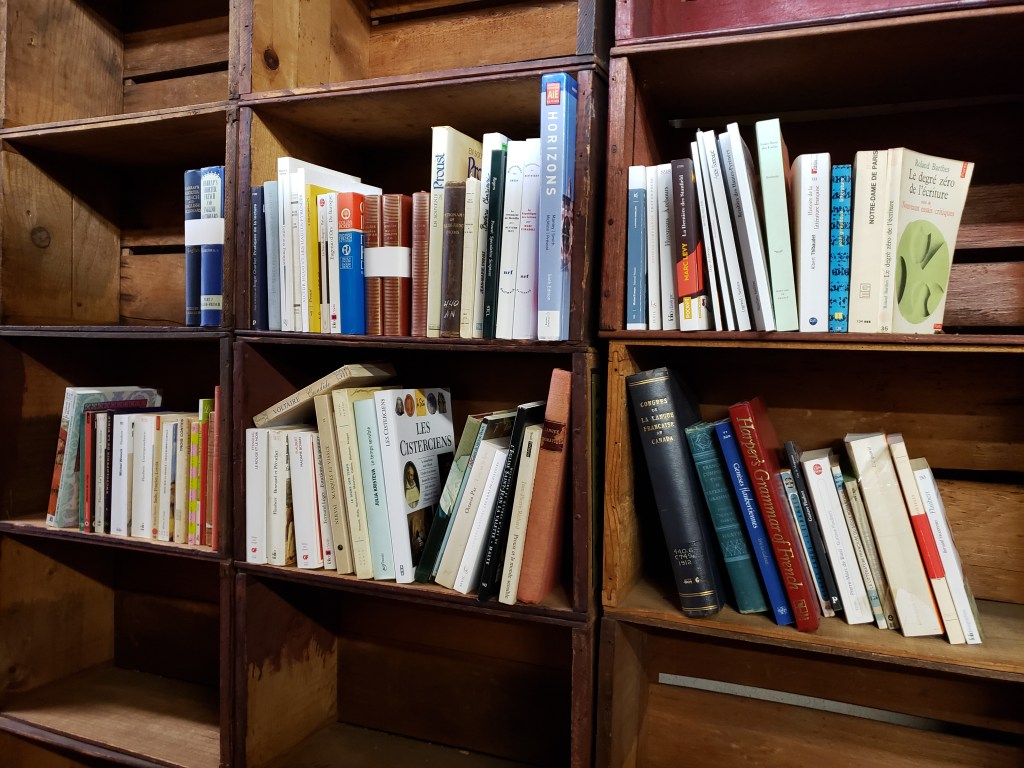
For over 40 years, Arcadian Books & Prints had offered a variety of items like DVDs; prints; and used books from a whole lot of genres, including some in French (hence its alternate name Livres D’Arcadie) and rare copies of select titles (like a Cold-War-era book that covered Russian Marxism).
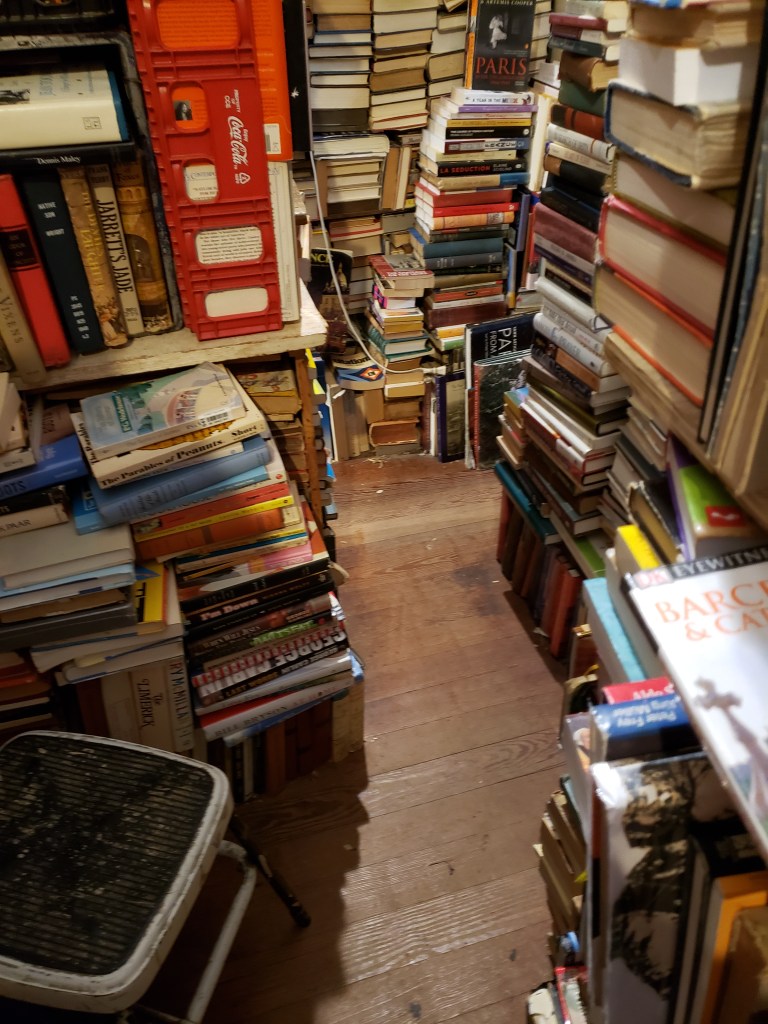
The shop has been described by the French Quarter Journal as “organized chaos,” and it’s easy to see why. All of the books are stacked on top of one another, yet they’re not always on the shelves.
There was a narrow walk space for us to use. This was fine for someone who’s small and skinny (like me). On the other hand, my husband had a tough time navigating the bookshop due to his height. He was cautious moving around because he didn’t want to bump his head on the shelves above. In fact, he mentioned that he felt like a bull in a china shop.
The bull in a china shop
Oh and I forgot, there was a fan hanging above. Knowing how hot summers can be down in the south, I’m sure customers are thankful to have that. Above the fan is, I kid you not, a shelf that acts like the Arc de Triomphe, or should I say the Arc de Livres. I’m not going to lie: I was worried that the shelf would collapse on us while we were there. Luckily, it didn’t since it was probably made from steel panels. These stood out in a store containing wooden shelves for the rest of the items.
While there, I bought Beautiful Crescent: A History of New Orleans by Joan B. Garvey and Mary Lou Widmer. From I understand, it’s a good overview of the history of the Crescent City. I can’t wait to read and review it.
Overall, Arcadian Books & Prints is a disorganized bibliophile’s dream as long as they are small and are comfortable in compact spaces (sorry, claustrophobic people.) They don’t have an official website, but if you want to find out more about them, you can call them at (504) 523-4138 for more details.
Our second bookstore is Beckham’s Bookshop!
Photo Credit: Bookstore Explorer
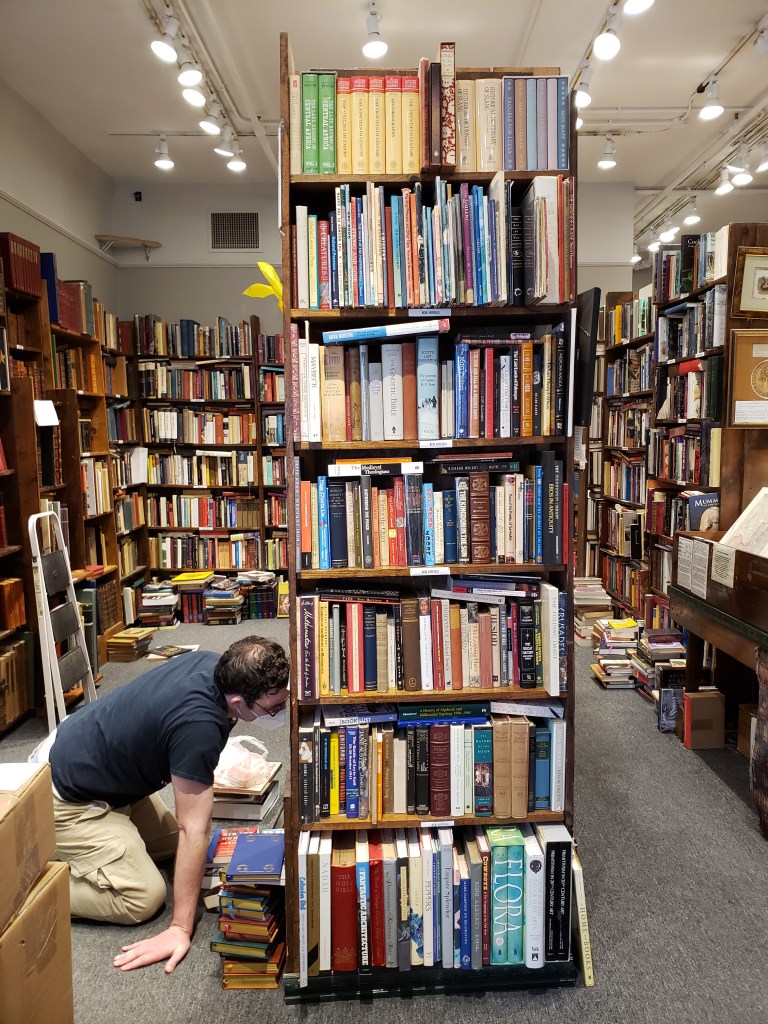
Beckham’s Bookshop is a second-hand bookstore that contains 50-60,000 titles on two floors. Those books cover any topic imaginable like food, movies, theater arts, and foreign languages. It has been open since 1967 and at its current location since 1979.
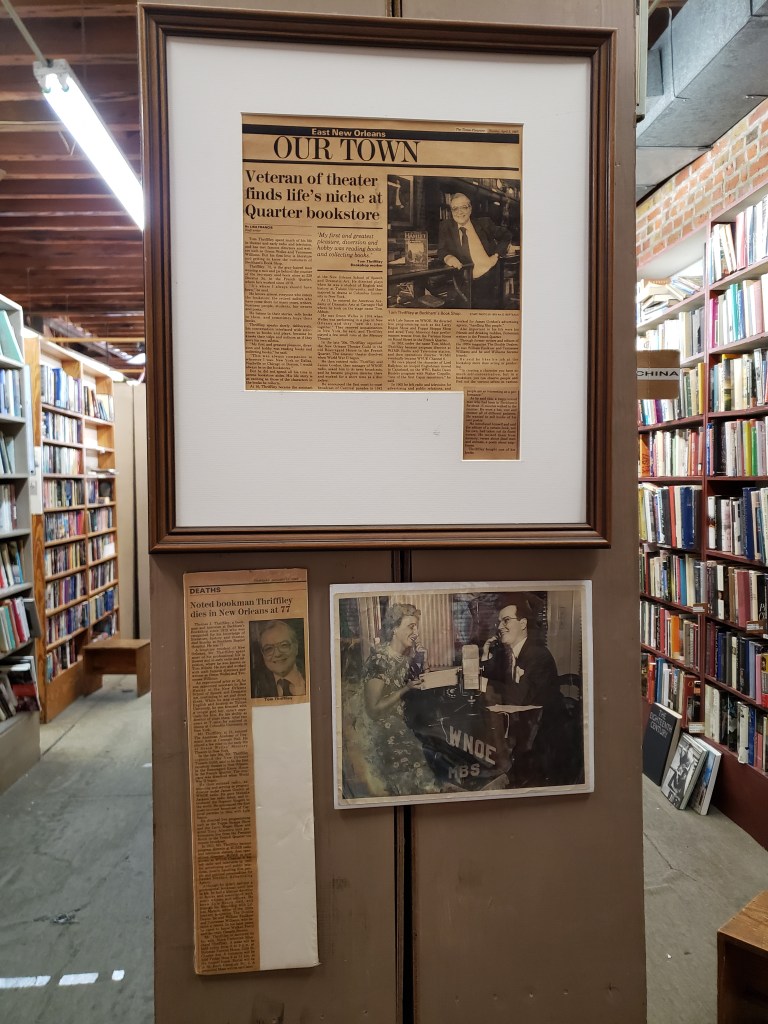
Various newspaper articles about the bookshop over the years grace several bookcase ends. This shows that the place is proud of it history, and as someone who has studied history and archival administration, this made me very happy.
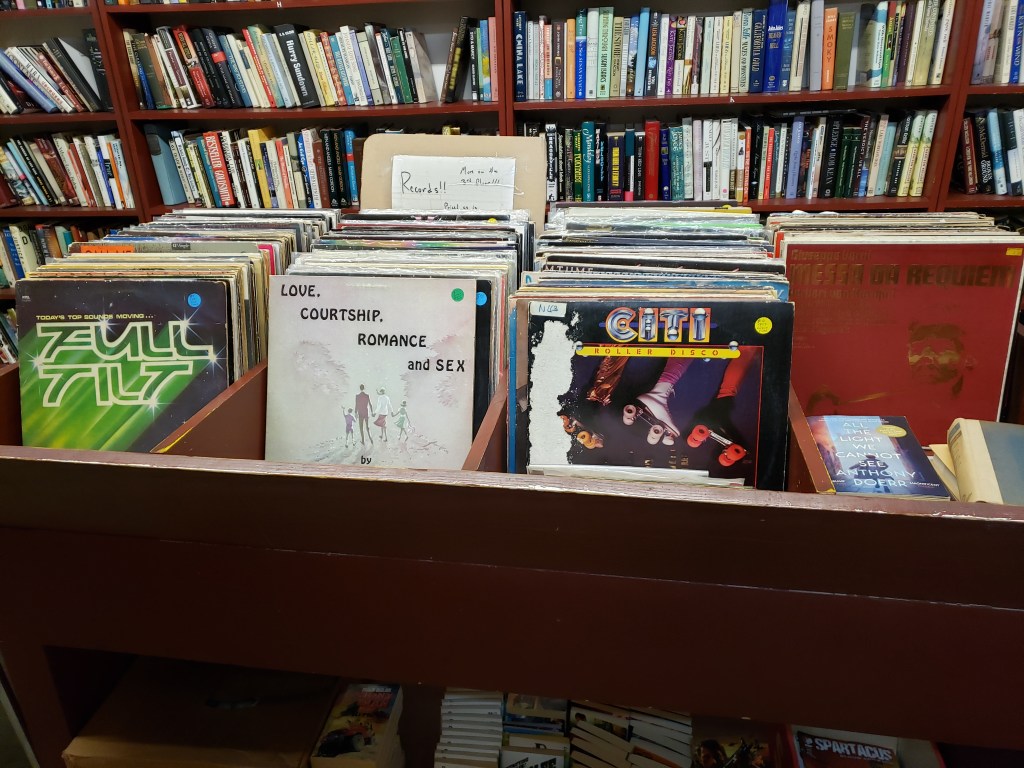
The bookstore also contains vinyls, but one can go up to the third floor to find more of the latter at Man Ray Records – a music shop that sells vinyls of various genres ranging from jazz to opera.
The vinyls at Beckham’s Bookshop
And last, but not least, Beckham’s has its own book cat named Juniper. Juniper is 13 years old and has been at the bookshop since he was a kitten. He was asleep during the time we were there, but I managed to pet him when he eventually woke up.
Isn’t Juniper so cute???
Beckham’s had wider walkways, so it was easy for us to roam around the store. There’s even chairs around for those who need to sit.
To access the second floor, a wooden staircase is located by the entrance. While there, people can look at even more books like these for the kids and young adults.
Overall, Beckham’s Bookshop is a bookstore that’s full of wonderful surprises and a rich history. It’s definitely for readers who like to read everything (like myself), music, and cats, but anybody can come in! To learn more about them, one can access their Facebook and Instagram pages!
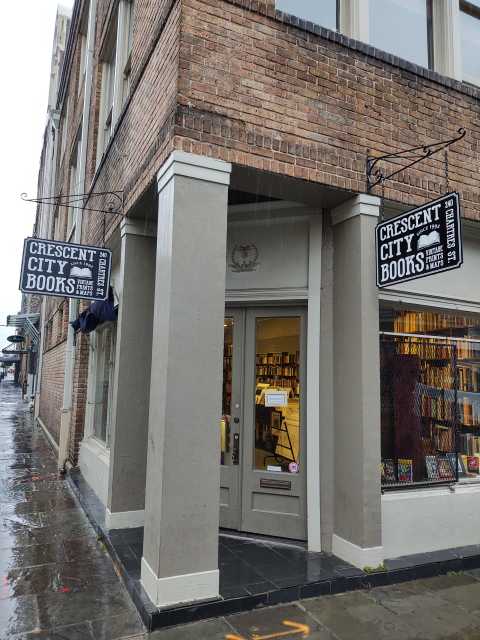
Now, let’s look at our third bookstore – Crescent City Books!
Photo Credit: Crescent City Books
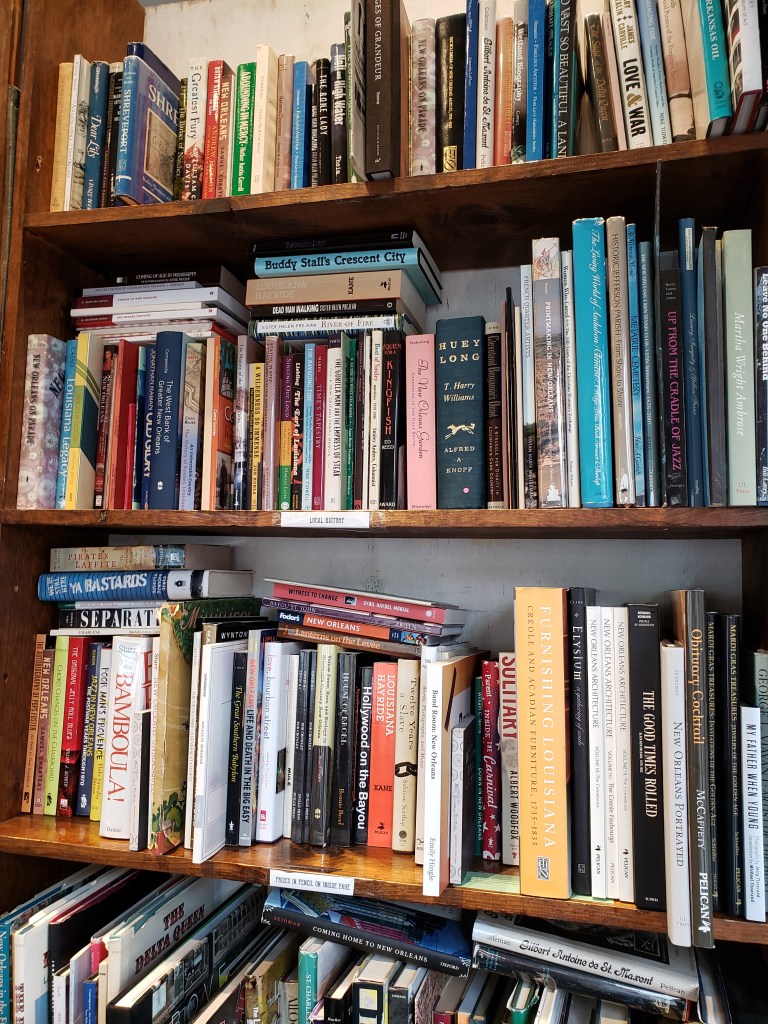
Started in 1992, Crescent City Books is another bookstore that offers a variety of books with an emphasis on local history.
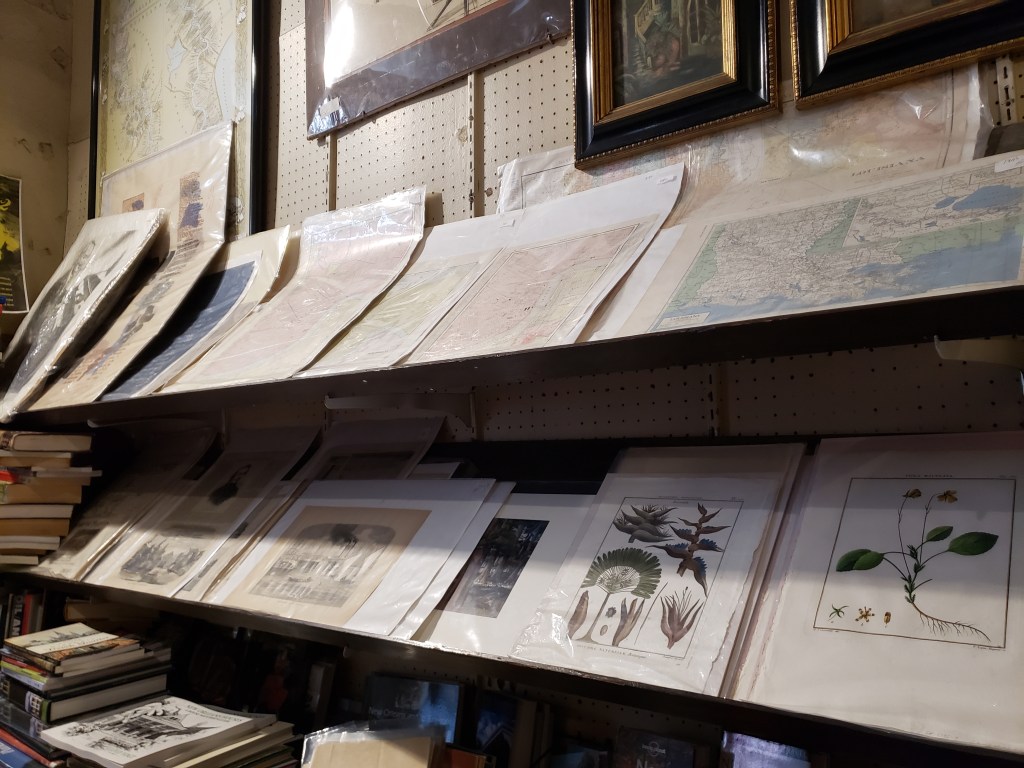
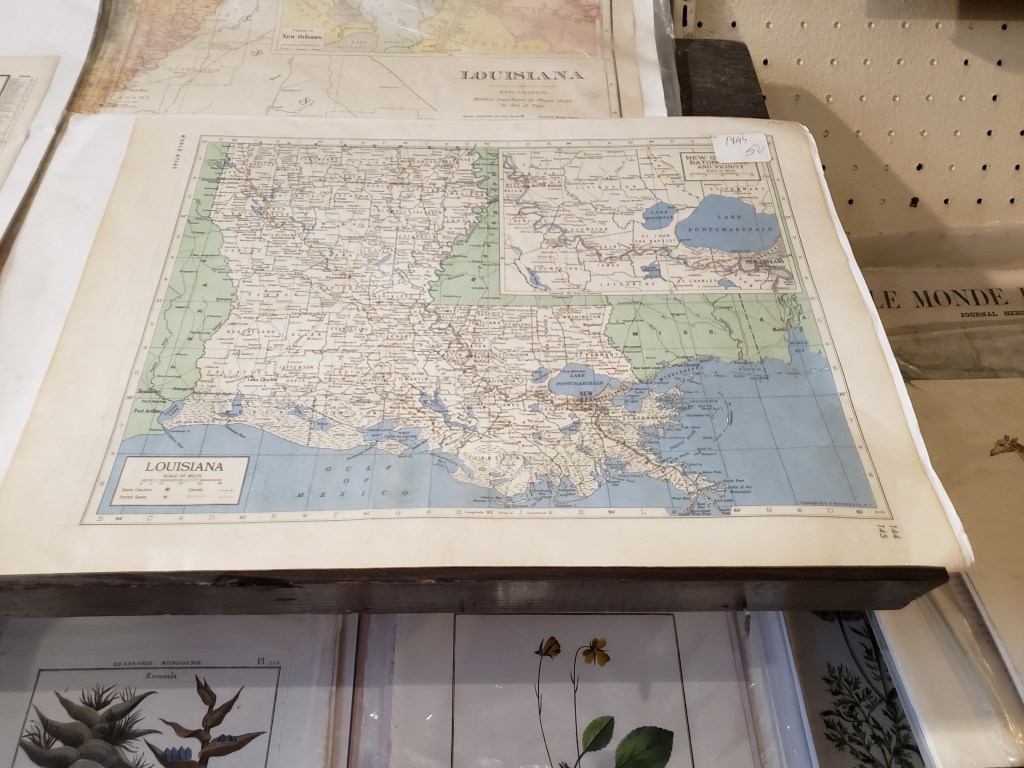
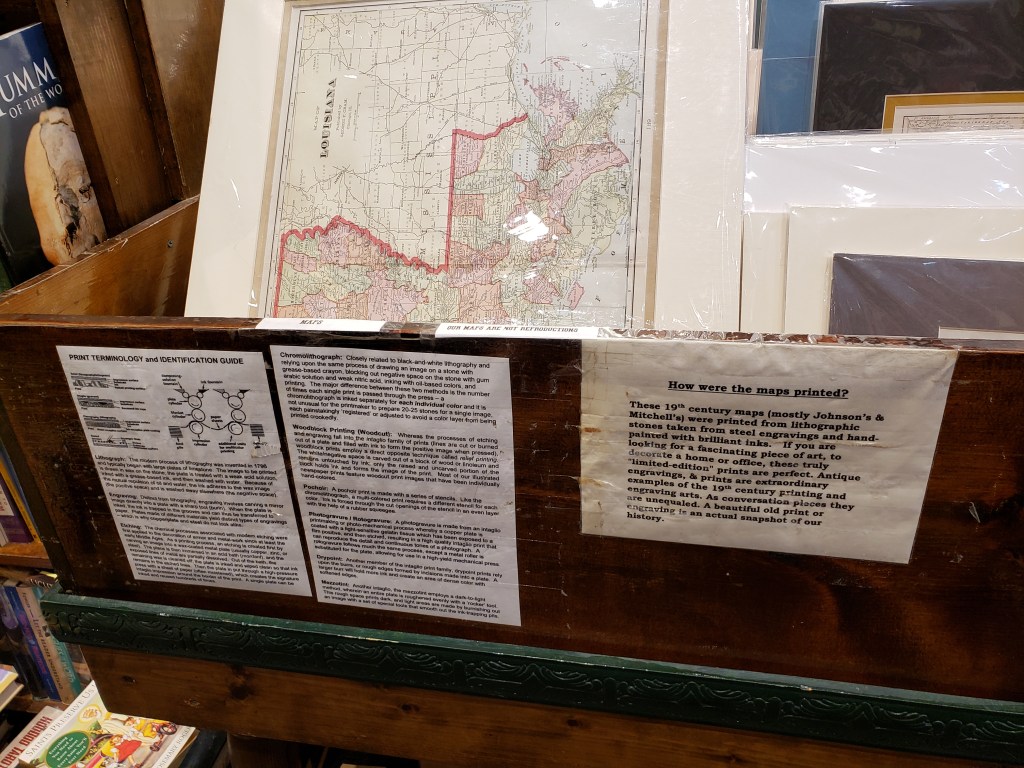
What makes this bookstore stand out is that they offer original maps and prints from the last 500 years! The maps even included the original plan for New Orleans and Manhattan! The prints contain botanical and architectural ones as well as engravings, etchings, and woodcuts. Crescent City wanted customers to know that these prints are NOT reproductions.
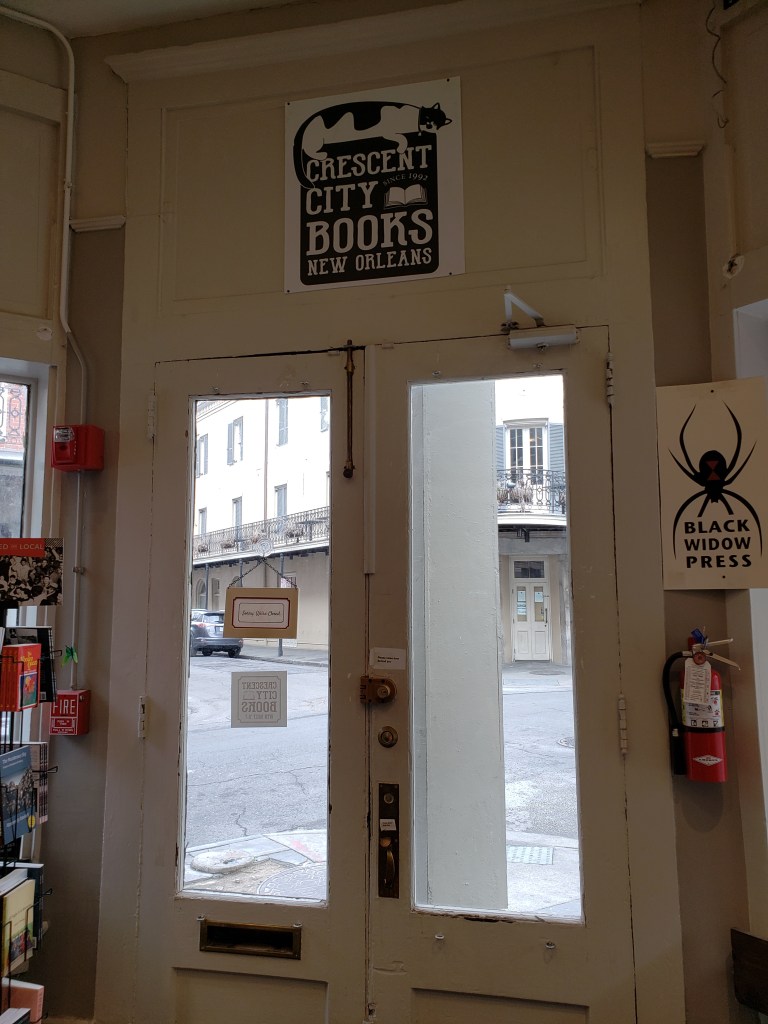
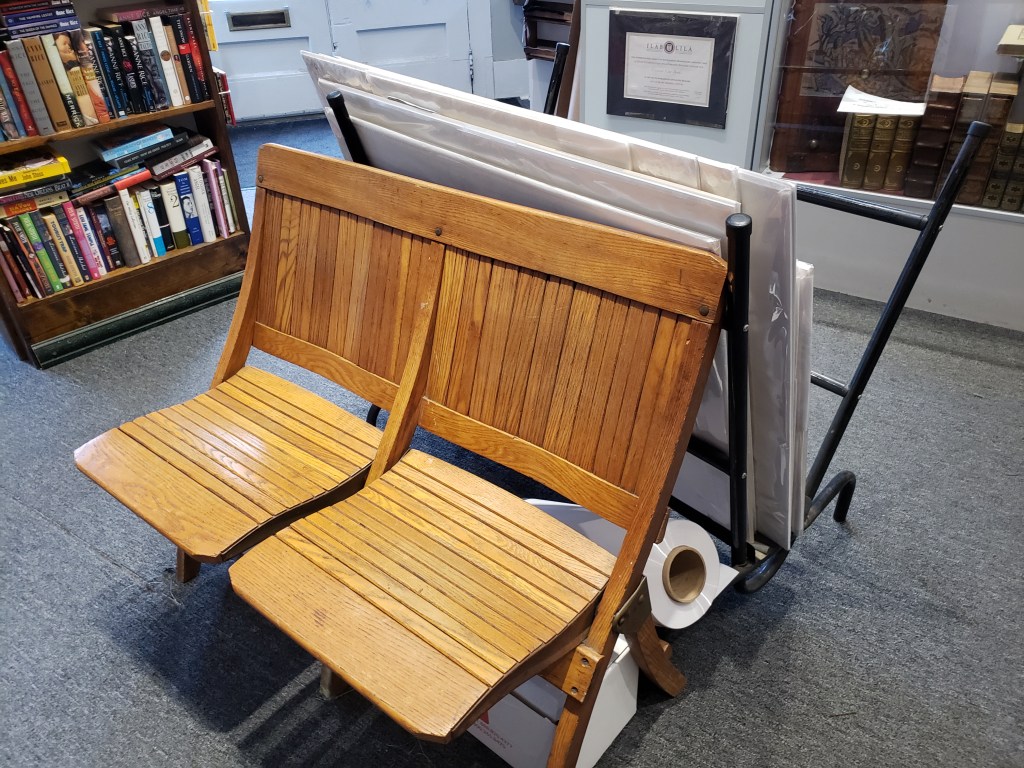
The store itself is in a small space, but the walkways are wide enough that people can move around. It even has a bench for those who need to sit down.
Adding to its authenticity image, the bookstore also contains leather bound books, both in a case and out of it.
Of course, I have to admit that I bought the book Frenchmen, Desire, Good Children: . . . and Other Streets of New Orleans! by John Chase, which discusses the origin of the various street names in the Crescent City. Like with the title mentioned above, I can’t wait to read and review it!
Overall, Crescent City Books offers the most unique items with its antique maps and prints! If people want to buy items that are distinct to New Orleans and the state of Louisiana, this bookstore is the best place for that! To learn more about them, one can check out their Facebook and Instagram pages!
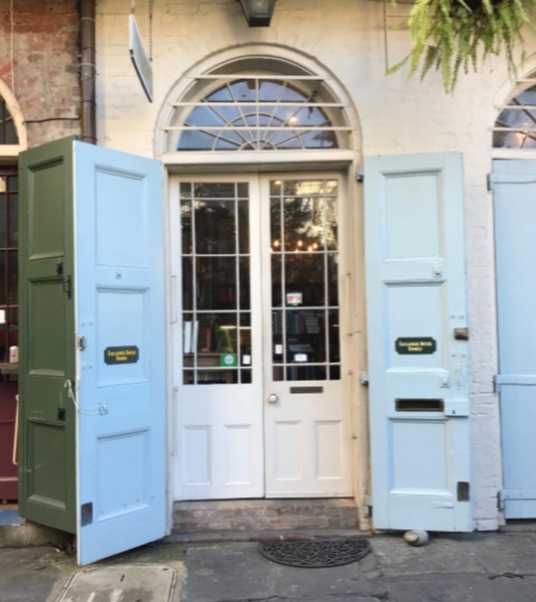
And finally, we have Faulkner House Books!
Photo Credit: Jenidza Rivera – Date: 2017
Faulkner House Books is a bookstore that contains fine literature, rare editions, and of course, books by William Faulkner. Apparently, he lived in that specific building when he wrote his first novel Solider’s Pay.
It was ironically the first bookstore that we encountered. When I say encountered, it was more like we stumbled upon it as we were trying to find a place to book some tours. As one can see from the photo above, it doesn’t have much signage outside of its name and a plaque indicating that Faulkner lived there.
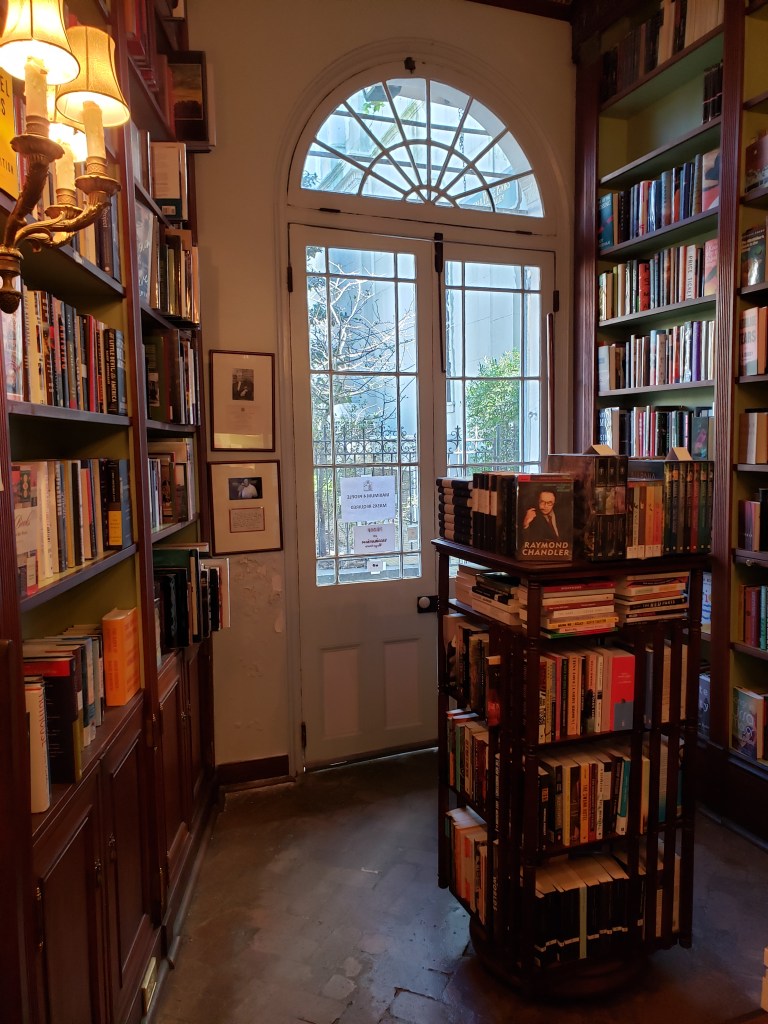
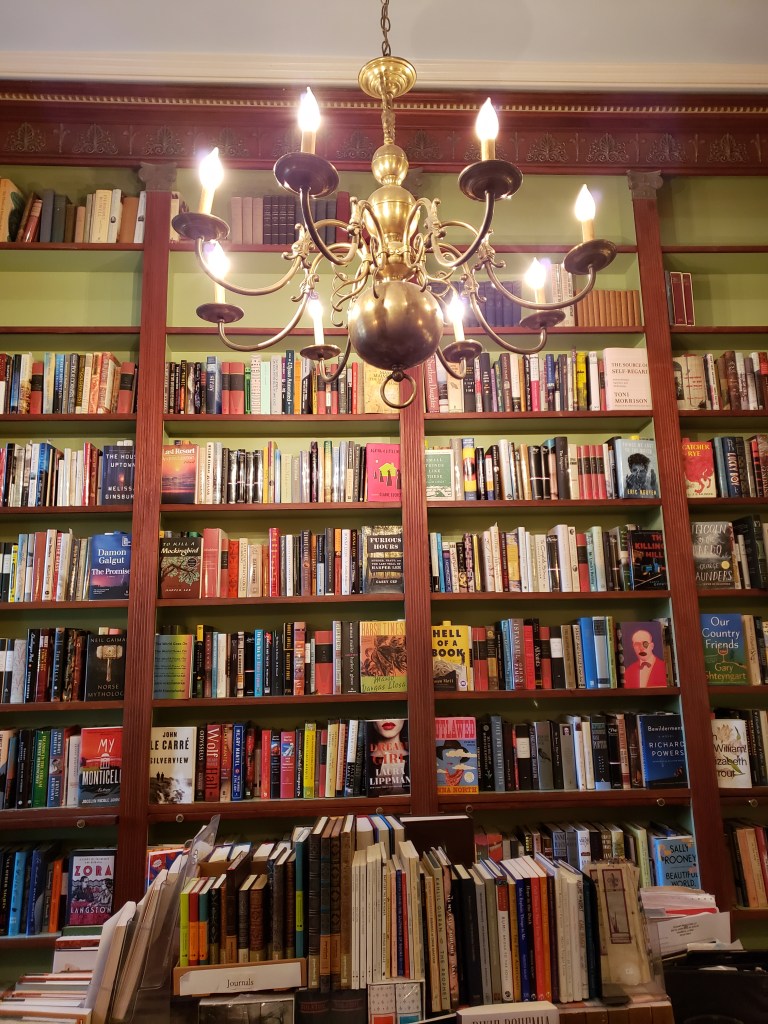
Nevertheless, I’m glad that we went there because despite the space being limited to two rooms, it was the quaintest of the bookstores that we went to. I think it was the old fashioned lamps and the chandelier. It was also the most organized of all the bookshops we went to as all of the books were lined up spine to spine in neat ways.
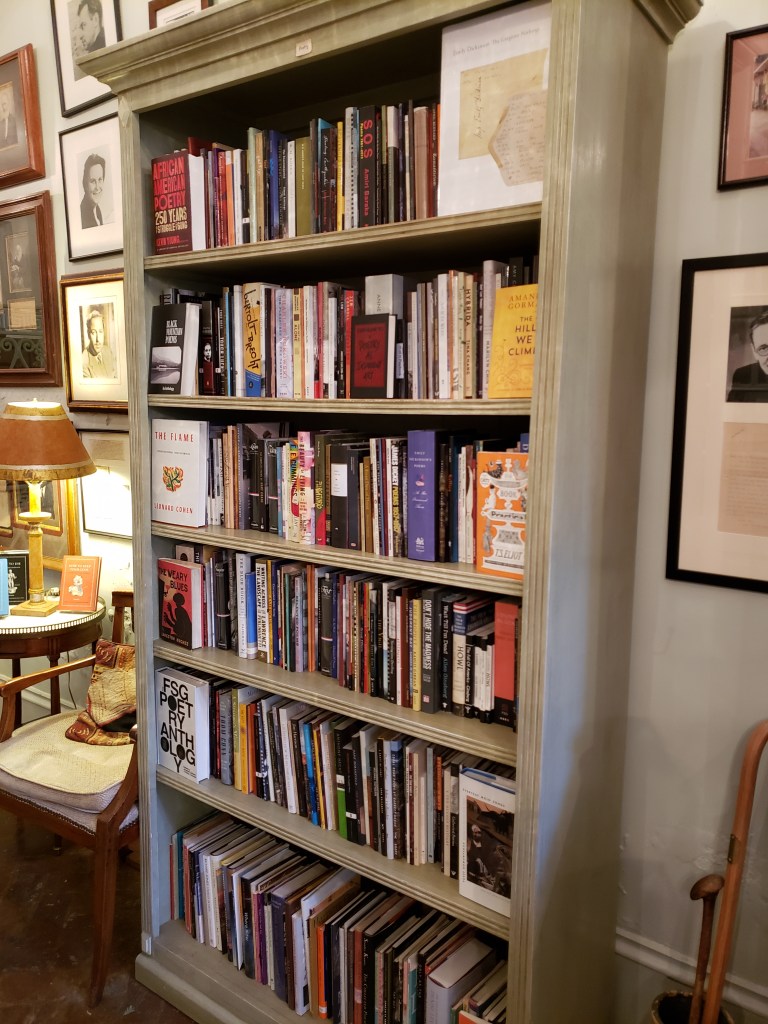
The bookstore emphasized poetry, which makes sense as Faulkner himself wrote plenty of poetry. Al lot of them were stored in separate bookcases in a hallway that lead to a fancy gate that indicated the space it was guarding was private.
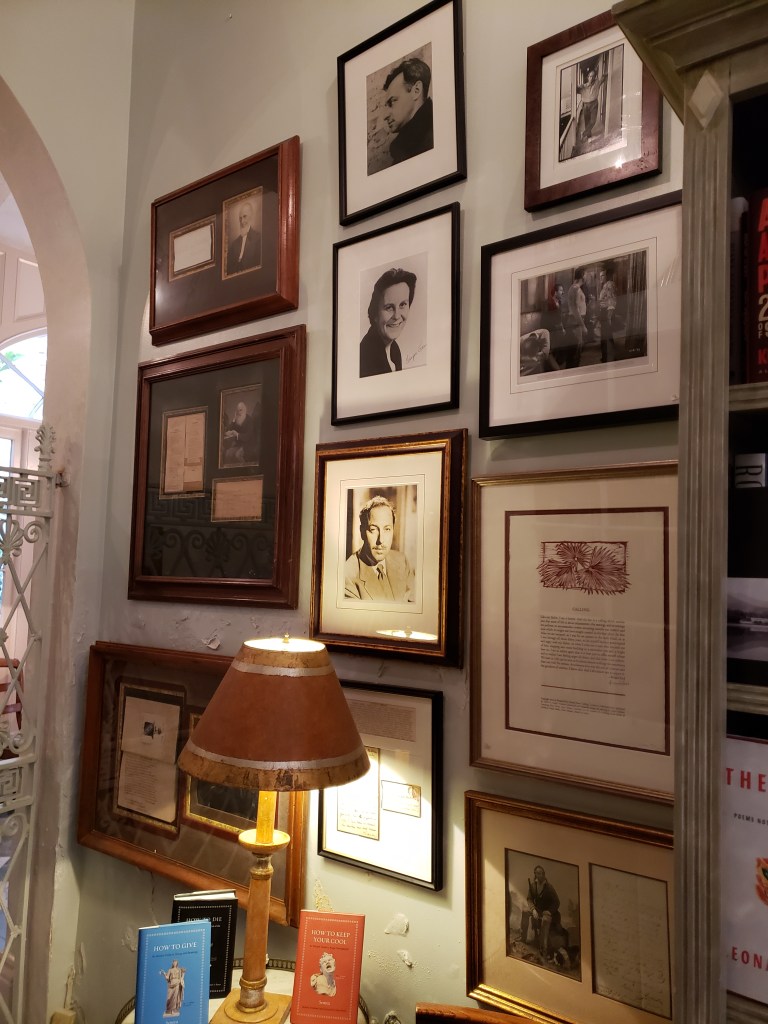
Another aspect that made Faulkner House Books was that it possessed pictures and notes of various writers who spent time in New Orleans like Tennessee Williams and Ernest Hemingway. One of them included a photo of Williams and Marlon Brando in the Broadway production of A Streetcar Named Desire. That one is second from the top on the right.
Joanne was the lady who works at Faulkner House Books, and she was very kind and personable as we chatted up on the house itself as well as, you guessed it, books. It also turns out that she does personalized book subscriptions. These involve sending the reader 3 to 5 books a month based on their personal tastes. One can go to the Faulkner House Books website to find out more details.
Sadly, I didn’t partake in the subscription, yet I purchased two books while I was there. One was The Pun Also Rises: How the Humble Pun Revolutionized Language, Changed History, and Made Wordplay More Than Some Antics by John Pollack. I love puns as well as how it parodies the title of one of Hemingway’s most famous novels. The other one was called New Orleans Sketches by William Faulkner. I had to buy that while at the one-time residence of that author. It contains stories that he wrote while living in New Orleans, while working on his debut novel. Also, it’s like ordering gumbo at a New Orleans gumbo shop. It’s mandatory. I’m looking forward to reading and reviewing both!
Overall, Faulkner House Books is a cozy bookstore tailored made for those who love the classics, poetry, and the idea of other people picking out their books to read. It’s a compact space, but my husband and I had no problem going through it. Along with their website, one can also find them on Facebook and Instagram!
And that concludes of the first installments of my new series “Literary Travel!”
Let me know what you think of this series!
Subscribe below to get notified when I post new updates. Also feel free to email me here for any review suggestions, ideas, or new titles!
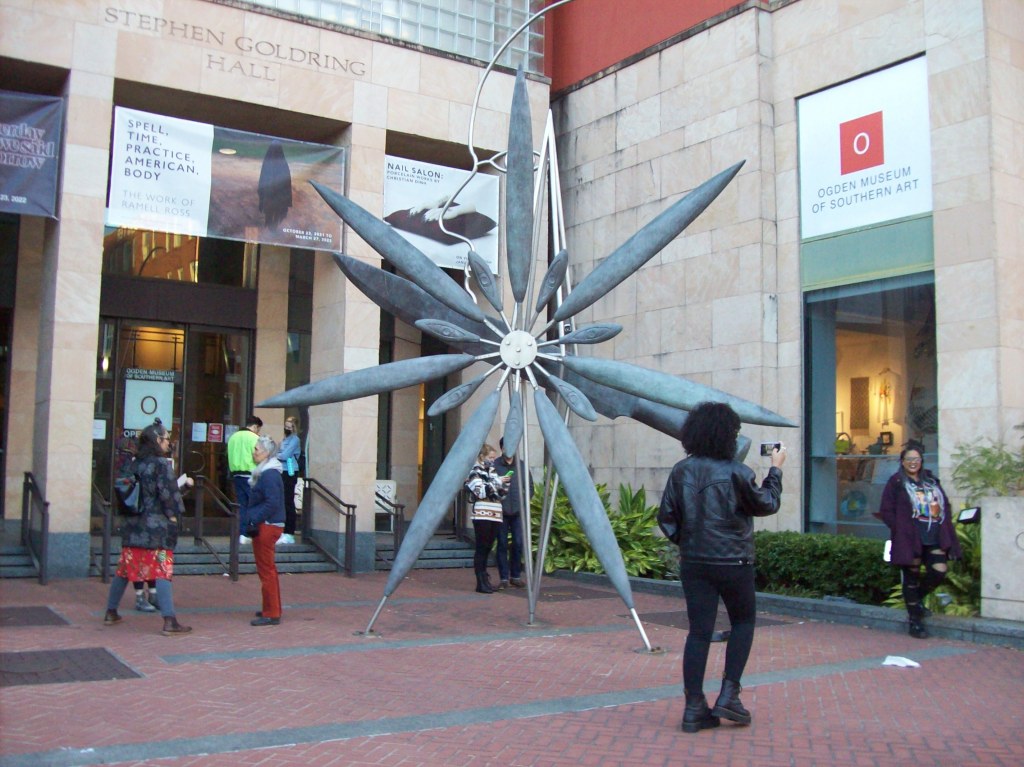
This week, I promised you all something special for Martin Luther King (MLK) Jr. Day, and I have it here. Yesterday, I celebrated this day by going to the Odgen Museum of Southern Art for its 5th Annual Free MLK Jr. Day Celebration. It was presented with support provided by Cox Communications.
The event contained a museum scavenger hunt, family friendly entertainment, an interactive “I Have a Dream” wall, and a lot more. My husband and I had fun writing our own ” I Have a Dream” messages, and I had a great time using the 360 degree photo booth!
Led by Shukrani Gray, African American Resource Collection Equity and Inclusion Librarian at the New Orleans Public Library, the panel consisted of guests like Mariah Moore – an award-winning social justice advocate, National Organizer at the Transgender Law Center, and Co-Founder and Co-Director of the House of Tulip – and Leon Waters – the board chairperson of the Louisiana Museum of African American History as well as tour host and manager of Hidden History, L.C.C.. Both guests espoused their knowledge perspectives on the history of social justice movements in the city and what people could do to continue the communal effort.
Since Waters is the manager of Hidden History, he received cheers and ruffled some feathers with asserting that MLK became a hero for the oppressive party and that he was murdered by the FBI (the latter has been proved to be false.) Despite that misinformation, Waters was right was about how we shouldn’t put MLK on the pedestal. Like other famous names in the 1960s civil rights movement, he has been mythologized, and it’s important to humanize him and to see the events from that era from multiple perspectives, so we can have a more nuance view on that time.
Overall, it was a fun time, and I certainly look forward to attending more events like this and finding ways to enhance equity and inclusion as a librarian.
Stay tuned for part two next week where I show you all the bookshops that I explored in New Orleans!
Subscribe below to get notified when I post new updates. Also feel free to email me here for any review suggestions, ideas, or new titles!
It’s been awhile since I showed you the last chapter. I finished a number of books like The Women of the Copper Country by Mary Doria Russell, and I started a new title not too long ago that I’d like to share with all of you.
American Shaolin – Flying Kicks, Buddhist Monks, and the Legend of Iron Crotch: An Odyssey in the New China by Matthew Polly is a coming-of-age story of one American’s quest to become a kung fu master at China’s legendary Shaolin Temple. When he was young, Matthew was scrawny and tormented by bullies at school. He dreamed of one day journeying to China to become the toughest fighter like Caine in his favorite TV series Kung Fu. While in college, he decided that the time had come to pursue his dream. Despite the objections from his parents, he dropped out of Princeton to spend two years training with the legendary sect of monks who invented kung fu and Zen Buddhism. When he landed in China, he expected an isolated citadel populated by supernatural ascetics that he’d seen in countless chop-socky films. Instead, he discovered a tacky tourist trap run by Communist party hacks. Nonetheless, the monks still trained in the rigorous age-old fighting forms. As Matthew became more knowledgeable about China and kung fu, he would come to represent Shaolin Temple in challenge matches and international competitions, and ultimately the monks would accept their new American initiate as close to one of their own as any Westerner had ever become.
I was a little worried at first since I rarely read nonfiction in bed. The last time I did that with So Anyway by John Cleese, I stayed up for hours. Luckily, I haven’t had that issue so far. This isn’t a bad thing. I read roughly a chapter a night and sleep afterwards. I can still enjoy it and get plenty of shut-eye.
As for the memoir itself, it’s pretty good so far. Polly demonstrates his knowledge of China very well prior to arriving in that nation since he studied the language while at Princeton. I liked how he discovers more about the country beyond the classroom and the kung fu media. One scene that stood out to me was when he was at the rundown hotel, and the clerk was trying to get with him. He handles the situation like any naive foreigner would. I’m looking forward to reading more of this.
We have now come to the end of the twenty-fifth chapter of “What Am I Reading?”
Subscribe below to get notified when I post new updates. Also feel free to email me here for any review suggestions, ideas, or new titles!
I hope you all had a great New Years! I sure did! I’ve been looking forward to 2022 for awhile because I got a wide range of books to show you like this one:
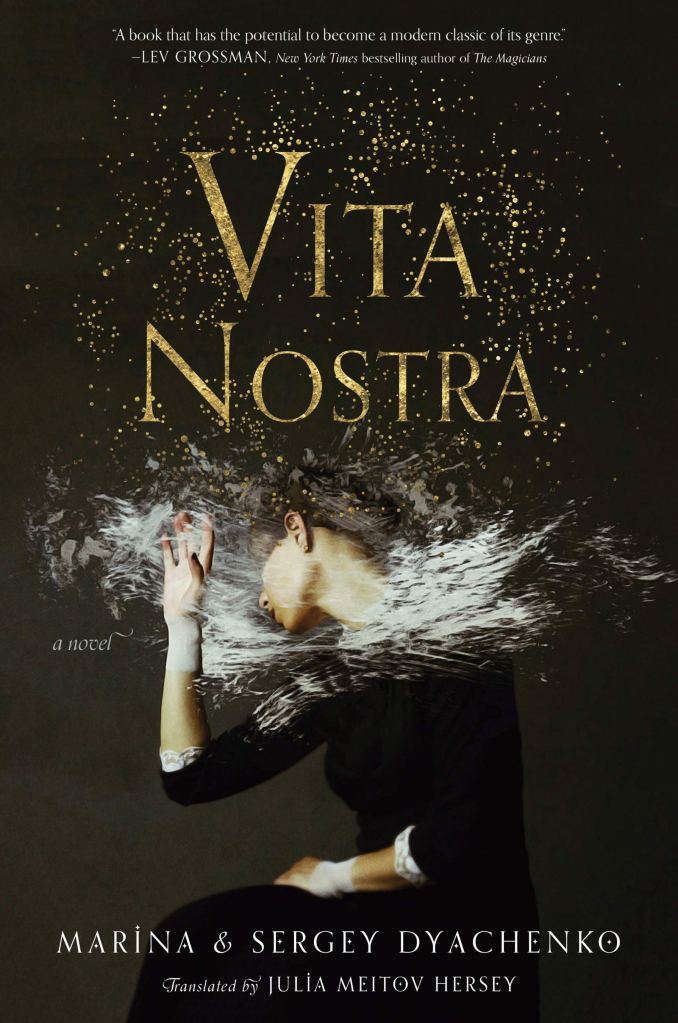
Have you ever read a book that boggled your entire mind? A book so confusing that you have to double check to make sure that you read it right? Recently, I read a novel like that called Vita Nostra by Marina and Sergey Dyachenko. It may not be for everyone, yet for those who chose to go on this journey, it’s worth it.
Translated from Russian by Julia Meitov Hersey, Vita Nostra is a dark version of Harry Potter. While vacationing with her mom, Sasha Samokhina meets the mysterious Farit Kozhennikov. He directs her to perform certain tasks, and she is powerless to refuse. Every time she completes one, she is rewarded with strange gold coins. As her schooling and summer end, her domineering mentor makes her move to a remote village and use her gold coins to enroll in the Institute of Special Technologies. Even though Sasha doesn’t want to go, she feels that this is the only place she should be at. She quickly finds out that the institute’s “special technologies” are unlike anything she has ever encountered like the books being impossible to read and the lessons being maddening. The institute uses terror and coercion to keep students in line, yet they don’t outright punish them. Instead, their families pay a price. Despite her fear, Sasha goes through changes that defy matter and time as well as experiences which were nothing she ever dreamed of and suddenly all she ever wanted.
As one can see from this summary, it’s a lot, but it’s truly like Harry Potter. Like Sasha, Harry also goes to a magical school and experiences things that he couldn’t ever dream of while living with the Dursleys. The difference is how intense Vita Nostra can get, especially with how Sasha is forced to go to the school almost against her own will.
However, that summary doesn’t quite describe everything that goes on in the book. The YouTube channel “rincy reads” expressed the novel as this: “This book is like Harry Potter, but if it was written by Kafka.”
Although I’ve never read anything by Franz Kafka, I couldn’t have interpreted that book any better. That author wrote a novella called The Metamorphosis, and Sasha goes through one herself of a slightly different sort.
At first, I was a little worried since the book contained no chapters, just sections that functioned like a 3-act play. I was about to get flashbacks to The Polished Hoeuntil I noticed that every first line in every subsection was bolded. I have a feeling that either the authors or the translator were aware that readers might not have a place to stop reading for the time being, hence the bold first sentences.
That was a clever move, for it grabbed me from the very first page, and there were times that I couldn’t put it down. I could vividly imagine a lot of the locations like the remote village, especially when Sasha and Kostya – Farit’s son – first encounter it. At times, I was addicted to the book like Sasha was to her textbooks. In fact, she got so into her homework that her professors had to stop her from going too far on multiple occasions.
As other readers have mentioned, this is an accurate depiction of being confused by something and then immediately getting it. Sasha and her classmates at the Institute of Special Technologies are often befuddled by the text that they have read for various assignments. They, especially the protagonist, ask the professors why, and they are often told that they can’t tell them quite yet, but they will get it in due time. The more Sasha reads the paragraphs, the more she gets them to the point that she has little to no social life. That kind of sounded like me when I was in high school and in college. And this even reflects how I felt while reading this book. I had no idea what the school was trying to teach them, and I wanted Sasha to know too, so it was good that both of us were in the same boat.
Speaking of Sasha, I’m glad that the authors wrote her as flawed. She is someone who’s so consumed by her work that she drives people away from her. She even scares a lot of the younger students because of how strict, assertive, and studious she is. This can make her seem cold, but she is a loving daughter to her mother and eventually warms up to her step-father and baby half-brother. She even has feelings for Kostya, but she constantly denies them in lieu of doing the assignments. In other words, it’s good to see a truly flawed female protagonist.
The book talks about philosophy a good chunk of the time like ceasing to be human and to become a verb, word, etc. I thought these sections were just alright as I focused more on figuring out what was even going on and if Sasha will survive the school.
Now, let’s talk about the ending. I’ll give no spoilers. All I will say is this: at first, I thought that it was one of the most WTF conclusions I have ever read. However, once I learned that it was the first book in a trilogy, I began to see it as a beginning to something else. Although it still doesn’t change the fact that the ending was crazy, I’m willing to read the other two novels to see how things play out because of that conclusion.
Overall, Vita Nostra by Marina and Sergey Dyachenko is not your average fantasy, magic-realism book. Weird things happen, but you get addicted to it pretty quickly. It helps that the protagonist is flawed in a good way. I would recommend this to those who like books that involve magic schools, darker fantasy novels, Harry Potter,and Kafka. Like I said earlier, it’s not for everyone because of how confusing it can get, but if you are willing to read it, you’ll probably remember it for a long time.
What are your favorite translated books? Let me know in the comments!
Subscribe below to get notified when I post new updates. Also feel free to email me here for any review suggestions, ideas, or new titles!
Today is the last Monday of the year! You know what that means??? It’s the 2nd annual year-end countdown of books I reviewed in 2021!
Like before, I’ll pick 6 books for this list – 3 for the best and 3 for the worst! Now, I have only one question for you!
I sure am! Let’s get started with the Best Books of 2021!
I read lots of wonderful titles this year, so it was a bit hard to chose. I wish I could include all of the 4- and 5-starred rated books, but I knew I had to select the best of the best for this year. At the end of the day, I found 3 of those titles that not only fit that criteria, but were also unforgettable.
3. Wild Women of Michigan: A History of Spunk and Tenacity by Norma Lewis
In my last installment of “What Am I Reading,” I mentioned Wild Women of Michigan since I’m currently reading The Women of Copper Country, which centers around the Copper Country Strike organized by Annie Clements. Ever since I started reading the latter, it has made appreciate the former all the more because of its celebration of women like Clements who defied expectations and who just happened to live in Michigan at some point in their lives. It includes those from various times and backgrounds, showing that anyone can be a game-changer. Despite its structural and glaring editing issues, it’s an essential read for those who want to learn more of Michigan history beyond a textbook.
2. Around the World in 80 Days With Michael Palin by Sir Michael Palin
I know you’re probably thinking, “Didn’t you put a book involving one of your favorite comedians on the best list last year?”
Yes, I did, and I put it on the list because it was written so well that I couldn’t get it out of my head. The same goes with Around the World in 80 Days With Michael Palin. It’s a fabulous travelogue of someone with money and proper backing who did what the title implies. Palin’s observations are hilarious and genuine, and I got the sense that he sincerely wanted to get to know the people he encountered on the trip. And most importantly, it made me want to travel. I completely understand why Palin got knighted in 2019 due to his “services to travel, culture and geography.”
1. On the Come Up by Angie Thomas
Now, I know you’re going to say, “Wait. Didn’t you put a book by Angie Thomas on last year’s best list?”
I sure did. Normally, I try to stay away from putting the same authors on my best lists, so I can give other ones the love and attention they deserve, but I couldn’t pass up On the Come Up. This YA book tackles a variety of issues like misogyny in the music industry, social justice, and poverty in non-sugarcoated ways. The best part of this novel is the main character Bri. She acts like a real teenager, flaws and all. It also helps that her rhymes and flows were incredible, and I was rooting for her all the way despite the impulsive and stupid things she did throughout. I can’t wait to see the movie when it comes out because the book is that wonderful. In addition, Bahni Turpin nailed the audiobook!
Before, we get the worst list, I want to mention that the titles listed are not all that bad. I found these to be the weakest of the ones that I read this year.
Now that we got that out of the way, it’s now time to get to the Top 3 Worst Books of 2021!
3. Legends of the Fall byJim Harrison
There were plenty of things I liked from Legends of the Fall like The Man Who Gave Up His Name short story. However, whenever I thought of the novella, I often remembered the aspects I didn’t like more than the ones I enjoyed. It illustrates the main problems I have with Harrison, namely his macho and overly self-indulgent style of writing, especially with the titular short story. Also, if he mentioned, “And she went mad” one more time, I swore I was going to go mad!
Also, from what I’m told, the movie version of Legends of the Fall is supposed to be different from the story. All in all, it has plenty of enjoyable elements; it just needs to be more concise and less self-indulgent.
2. White Fragility: Why It’s So Hard for White People to Talk About Racism byRobin DiAngelo
We need to have books that discuss how people can improve their racial education. White Fragility: Why It’s So Hard for White People to Talk About Racism is certainly one of the more popular titles in that subject, but I would be hesitant to recommend it. Despite her revelations on the good/bad binary and her advice on how to combat it, DiAngelo tends to act like she knows everything because she is a diversity consultant, which is off-putting. It doesn’t help that she doesn’t use concrete examples for her points all the time. I wish it was written by someone who wasn’t on their high horse, preferably someone of color.
To summarize, I’ll quote the last the line of that review, “Whatever you do: don’t treat this like it’s the Bible of racial education because it’s simply not.”
1. Carry the One by Carol Anshaw
Even though I published the review for Carry the One last week, I knew even then it was the weakest title that I’ve read this year. Like the title I chose as my worst book of 2020, it took a potentially interesting story and executed it in the most boring way possible. It focused on three siblings and how they dealt with a tragic incident. The problem is that the novel focuses on the wrong elements. One of the siblings is not even actively involved with the event. If it emphasized the characters that were directly affected by the accident, it would’ve been a much better book.
And that was the Top 3 Best and Worst Books of 2021! I hope all of you enjoyed it. I look forward to having plenty of new reviews for 2022! See you next year!
Subscribe below to get notified when I post new updates. Also feel free to email me here for any review suggestions, ideas, or new titles!
I understand that there are some books that are intended to be character studies. The emphasis is on the character and how they deal with things, and the plot is put on the back burner. If done right, they can be pretty engaging with characters so fascinating that readers will look past the thin plot. If not, the novel will become a slog with protagonists that barely anyone will root for. An example of the latter is Carry the One by Carol Anshaw.
Carry the One is about three siblings and their friends who experience a devastating moment following a wedding. It takes place over 25 years as they deal with this trauma in their own ways through friendships and love affairs, marriage and divorce, parenthood, holidays, and the modest calamities and triumphs of ordinary days.
Much as I liked the premise, I had a feeling that not much would happen. Now that I’m done with it, I can say that it’s more a character study, but with a goal of trying to move on. It’s not a bad thing. The Four Sworn: Spring Equinox by Leonore Sagaskie was an origin story for the main characters. It explained how they got their powers, how they met, and how they formed a group to defeat a powerful villain. Both have thin plots, yet the protagonists in The Four Sworn were compelling enough that it kept me engaged throughout. In Carry the One, the characters are not all that interesting. Each of the siblings – Carmen, Alice, and Nick – deal with the tragedy in different ways. One puts herself into her work, her son, and her family with her second husband; another paints and goes through women while trying to get over her true love; and the other one does drugs.
As one can see from that, only one has a legitimately intriguing story. Even though Nick used drugs before, he continues to utilize them to get over his guilt of not telling the driver aka his girlfriend at the time Olivia about seeing the little girl that they hit. It doesn’t help that Carmen – the one who actually gets married – wasn’t even there when the accident occurred. I liked her, yet I had a hard time caring for her and her second marriage due to her absence from the tragedy in the first place. As for Alice, I feel that there was a missed opportunity with her. Part of her atonement was painting the little girl in the various stages of her life while wearing the same outfit that she was killed in. At one point, a famous painter views those works and asks, “What if these are the best paintings you will ever make?”
Sadly, Alice never shows them to others. I understand that she didn’t want to profit off the girl’s death like Tom – a family friend – did with his song about the accident and that it would’ve been a predictable move. However, displaying them would’ve helped others dealing with similar situations as well as herself in her road to healing. She could’ve established a scholarship in the girl’s name or donated them to a charity devoted to car accident prevention. Above all, it would have allowed for something to happen besides Alice going through each woman before getting back with Maude. In addition, it would’ve been a satisfying conclusion to her story.
This book is like an improvisational game, in which barely anyone says, “Yes and…”
It could be interesting, yet it holds back from exploring more in depth about how certain characters like Carmen and Alice go through grief and loss. In other words, it rarely frames the accident in the context of their stories, and how their lives are affected because of it.
In fact, I think that the novel doesn’t focus on the right characters. Nick’s story is compelling, and so is Olivia’s. Olivia is the only one that faced any clear consequences to her actions as she spends some time in jail for having marijuana in the truck. The book doesn’t spend any time with Olivia while she’s in jail as it chooses to focus on her when she leaves. Of all the characters, she’s the one who desperately wants to leave the accident behind and become a better person. She even leaves Nick as he tries to sober up when she discovers a Vicodin pill in his coat pocket. If the book emphasized the accident’s aftermath through Nick’s and Olivia’s eyes, it could’ve been a lot more interesting.
I listened to the audiobook, and it’s narrated by Renee Raudman. Raudman is best known for voicing Ms. Butterbean in The Grim Adventures of Billy and Mandy. At first, I was worried that I might hear that character throughout the novel and not be able to take it seriously. Luckily, that was not the case, for none of the main female characters had that voice. Raudman has a range with voicing Carmen as a woman who acts like she has it together, but in reality doesn’t, while she portrays Alice as more free-spirited, but frustrated with her love life. The men kind of sound the same, but as I have mentioned on this website, voicing audiobooks is hard. Given the material, Raudman did her best.
All in all, Carry the One by Carol Anshaw is a book that serves as a clear example of how not to do a character study. Some of the characters are interesting, but the novel’s decision to focus on the ones that weren’t directly involved and the lack of action hold it back from being compelling from beginning to end. It’s not a bad book, but I would hesitate to recommend it to others. There are much better character studies out there.
Before I go, I want to announce that I’ll be posting my Top 3 Best and Worst Books of 2021 next week, so stay tuned for that! Until then, Merry Christmas to all who celebrate it!
Subscribe below to get notified when I post new updates. Also feel free to email me here for any review suggestions, ideas, or new titles!




















 Book Reviews by a Chick Who Reads Everything