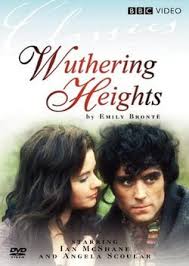
Welcome to Part 5 of looking at various adaptations of Wuthering Heights and seeing if they can capture the spirit of the book by Emily Brontë. Today, I’ll be looking at the 1967 BBC miniseries starring Ian McShane (best known for his role as Winston Scott in the John Wick films) as Heathcliff.
This is a truly faithful version of Wuthering Heights. It includes the second half of the book! The BBC ran this series in 1967 with 4 episodes that were between 40-50 minutes each. It originally aired in color. However, that print is lost. What we have is the black-and-white version, and it’s available on YouTube. While it would’ve been nice to have it in color, the black and white brings out how bleak the story is. Although the print is not in the greatest quality, I’m glad that we do have it, considering that the earliest adaptation from 1920, which includes the second half as well, is lost. In addition, it was this version that inspired Kate Bush to write her awesome song of the same name.
It contains almost everything from the novel like the subplot with the next generation and Heathcliff opening up Catherine’s grave. Even the time period is accurate. The pre-1960s adaptations looked like they took place in the Victorian era. This one understood that the book’s events were in the late 1700s/early 1800s. The costumes reflect this from the tricone hats and coats for the men, the sack-back gowns for Catherine and Isabella, and the empire-waist dress for Catherine’s daughter Cathy. The only noted difference is how the story is told chronologically as opposed to through the Mr. Lockwood framework in the novel. That character still shows up, but not until the third episode, and Nelly is not even present when he arrives at Wuthering Heights. I’m perfectly ok with this because it doesn’t fundamentally change anything about the plot.
This version actually was shot on the English Moors. This brings authenticity since it’s a character in itself. I can see why Brontë wanted to have a story set in that location. The open fields and winds make it possible for anyone to be themselves and not care about societal expectations.
I like how almost every character is given empathy. In the beginning, when Mr. Earnshaw brings home Heathcliff, the first person to scoff at the child is Mrs. Earnshaw. Prior adaptations eliminated her all together, but this brought her in to show how trauma can start. Even though she lets him stay, she continues to berate her husband for bringing him in until she dies. Additionally, Mr. Earnshaw remarks why Catherine and Hindley are the way that they are, and he tries to get them to respect Heathcliff. He even attempts to throw Hindley out of the house if he doesn’t learn to treat his adopted brother fairly. Furthermore, Hindley has some moments where viewers can see what he’s going through. There’s a scene where he cries over his wife Frances’s grave, which leads to him being a drunken mess.
I enjoyed how this version embodied the book’s gothic horror tone. For one thing, there is no soundtrack outside of harrowing winds and roosters crowing. The winds are present in almost every scene. Even though they drown out the dialogue at times, it shows off how desolate the environment is even more. In addition, when Mr. Lockwood opens the windows up, not only does he feel Catherine’s hand grabbing at him, but he also sees her ghost, which is super creepy. This was the moment that inspired Kate Bush to write her famous song. What’s eerier is when Mr. Lockwood shuts the window, her hand is caught. My favorite moment is actually when Heathcliff comes back to Wuthering Heights, it’s done as a POV shot as seen in slasher movies, so viewers never see his face. I especially love Joseph’s and Hindley’s reactions when they realize that it’s him. I almost expected Heathcliff to slash them. To be fair, Hindley deserves that.
While there’s plenty of things to like about the series, there were some problems as well. First off, because this adaptation’s goal was to include as everything from the novel as possible, it rushed some relationship development. This is especially true between Catherine and Heathcliff. In the first episode, viewers see Catherine and Hindley being cruel to Heathcliff. Then some time later, Catherine and Heathcliff are bonding in the English Moors. There should have been more time with them, especially how Catherine goes from being nasty to kind. A similar issue happens with Cathy and her relationship with Hareton – Hindley’s son, but that one is more fleshed out. Moreover, it could have been trimmed down. The pacing can be sluggish at times. There were some scenes which I didn’t feel were necessary. This is true when Mr. Earnshaw is walking and carrying a young Heathcliff through the Moors at the very beginning.
Second, the hair and makeup aren’t great. There’s this adage that people can figure out when a period film is made by looking at the women’s hairdos. In this case, that’s sort of true since the actresses have hairstyles that are 1960s-ish, yet the crew tried to make them look like the late 1700s/early 1800s. They’re fine. It’s the men’s hair, or should I say shaggy wigs, that make them appear like they’re in a 1960s rock band. Ian McShane’s wig looks appropriate for Heathcliff, but it also made me want him to sing “Wild Thing” by The Troggs. Keith Buckley, who plays Hareton, resembles Mickey Dolenz from The Monkees with his hairpiece.
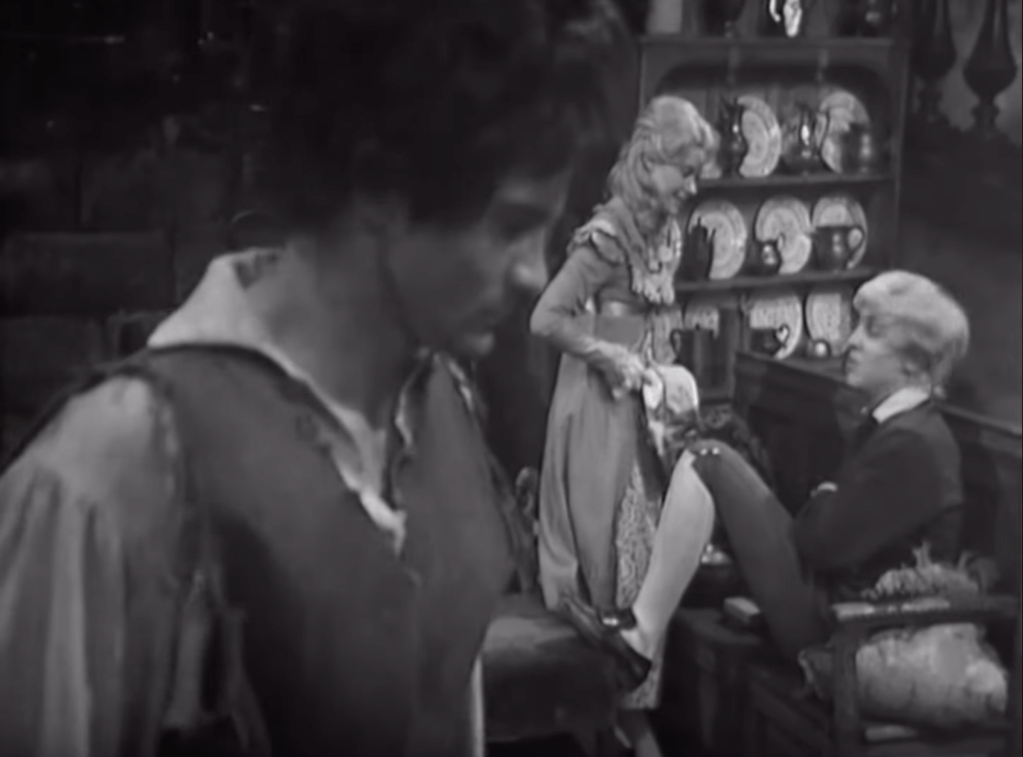
Third, there were some budget limitations with this one. Even though it’s not as egregious as the 1950 teleplay, I could tell that director Peter Sasdy had to make some shortcuts. For one, the scene of Catherine in the rain is cut drastically. The rain itself looks like water coming out of a hose running through a filter. In another, when Catherine gets bitten by the Lintons’ guard dog, I’m convinced that none were in the same shot together, judging by the way it was edited.
Everyone in this adaptation does a good job acting-wise. Ian McShane plays Heathcliff. Now, it may look like he might be a person of color because his skin appears darker than the other actors, but he’s a white guy who happens to be tan from the photos I’ve seen of him in real life. His Heathcliff is cold and distant, which is very effective in the last two episodes, yet he isn’t passionate enough. When he hears that Catherine’s dead, he is unreactive. In many ways, readers expect him to be emotional, especially in how he loved Catherine and responds to her death. Sure, McShane can be over the top, but
playing Heathcliff allows him to do that, particularly when he’s abusing other characters. It’s that I wanted him to be more passionate, so I could see what Catherine saw in him. On the other hand, Angela Scoular (best known for her roles in Casino Royale and On Her Majesty’s Secret Service) is the stand out performer. She plays the brattiest Catherine I’ve ever seen. She could be cruel to the people around her like Heathcliff, Edgar, and Nelly. When Catherine has her temper tantrums, Scoular gives it her all by throwing dishes and writhing on the floor. Additionally, she does a good job as Cathy. Cathy could be nasty and emotional as her mother, yet she can also be level-headed like her father Edgar, especially when she calls out Heathcliff for spreading lies about her to his son Linton.
The Wuthering Heights 1967 BBC miniseries is automatically one of the better adaptations because of how faithful it is to the source material. However, because it seems like the goal was to include practically everything, it has some drawbacks like the pacing and the budget constraints. Nonetheless, I enjoyed how bleak it was and how it embodied the novel’s tone. While I have my issues with Ian McShane’s performance, his and the others were good, especially Angela Scoular’s. Although it’s a decent version, this is the first true adaptation of the book that I saw. For that reason, I would recommend it to people watching every adaptation of Wuthering Heights as well as diehard Ian McShane and Kate Bush fans.
Now, let’s see how this one fits into the ranking.
- Wuthering Heights 1939 Movie
- Wuthering Heights 1958 Teleplay
- Wuthering Heights 1967 Series
- Wuthering Heights 1950 Teleplay
- Wuthering Heights 2026 Movie
We’ll see how this ranking evolves after I see all the others.
Stay tuned next month when I review the 1970 movie with Timothy Dalton.
Subscribe below to get notified when I post new updates. Also, feel free to email me here for any review suggestions, ideas, or new titles!
 Book Reviews by a Chick Who Reads Everything