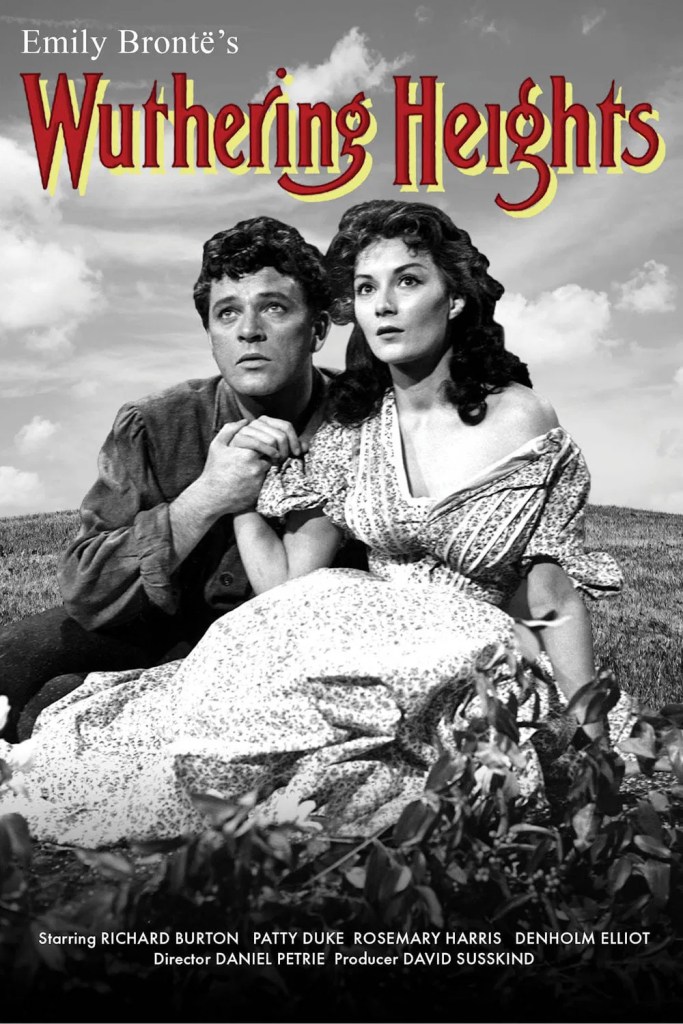
Welcome to Part 3 of looking at various adaptations of Wuthering Heights and seeing if they can capture the spirit of the book by Emily Brontë. Today, I’ll be analyzing the 1958 teleplay made by DuPont Show of the Month starring Richard Burton as Heathcliff.
Like the 1950 version, this one too is a play made for television. It was produced for the first season of the DuPont Show of the Month drama anthology series. That show ran from 1957 to 1961, and it focused more on adaptations of classic literary novels like Wuthering Heights. The DuPont Company sponsored the series, and they showed long advertisements on how they made the world better through chemistry (note: they are responsible for the microplastics in the world, so screw them). What’s interesting about this adaptation was that the kinescope version was considered lost for a long time until Turner Classic Movies showed it for the first time since its original May 9, 1958 airing in 2019.
Also, like the 1950 adaptation, the 1958 teleplay is a truncated version of the story. This one runs for 90 minutes (commercials included), and you guessed it, it omits the second half of the novel. However, it looks like it had a bigger budget than its immediate predecessor. It contains dogs; horses; rain effects; and realistic sets for the interiors and exteriors of Wuthering Heights, Thrushcross Grange, and the Moors. They all helped to enhance the sense of place.
While this one too focuses on the tragic romance between Catherine and Heathcliff, it also places a great emphasis on the supernatural elements and the torment both feel. In the very beginning, when Mr. Lockwood hears Catherine’s voice, her hand comes out to grab him. I know that’s in the book, but I was honestly surprised that the teleplay did that. Additionally, when Catherine is getting married to Edgar, she hears a robotic voice saying Heathcliff’s name over and over again. Then, when Catherine dies, Heathcliff basically condemns her to a life of purgatory and torments her until he dies.
Speaking of causing pain, there’s a lot of talk about how those lovers make each other and the people around them miserable. The story that Nelly tells Mr. Lockwood is not just about their tragic romance, but also why Catherine the ghost is tormented. Early in the teleplay, Catherine asks why Heathcliff doesn’t leave Wuthering Heights because it hurts her to see Hindley treat him like a servant. He proclaims that he stays for her. Later, when Heathcliff marries Isabella to spite Catherine, Isabella inquires why he doesn’t let her go despite not loving her. He outright states that she’s a proxy for her brother Edgar, whom he’s mad at for marrying Catherine. This proves that even though they make each other miserable, they should be together in order to stop ruining other people’s lives. It’s in this way that makes this adaptation closer to the book’s gothic horror spirit than its two predecessors.
Another thing that I want to point out is how sensual this version is. Heathcliff and Catherine share many passionate kisses throughout, which certainly will titillate and bother viewers. Moreover, Richard Burton is seen at times with a shirt that’s unbuttoned at the top and another all the way open that exposes his chest. For the latter, when Isabella goes to see Heathcliff at Wuthering Heights, she remarks that he’s half-naked. I’ll give credit to the people who made this version for intentionally making it arousing by 1950s standards.
A pitfall that it runs into is the acting. Considering that this is a play made for television, almost everyone overemotes. The 1950 adaptation has the same flaw because it was created in the same medium, yet the 1958 one tones it down just a notch. Yes, there are certainly scenes where Richard Burton bellows in his signature baritone voice, but those are warranted given the character he plays.
Speaking of Burton, while he’s best known for his on-again-off-again relationship with Elizabeth Taylor (it’s he that Taylor Swift refers to when she sings “Burton to his Taylor” in “Ready for it?”), he’s still a good actor in his own right. By 1958, he received two Oscar nominations for My Cousin Rachel and The Robe, and his most widely acclaimed work was yet to come. And once again, I have to acknowledge the white elephant in the room with that Burton is a white guy playing a racially ambiguous character, especially with people making explicit remarks about his appearance (“dark as the devil” and “rogue g***y”). With that aside, Burton is still good in the role. He’s like Olivier in how he broods and expresses passion, yet he takes it a step further. He’s so passionate that one might think that he and Catherine did the dirty deed. Also, in the beginning when Heathcliff hears her voice, he literally breaks the windows in a fury known only to some. Furthermore, he leans more into Heathcliff’s cruelty. There’s the scene in which Isabella comes to Wuthering Heights that he comes off as predatory, especially when he kisses her nonconsensually. Additionally, he’s willing to portray Heathcliff’s violence towards others whether it’s Hindley, Isabella, etc. I appreciate how Burton portrays Heathcliff’s negative traits while retaining the spark that made him irresistible to Catherine.
With that all being said, Rosemary Harris (who’s best known for playing Aunt May in the 2000s Spider-Man movies) puts on the best performance. Her Catherine is psychologically damaged and emotional throughout, but she puts on a brave and happy face when needed. The version makes it clear that she was tormented after all the times she tried to defend Heathcliff from her brother while growing up. And yet, when Heathcliff leaves, Harris bellows out like her life depended on it while in the rain. Then, when Heathcliff comes back and tries to guilt trip her, she withers away. Harris plays this gradually, which works.
While I have plenty of praise for this adaptation, I have two issues that hold me back from placing it at the top as of now. One is that it lifts scenes from the 1939 version even though the writers of the earlier version aren’t credited. These include the conversation between Catherine and Heathcliff before she has dinner with Edgar and Catherine’s time with the Lintons after she runs out into the rain. The other problem is the pacing. By cutting the second half of the novel, the first part would be undoubtedly stretched. Surprisingly, the 1939 and 1950 adaptations are well-paced. This one is not much. The first part moves just fine, but after Heathcliff comes back and before Catherine’s death felt sluggish. My husband got so bored that he fell asleep while watching it. I don’t know if it’s because of Daniel Petrie’s direction, the amount of commercials DuPont showed, or what else. Regardless, the pacing could have been better.
The Wuthering Heights 1958 teleplay is another truncated version of the story that captured the spirit of the book better than its predecessors. I enjoyed how it emphasized the supernatural elements and the torment the famous lovers feel. In addition, I liked how it took it a step further by showing Heathcliff’s cruelty in more explicit ways. However, it still has the same problems as its predecessors because it excludes the second half of the novel along with its issues like retreading scenes from the 1939 movie and the pacing. Even though it doesn’t fully capture the spirit of the book, it’s still a good version that I would recommend to people watching every adaptation of Wuthering Heights and diehard Richard Burton fans.
Now, let’s see how this one fits into the ranking.
- Wuthering Heights 1939 Movie
- Wuthering Heights 1958 Teleplay
- Wuthering Heights 1950 Teleplay
We’ll see how this ranking evolves after I see all the others.
Stay tuned next month when I review the 2026 movie with Jacob Elordi and Margot Robbie!
Subscribe below to get notified when I post new updates. Also feel free to email me here for any review suggestions, ideas, or new titles!
 Book Reviews by a Chick Who Reads Everything
I love that you reviewed the 1958 version, but pray tell, where did you find it?
LikeLiked by 1 person
It’s on YouTube, and I found a DVD of it through my library.
LikeLike