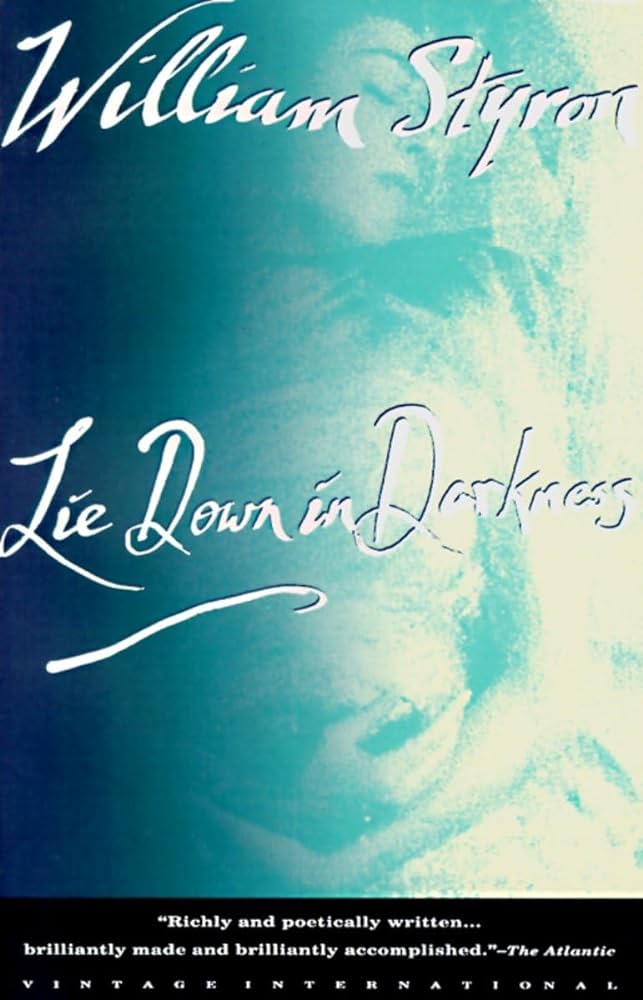
Content warning: this review discusses mental health and racism.
I’ve reviewed a handful of books that many readers would consider to be archaic. They can be considered timeless like A Farewell to Arms and Goodbye, Mr. Chips. Others can be dated to some extent. I’ve talked about both on this website before, yet I’ve never dove into the subject, so I’ll do so with today’s subject Lie Down in Darkness – the 1951 debut novel of William Styron. It’s a Southern Gothic tale that does well with diving deep into character mindsets, but it’s slightly marred by unnecessary racism.
Lie Down in Darkness is about the Loftis family of Port Warwick, Virginia as they grieve for their daughter Peyton’s death. On the day of their daughter’s funeral, separated couple Milton and Helen Loftis reflect on the betrayals, infidelities, disappointed love, and expectations that led to her suicide. Milton is a man of great charm and infinite weakness, especially for alcohol, while Helen gave all of her love to their physically and mentally disabled daughter Maudie. Peyton is adored by her father and loathed by her mother, and she is ultimately destroyed by that mixed inheritance.
Now, one might think, “Oh, is this another tragedy about a Southern family?”
I can easily see that because the early to mid-twentieth century liked those kinds of stories. They take place in the American South and often focus on family dynamics and the loss of Southern heritage. Examples are books written by William Faulkner as well as movies like Cat on a Hot Tin Roof, A Streetcar Named Desire, and A Summer Place. I especially bring up Faulkner because there are reviews of Lie Down in Darkness that compare Styron to The Sound and the Fury author.
Nonetheless, Lie Down in Darkness still stands out in a few ways. For one thing, I liked how the flashbacks jumped back and forth. I was a little confused by this at first, but it made sense because this reflects the parents’, especially Milton’s, state of mind as they grapple with Peyton’s death. While they go through the funeral, both think of what led up to her suicide, which results in the flashbacks. While this isn’t anything new, it’s more realistically executed than say in Goodbye, Mr. Chips.
Another thing that makes it stand out is what separates Milton and Helen. In many stories of this time period, if a marriage is falling apart, it’s usually because of some outside force. For example, the union between Doc and Lola Delaney in the William Inge play Come Back Little Sheba is threatened due to the former’s alcoholism. In Lie Down in Darkness, it starts crumbling after Helen and Milton find out that their eldest daughter Maudie is disabled. This results in the former wanting to take care of her as much as she could, while the latter barely does anything with their daughter and drinks. When Peyton comes around, the opposite occurs. Once Maudie dies (most likely from being too good in that world), they begin to reconcile, but soon after, they are back to being at odds with each other. This ultimately shows that there was something deeper that drove them apart in the end. One character sums it up that Milton has too much love, while Helen doesn’t have enough. Also, the book doesn’t reveal if they got back together in the end, which is a great, realistic touch.
Finally, the novel does a good job with depicting Peyton’s depression. Throughout, she doesn’t get along with Helen because she always felt that the latter didn’t love her for some reason. On top of that, even though she adores her father, once he kisses her at her wedding in a way that makes her uncomfortable, she begins to see him for what he is. Also, there’s a section inserted in the final chapter that portrays the final days of her life. In it, she explains that she feels like her head is underwater. The book doesn’t judge her for feeling that way. She grew up in a household that was full of mixed messages. One parent offers you too much love, while the other doesn’t give enough. In addition, she is not a saint. Peyton is immature and spoiled, and the novel is fully aware of that. She even ties Maudie up to a tree during their childhood. I’m not surprised that the portrayal of depression is done well because Styron himself would have that during his lifetime. In fact, he wrote about it in his 1989 memoir entitled Darkness Visible: A Memoir of Madness, which is one of his best-known works outside his 1979 novel Sophie’s Choice. It’s a believable portrayal.
Finally, let’s discuss the racism in the book. I get that it takes place in the mid 1940s American South and that the family is an upper-middle class one with two black servants. In many ways, racism informs the privileged environment that they live in, so yes, the mentions of the n-word are to be expected. Money is sometimes talked about since Helen received an inheritance of $20,000 early in her and Milton’s marriage. Also, I understand that Styron had a Northern mother and liberal Southern father, which helped him to understand race relations in the broader sense, but one would not get that while reading Lie Down in Darkness because the black characters that have names and personalities are often portrayed as fat, ugly, primitive, and God-fearing people. And yes, the novel even mentions a group of them eating what else watermelons and chicken. Granted, if these characters existed in real life, they would be racist given the environment that they’re in even though when Peyton marries a Jewish guy, both Milton and Helen think about their prejudice against semitism. Moreover, while being liberal in 1951 is not the same as being so in 2024, the constant use of black stereotypes was still unnecessary, and it slightly ruined the novel for me.
Lie Down in Darkness by William Stryon is both timeless and a product of its time. There will always be tales about family breakdowns, and this is no different. The things that make it stand out are the natural flashbacks, the subversive reason of why the marriage didn’t work, and the realistic depiction of depression. The racism, while reflecting the privileged environment the Loftises live in, threatens to undo what good the novel does. I would recommend it to those who like Southern Gothic novels as well as titles by William Stryon and William Faulkner. On the other hand, I will warn readers about the constant racism and how depressing it can be. Although Lie Down in Darkness is an archaic novel, it’s timeless to a degree.
Before I go, I want to let you all know that the latest episode of the Adapt Me Podcast is out now! Returning guest Zita Short and I discuss how we would adapt this novel. Check it out at this link!
Subscribe below to get notified when I post new updates. Also feel free to email me here for any review suggestions, ideas, or new titles!
 Book Reviews by a Chick Who Reads Everything
You nailed it. The negative caricatures may not have struck the author and his editors as racist in 1951, but seem obvious now. Variation on that theme: Styron’s cultural appropriation in The Confessions of Nat Turner. He is a gifted writer, but in my view these books have not aged well.
LikeLiked by 1 person
Thank you! I’m a little hesitant to look at “The Confessions of Nat Turner” for that reason, but maybe one day, I’ll read “Sophie’s Choice” even though I understand how Styron handles the Holocaust is questionable.
LikeLike