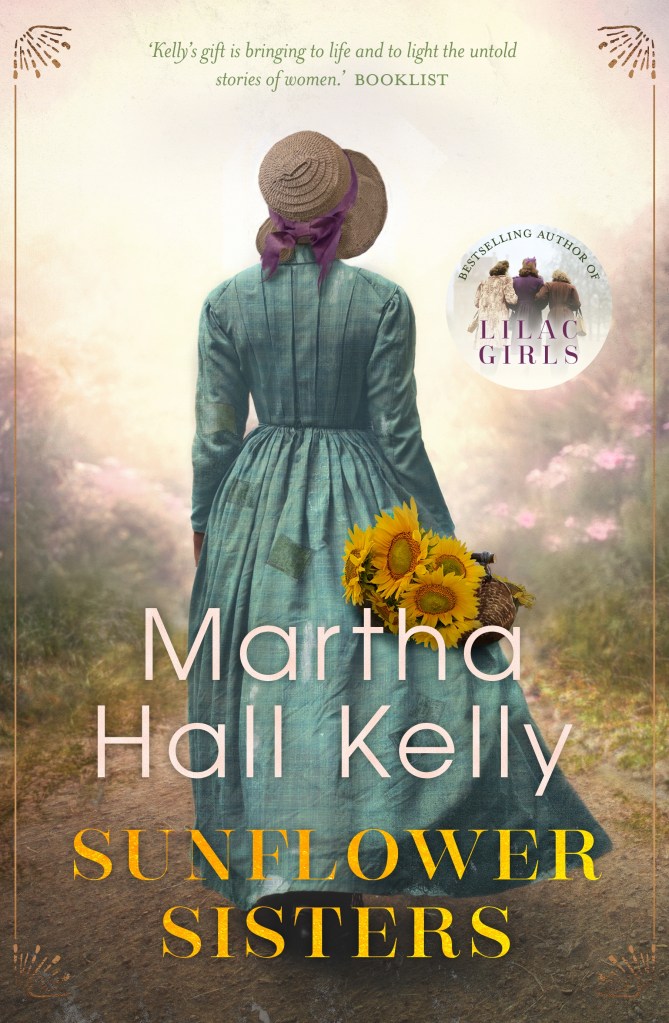
A book series has a hard job of keeping up a story’s momentum while expanding what it can do. Some have been successful like Harry Potter, while others start to feel formulaic as it progresses. Even if the series begins to feel bland, there could still be interesting aspects that make readers keep going. Case in point: Sunflower Sisters by Martha Hall Kelly – a book with highlights despite having the same old tropes in American Civil War fiction.
Sunflower Sisters is the third book in the Lilac Girls aka the “Woolsey-Ferriday” series although all three titles can stand on their own. It revolves around Caroline Ferriday’s ancestor Georgeanna Woolsey, a Union nurse who joins the war effort during the Civil War. She crosses paths with Jemma – a young enslaved girl who is sold off and conscripted into the army – and Anne-May Wilson – a southern plantation mistress whose husband enlists.
While reading it, I noticed that Sunflower Sisters followed a similar structure to Lilac Girls. Both have multiple perspectives; have an activist, a victim/survivor, and a villain as their main characters; many chapters end on cliffhangers; and most obviously, flowers in their titles. Furthermore, the victim’s tale is the heart of the story. I understand that having more than two viewpoints is unique in the literary world, especially when it comes to historical fiction. I guess Martha Hall Kelly thought that if it worked the first time, it can work a second, uh I mean third, time (I’ve not read Lost Roses yet, but I plan to do that in the future).
I probably would’ve forgiven this if it were more interesting. Lilac Girls explored the Rabbits of Ravensbrück in depth with its victim being a part of that horrible experiment, the villain being partially responsible, and the activist trying to help out that group. It was an aspect of Holocaust that I never knew about before, and it made me want to research it more. With Sunflower Sisters, the only aspect that makes it stand out from other American-Civil-War-based novels is that it’s mostly set in Maryland – a Union state that was still pro-slavery. This permitted characters to express more diverse views on the topic. For instance, Anne-May’s husband Fergus wants to free their slaves as soon as possible despite being a plantation owner, while her brother Henry fights for the Confederacy even though he wants the enslaved to be freed gradually. Everything else was something that I’ve seen before: the woman in a man’s world, a slave trying to escape, and a plantation mistress attempting to maintain her lifestyle. It does cover the New York City Draft Riots of 1863, but it’s contained to 1-2 chapters.
This is not to say that I didn’t enjoy the book. I was rooting for Jemma all the way. The relationship between her and her family was so strong that I wanted them to escape together and have a chance at freedom. My heart pounded when Jemma faced various obstacles including thrashings from Anne-May. Speaking of Anne-May, she felt like a more selfish version of Scarlet O’Hara with the only other difference between them is that the former is a snuff addict. I wanted Anne-May to get her comeuppance, and there were times that it came close.
When it came to the sections about Georgey, I felt a little less interested. It’s not that I didn’t care about her, her family, and her relationship with Dr. Francis Bacon. It was that while reading those sections, I felt like I was reading a medical dissertation. Granted, Kelly relied on the real Woolsey letters and even used them verbatim at times, and Georgey was a nurse, so I can understand that part. In addition, I knew that Georgey and Francis would get married, so the whole unrequited love situation dragged on for a little too long. It didn’t help that Francis’s fiance was mean, and I was like “Oh great! Here comes another antagonist.”
The story actually starts off with a prologue told by Mary Woolsey Howland – one of Georgeanna’s sisters. This explains why the Woolsey family became abolitionists and sets up the eventual connection between Georgeanna and Jemma. I like how it describes the slave auction that the family attends as well as their shock and horror, especially how the auctioneer lifts up the skirt of one of the enslaved females for all to see. However, I’m not sure why Mary is the one narrating it, for readers never hear from her again. I get that she was a writer (she wrote the poem that would become known as “Taps”), but so was Georgeanna. Why didn’t the latter narrate that prologue?
One of the things that a lot of reviewers agreed on was that the Author’s Note was a definite highlight. I concur 100%. Martha Hall Kelly narrates that part in the audiobook. One can tell how much she loved researching and writing about the Woolsey family. It’s a shame that Sunflower Sisters is reported to be the last in the Lilac Girls series although I wonder if Kelly is able to research even further back in that family.
In regards to the audiobook, I found it to be pretty good with narration done by Saskia Maarleveld, Shayna Small, Jenna Lamia, and Cassandra Campbell. Campbell needs no introduction as she narrated plenty of books like Where the Crawdads Sing and most logically Lilac Girls. She plays Mary in the prologue. Campbell does a fine job with conveying the shock and horror that Woolsey sisters experience while witnessing a slave auction.
Meanwhile, Maarleveld has recorded several audiobooks like The Secrets We Kept by Lara Prescott and lots of titles by Kate Quinn. She takes on the role of Georgey, and I liked the overall performance. She gives off a Jo/Amy March vibe specifically from the 2019 version of Little Women with a little less selfishness. She brings the determination and vulnerability needed for the character.
Small also previously appeared on this website for narrating The Vanishing Half by Brit Bennett. She plays Jemma. Small plays that character with bravery, nobility, and anxiety as well as having an inner strength that she doesn’t realize she has.
Finally, Jenna Lamia not only has recorded audiobooks for stories like The Shape of Water, The Help, and The Secret Life of Bees, but she’s also a writer and producer. She has created shows like MTV’s Awkward and NBC’s Good Girls. She takes on the role of Anne-May. Lamia’s performance brings out the cruelest and most selfish parts of that character. In addition, she has the most perfect Southern drawl I’ve ever heard outside of Vivian Leigh in Gone With the Wind. Her male characters tend to have the same woman-trying-to-sound-like-a-man voice, yet she gives little distinct characteristics like Jubal Smalls with his Southern drawl and Fergus with his gentility and concern.
All in all, Sunflower Sisters by Martha Hall Kelly is a fine book in the Woolsey-Ferriday series. It doesn’t really add anything new about the American Civil War despite being able to explore a lot of morally gray areas. I also felt for the characters for the most part despite being the kinds I’ve seen prior. I would recommend it to those who want to get their hands on books about the American Civil War, like stories about women being in a man’s field, and want to finish the Woolsey-Ferriday series. As for me, I plan on completing it myself by reading the 2nd book Lost Roses, so make sure to be on the lookout once that review drops in the future.
Subscribe below to get notified when I post new updates. Also feel free to email me here for any review suggestions, ideas, or new titles!
 Book Reviews by a Chick Who Reads Everything