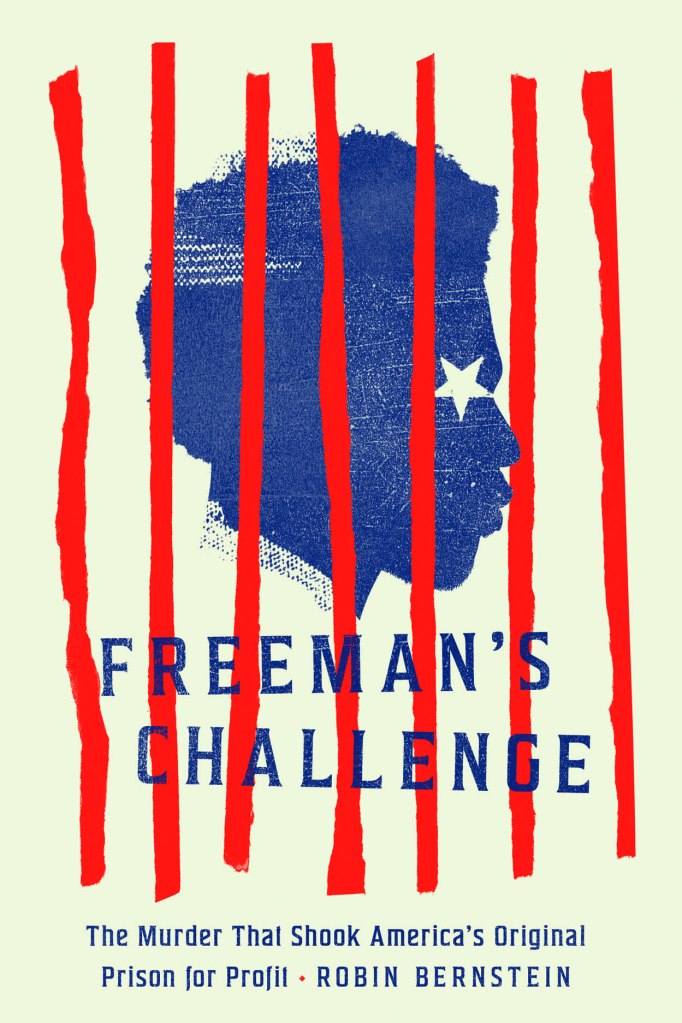
Full disclosure: I was given a copy of this book from Coriolis Company in exchange for an honest review.
The 250th Anniversary of America’s independence is coming up this year, and I always strive to learn more about American history, even if it means uncovering some skeletons in the closet. One story that I recently discovered was about the Auburn Prison – the country’s first profit-driven correctional facility. Specifically, I learned about how a former prisoner named William Freeman murdered a family and how its aftereffects linger on in the inherent Black criminality myth. I read about it recently in the book Freeman’s Challenge: The Murder That Shook America’s Original Prison For Profit by Harvard historian Robin Bernstein. It was highly informative, accessible, and riled me up in a good way.
Freeman’s Challenge: The Murder That Shook America’s Original Prison For Profit explores the origins of prison for profit and anti-black racism. In the early nineteenth century, while slavery was gradually fading away in the North, a village in New York State invented a new form of profit-driven prisons. It used incarceration and capitalism by building a prison that enclosed industrial factories. Therefore, the “slaves of the state” were leased to private companies. Even though the prisoners didn’t earn wages, they manufactured items that were bought by consumers throughout the North.
Then, one man challenged the system. Enter William Freeman. He was an Afro-Native teenager who was convicted of horse theft. He insisted that he didn’t commit, yet he was sentenced to five years of hard labor in Auburn’s prison. Infuriated at being forced to work without pay, Freeman demanded wages. His challenge first triggered violence against him, then by him. He committed a murder that confused and terrified white America. They struck back with ideals whose aftereffects reverberate in the myth of inherent Black criminality. William Freeman’s story reveals how the North invented prisons for profit 50 years before the 13th Amendment outlawed slavery “except as a punishment for crime” – and how famous African American figures like Frederick Douglass and Harriet Tubman invented strategies of resilience and resistance in a city full of unfreedom.
As I alluded to earlier, I knew nothing about the William Freeman case and the Auburn Prison. Bernstein provides plenty of information with lots of sources to back it up. For example, Harriet Tubman’s family actually lived in Auburn while she was on the Underground Railroad. In another, I didn’t know that William Henry Seward – future Secretary of State under both Abraham Lincoln and Andrew Johnson, as well as the guy who convinced the US government to buy Alaska from the Russians – lived and worked in Auburn and was invested in prison reform. He even defended Freeman, arguing that he was mentally ill due to his time in the correctional facility, hence he couldn’t stand trial. This was one of the earliest known cases involving insanity pleas.
The way Bernstein structures the book is accessible. It’s set up in three acts. The first provides the backstories of the Auburn Prison; William Freeman and his family, who were well-respected pioneers of the village of Auburn; and his time as a prisoner. The section involving William’s time at the prison is horrific as he’s subjected to a lot of torture, such as the shower-bath. The second deals with how William tried to get his unearned pay after his release and how that turned into payback. Bernstein uses this play on words quite a lot. It might annoy some people, yet it didn’t bother me all that much. The final act revolves around the trial and the aftermath. The book also includes tons of illustrations, including maps and photographs. It even has a series of paintings depicting the murder of the Van Nest family; it’s quite gruesome.
The strongest aspect of Freeman’s Challenge is how Bernstein skillfully imparts empathy to her subjects. She acknowledges the Auburn Prison’s politics and the harsh tactics it used to keep the prisoners in line, but she doesn’t preach on how terrible they were because it would seem redundant if she did. As for William Freeman, Bernstein paints him as a teenager who became broken after his time in prison. He did everything he could to get his wages that he believed he deserved legally, yet the author doesn’t excuse his actions of murdering an innocent white family. Despite the heinous crime, I still felt bad for him. While the whole notion that Black people were more inclined to commit crimes was present, Freeman’s crime exacerbated it. No one, not even his family, would take the time and listen to him about why he did it. At one point, Bernstein brings up that when the Cayuga Tocsin newspaper in Auburn published a portrait of Freeman, it met with great backlash because it didn’t fit with the public’s perception of the murderer. Freeman looked too neat. With the new portrait, he was more disheveled and had a sneer look on his face (p. 113-115).
Freeman’s Challenge: The Murder That Shook America’s Original Prison For Profit by Robin Bernstein is a great book about an overlooked event in American history. I always wanted to see how we got to believe certain things for good or for worse, and this falls right into that camp. There’s a lot of information, and it’s presented in ways that any kind of reader can understand. Also, it depicts the story as is, even if it got me riled up at times. I would recommend it to those interested in American history, Black history, and prisons. With America’s 250th birthday coming up, I’ve been more curious about learning about its history, even if it means shining a light on its ugly side, and Freeman’s Challenge falls into that.
Subscribe below to get notified when I post new updates. Also feel free to email me here for any review suggestions, ideas, or new titles!
 Book Reviews by a Chick Who Reads Everything
One thought on “Freeman’s Challenge: The Murder That Shook America’s Original Prison For Profit Book Review”