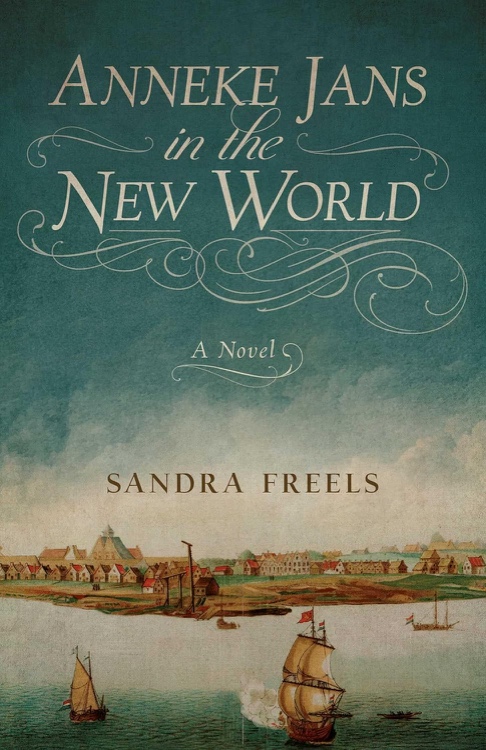
Full disclosure: I was given an ARC of this book from SparkPoint Studio in exchange for an honest review.
During the daytime, I’m an archivist. I help people find research material for their projects, especially about their ancestors. There are some people who have discovered so much about their families that they have written genealogy books based on what they know about their dead relatives. They are usually nonfiction as they focus on retelling the facts in a narrative format. However, there are some that are told as historical fiction novels. Author Sandra Freels found so much about her ancestors that she wrote a fictionalized tale based on the resources she came across called Anneke Jans in the New World. While it’s an inspiring tale, I wish the story and characters were more fleshed out.
Anneke Jans in the New World is about a spirited young mother who faces the unknowns of seventeenth-century New Amsterdam after leaving the Old World. It’s 1630, and Anneke Jans has just arrived in the New Netherland colony with her husband, Roelof, and two young daughters to create a new life for herself and her family. She is among the few women in the colony. In order to survive, she has to make her own rules. When Roelof dies, she marries Everardus Bogardus – the lively minister of the Dutch Reformed Church. With this marriage, she joins the colony’s elite. However, when the colony’s new director provokes war on the region’s Native Americans and her new husband emerges as the head of the anti-war opposition, she finds herself in the middle of political turmoil. As more difficulties grow, Anneke must rely on her wits to protect herself and her growing family.
I knew nothing about Anneke Jans before coming across this book. I did a little research on her, and it turns out that she’s known as the “Mother of New Amsterdam” because of her resilience, especially how she stood her ground over long-running legal disputes over her farm in that area. Her descendants kept the fight going centuries after her death, when the English took it over and transformed it into New York, and when the land became prime real estate in Manhattan. Freels claims that Anneke is one of her ancestors. She clearly had a lot to work with.
Making Anneke’s story into historical fiction was a big gamble since she is relatively unknown outside of New York State history, but Freels bit off more than she could chew. At nearly 200 pages, the narrative feels rushed. Plotlines are introduced and resolved very quickly. In addition, there’s little time for characters to sit with their emotions and reactions to various things. The closest that readers get with the latter is when Anneke finds out that her second husband died while at sea. The beauty of historical fiction is imagining how famous people felt behind closed doors and their reasonings for why they do certain things that would impact history. The writing belongs more in a textbook than in a novel because of how stilted it can be. Freels previously authored three textbooks, so that checks out. She needed to loosen up and explore more of the characters’ mindsets to succeed in the storytelling department.
As much as I complain about this book, there were things that I enjoyed when I took a step back and saw the bigger picture. I learned a lot about the New Netherland colony. It was fascinating to see how the people worked with each other and with the indigenous community as well as how those relationships changed over time. I kept going to see how Anneke Jans herself evolved over the years being in the New World. She starts off as a quiet and timid wife who didn’t know much about working the land. Over time, she learns how to utilize the property and trade with others in the most effective ways. Society pressured her to remarry after her second husband’s death, yet she remained resolved and wanted to make her own money and become the owner of her land as a widow. Since New York is celebrating its 400th anniversary soon, I hope people get to talk about her, for she’s a fascinating character.
Anneke Jans in the New World by Sandra Freels is a fine novel. It’s nice to know that a historical fiction book about Anneke Jans was written by one of her descendants. I learned so much about the environment at the time and the titular character. On the other hand, the writing needed more work. I felt like I was reading a textbook most of the time with how plots are introduced and resolved swiftly, and it rarely stopped to let characters’ emotions sink in. I would only recommend it to those who are looking to write stories about their ancestors. While it’s not perfect, Freels should feel proud for creating a historical fiction novel about her famous ancestor.
Subscribe below to get notified when I post new updates. Also feel free to email me here for any review suggestions, ideas, or new titles!
 Book Reviews by a Chick Who Reads Everything