Full disclosure: I was given a free advance reader copy of this book by Sasha Stolz Publicity in exchange for an honest review.
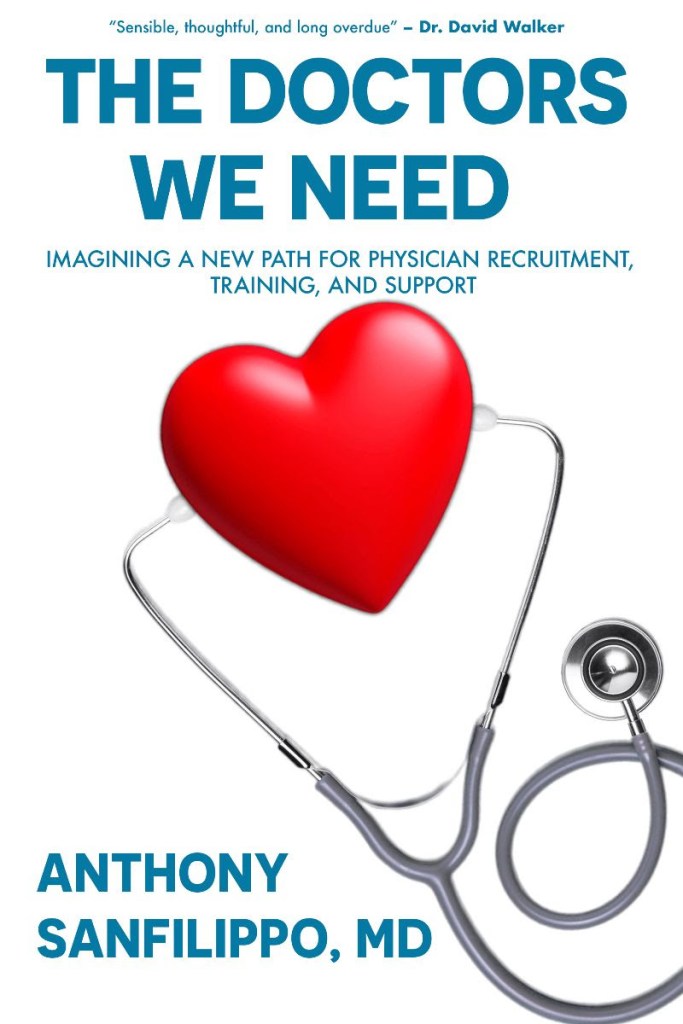
Even though I’m not in the medical field, I find it fascinating, especially how doctors navigate through it while taking care of their patients. Within the last two years, I’ve read three stories about doctors and their tales regarding their practices. These were Open for Interpretation: A Doctor’s Journey into Astrology by Alicia Blando, MD, Box of Birds: What New Zealand Taught Me about Life and the Practice of Medicine by Stephen Stowers, M.D., and Stress Test by Kay White Drew. Today, I’ll add a new book to that list: The Doctors We Need: Imagining a New Path for Physician Recruitment, Training, and Support by Anthony Sanfilippo, MD. This book addresses the “family doctor crisis” in Canada. Although I’m not Canadian and have no experiences with their medical system, I found this title to be an interesting look at the problem of not having enough doctors practicing family medicine.
The Doctors We Need: Imagining a New Path for Physician Recruitment, Training, and Support confronts the issue of the lack of family doctors. Despite Canada’s pledge to universal healthcare, over 6 million people lack a family doctor. This problem persists in spite of the investments in medical education and institutions. Dr. Sanfilippo addresses how the legacy processes for recruiting, educating, and promoting specialization in medicine have failed to adapt the basic healthcare needs any Canadian should expect. He offers real-life accounts when discussing the impact of outdated selection and training methods on doctor shortages, how the system lacks crucial oversight, and why current approaches fail to produce doctors with diverse skills needed today. In addition, he presents solutions that are more than just band-aids. This book provides a blueprint for transforming the medical system that can truly serve all Canadians.
Despite the fact that I have no experiences with Canadian medicine, it acknowledges problems that I’ve come across in the other medical-related books mentioned earlier. This is especially true with the conflict of profit/paperwork over patient care. Sanfilippo acknowledges that even if a person has a family doctor, they still have trouble finding a meaningful relationship with them, specifically if the physicians spend a good chunk of their time typing out the patients’ problems on a computer and the “one problem per visit” mentality. This shows that the American and Canadian medical systems have similar issues.
It also makes me grateful to have a primary care physician. I’m able to email her when I have questions regarding my health. She’s good at giving medical advice as a doctor should be. At the same time, it’s still an impersonal relationship since she comes and goes. This is the kind of problem Sanfilippo is referring to.
Despite the family doctor shortage, Sanfilippo offers reasonable solutions in the later chapters. These include “developing standards for admission that are relevant to modern medical practice,” designing programs to prepare learners for that kind of career, being realistic of about what it is and what it isn’t, and expanding “the admission process to attract and welcome individuals who have had some personal experience in other fields of health care” (p.130, 132, 135, and 140).
I am absolutely all for these answers, especially the fourth one. There are plenty of people who have plenty of experience working in the medical field, but for reasons like cost, disabilities, and other circumstances, they choose not to go to medical school.
On top of that, Sanfilippo backs up his arguments with footnotes from credible articles and uses regular language to convey what he wants to say. While I had a hard time connecting with the material, he did a good job with communicating his thoughts. After all, he knows what he’s talking about since he is a cardiologist and former Associate Dean of Medical Education at Queen’s University.
The best parts of this book are the stories of real-patients and doctors. They paint realistic and diverse situations that exemplify what Sanfilippo talks about. For example, to illustrate the issue of not enough primary care physicians in Canada, Sanfilippo tells the story of Rachel. She always wanted to be a family doctor, and she proved to be a highly capable and dedicated one. But when she was looking to go on maternity leave, she couldn’t find other physicians to take on her patients. As a result, she left the practice and started working temporarily replacing those on leave or on vacation (p.17-21). These stories serve to describe the depth of the problems faced by the small number of primary care doctors and how the system must change to better address the needs of today’s patients.
The Doctors We Need: Imagining a New Path for Physician Recruitment, Training, and Support by Anthony Sanfilippo, MD is a good book that takes a hard look at the lack of family doctors in Canada. It offers clear-eyed views on how the issue became what it is and reasonable solutions. Also, it cites credible sources as well as uses regular jargon and real-life stories to get various messages across. It’s definitely one of those titles that works the best if the reader is familiar with the Canadian medical system. Even though I’m not, I still found plenty of things to admire about it. The Doctors We Need: Imagining a New Path for Physician Recruitment, Training, and Support will be out Tuesday, December 3, so go grab it wherever you get your books.
Subscribe below to get notified when I post new updates. Also feel free to email me here for any review suggestions, ideas, or new titles!
 Book Reviews by a Chick Who Reads Everything