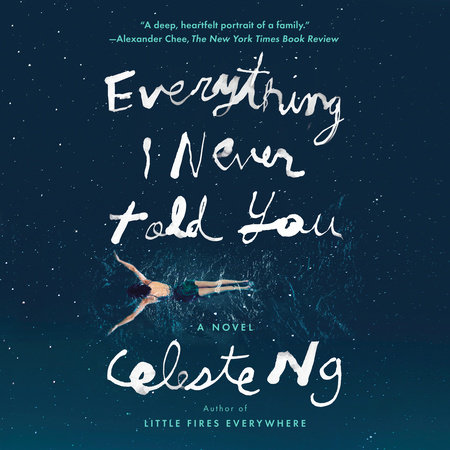
Before I began reviewing books, one of the best titles I read was Little Fires Everywhere by Celeste Ng. Since 2017, I’ve been wanting to read more of her novels. I finally did with her 2014 debut Everything I Never Told You. Today, I’m going to tell you everything about why I love that book.
Everything I Never Told You is about a Chinese American family reeling in the aftermath of their much-adored daughter’s death. In 1970s small-town Ohio, Marilyn and James Lee are determined that their favorite child Lydia will fulfill the dreams that they were never able to pursue. But, when she is found lying in a local lake, the balance that kept the family together is destroyed. This tumbles them into chaos as they reflect on their lives and how they tried to understand one another as husbands and wives, mothers and daughters, and fathers and sons.
The opening line, “Lydia is dead. But the family doesn’t know it yet” is one of the most iconic in modern books. It not only sets up the beginning scene, in which the family goes on their day while wondering what happened to Lydia, but also the tone. The book is told through the omnipresent third person point-of-view. It details every action and emotion each character goes through as if this narrator knows everything. Some readers might get annoyed with everytime that the novel mentions something like, “But they don’t know this” or “They will never know.”
However, this is the point. Parents James and Marilyn, brother Nathan, and sister Hannah all have their views on what led up to Lydia’s death, but they will never know the whole truth. Through the third perspective, readers are able to get to know the characters objectively. It’s honestly one of the best uses of the third person narrator I’ve read in a long time.
Another strong element is the characters themselves. Since this is a character study through and through, each one is given plenty of depth, which allows readers to determine how they feel about them. Marilyn is the white mom, who at one point in her life wanted to become a doctor. However, she was in high school and college in the 1950s – a period that wasn’t kind to ambitious women like her. This is cut short when she falls in love with her professor and gets pregnant while in college. She feels so stifled by her duty as a housewife that in 1966, she leaves the family to finish her degree, but she comes back eventually. She then puts all of her energy in making sure that Lydia’s “dreams” of being a doctor are fulfilled. James is the Chinese-American dad. While he went to a prestigious school growing up, he felt shame while the white kids in his classes gawked at him. All he wanted to do was blend in, and he got that chance when he found a student who didn’t look at him weirdly while teaching his course on the American West.
Then, there are the siblings Nathan and Hannah. Nathan is the eldest child, who was a swimmer and wants to become an astronaut. After Marilyn comes back home, he is often neglected by his parents to care more for Lydia. It was heartbreaking when his requests for a hard-boiled egg went unheard. He thinks that Lydia’s boyfriend Jack had something to do with her death mainly because he destains him for being mean to him at the local swimming pool when they were younger. Hannah is the youngest daughter, who was born after Marilyn’s return. She’s often ignored by the other characters non-deliberately, and she takes it in stride by hiding in nooks and crannies. She is the most objective character in the story as she notices things that the other characters don’t, yet it doesn’t mean she knows everything. In the end, James plays with Hannah in a way that he did with Lydia, thus acknowledging more of her presence and finding a way to move on.
And of course, I can’t forget Lydia. She feels too much pressure from both of her parents to not only succeed, but also to be liked. This is hard for her since she and Nathan are the only non-white kids at their high school. Nonetheless, she obeys since she made a deal when her mom was gone that if she came back, she would do everything that she would tell her to do. One will have to read the novel to find out what led to her death.
Now, I bet there are people reading this and wondering how I feel about Everything I Never Told You in comparison to Ng’s magnum opus Little Fires Everywhere. Well, even though I enjoyed both, I actually like the former more than the latter. It’s clear that a lot of elements from Everything I Never Told You made their way to its successor like the omnipresent third narrator, small towns in Ohio, what it means to be Asian in a close-knit community, mothers who expect too much from their daughters, and children who know more than they let on. Both titles are exquisite in their own rights with their intriguing characters and memorable opening scenes, but I prefer Everything I Never Told You because the people in it have more depth, and also, Elena the mom got more on my nerves as Little Fires Everywhere progressed.
Cassandra Campbell narrates the audiobook, and she is no stranger to this website. She has recorded several ones for books like Where the Crawdads Sing and Lilac Girls and is undeniably the most well-known narrator in this field. She does a good job with voicing the characters with subtle touches like James with a stoic tone; Marilyn determined; Nathan sulky; Hannah naive, but not stupid; and Lydia lonesome. However, there was one thing I pondered. Considering that the book deals with race, specifically the Asian-American experience, one would think that the people making this audiobook would have thought about getting a narrator who is of that ethnicity. This is not a knock against Campbell, a white woman. She does a good job with capturing the humanity of each character without leaning into stereotypes. It makes me wonder if the audiobook would’ve been improved if they had gone with an Asian-descended narrator since it was written by Celeste Ng, whose parents were from Hong Kong. Again, Campbell does a good performance.
Everything I Never Told You by Celeste Ng is a powerful look at a mixed-race family dealing with the death of their favorite daughter. Each of the characters have plenty of depth that leaves it up to the readers to decide how they truly feel about them. In addition, I can’t imagine this story without its omnipresent third person narrator. I definitely recommend it to all readers, especially to those who love family dramas and stories about marginalized people. The novel is beautifully written, and I will remember many things from this like its opening line and scene for the rest of my life.
Before I go, I want to let everyone know that I recorded the latest episode of the Adapt Me Podcast recently. Returning guest Cheyne Nomura and I talk about how we would adapt this book into a limited series. It’s up right now, so go check it out!
Subscribe below to get notified when I post new updates. Also feel free to email me here for any review suggestions, ideas, or new titles!
 Book Reviews by a Chick Who Reads Everything
4 thoughts on “Everything I Never Told You Book Review”