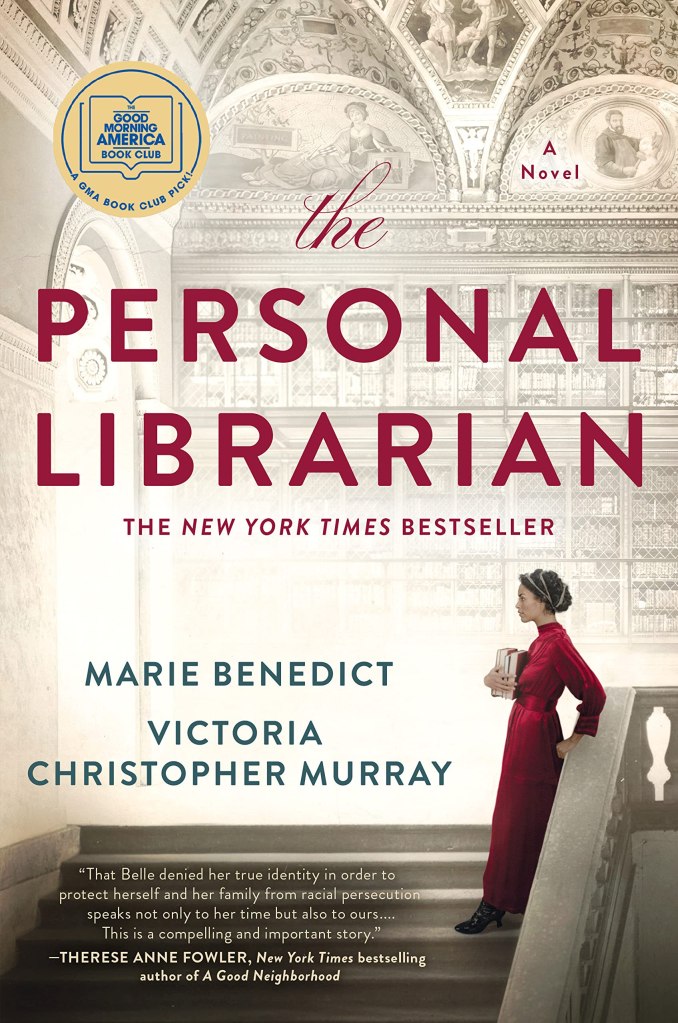
I love historical fiction. Specifically, I enjoy learning about real life people and events from those books, so I can do more research about them. I also love libraries (and I’m not just saying that because I work in one). These two aspects found their way together in a historical fiction novel called The Personal Librarian by Marie Benedict (the pen name of Heather Terrell) and Victoria Christopher Murray. I didn’t know anything about Belle da Costa Greene prior, but once I read it, the book made me want to learn more about her because it contained three-dimensional characters and realistic world building.
The Personal Librarian explores the little-known story of Belle da Costa Greene – J.P. Morgan’s personal librarian – who became one of the most powerful women of New York despite keeping a dangerous secret that would prevent her dreams from coming true. In her twenties, Belle is hired by the legendary J.P. Morgan to curate a collection of rare manuscripts, books, and artwork for his newly built Pierpont Morgan Library. She becomes a staple in New York society and one of the most powerful people in the book and art world, known for her taste and negotiating skills as she helps to build a world-class collection. However, she has a secret, one she must protect at all costs. Her darker complexion is not because of her Portuguese grandmother, but it’s because she’s Belle Marion Greener, daughter of Richard Greener – the first Black graduate of Harvard and a well-known advocate for equality. This tells the story of a woman known for her style, taste, and wit and the lengths to which she must go —for the protection of her family and her legacy—to preserve her carefully crafted white identity in the racist world in which she lives.
Before I get started, I want to give credit to Benedict. She recognized that as a white woman, her perspectives on the black experience in the United States is limited. As a result, she reached out to Victoria Christopher Murray – a black woman – because the former liked the latter’s work. It was also good to hear that they became friends while writing the novel, and I’m glad that they have collaborated on more than one novel together (my review of their latest title The First Ladies will be up in the near future)!
I really like the supporting cast. Each one of them carries a specific motivation and their own secrets. For example, Belle’s mother Geneiveve encourages her family to pass as white to ensure their survival in a society that discriminates against black people wholeheartedly. However, this decision also led to the separation between her and Richard. Throughout the novel, Belle struggles with her identity as she wants to be herself, yet society won’t allow it. She and Geneiveve fight over this, yet it’s revealed that at one point, the latter thought, like Richard, that black people could live as equals to white people during the Reconstruction period.
Another character who holds secrets is Anne Morgan – J.P. Morgan’s youngest daughter. Anne spends the majority of the book barely acknowledging Belle’s presence in her father’s professional life. However, she doesn’t want to thwart Belle. She simply desires recognition of her work by her father despite being a lesbian who’s in a Boston marriage with another woman.
The obvious main strength of the novel is Belle herself. She’s a savvy librarian and art collector, and I enjoy the sections where she displays her style and wit. At the same time, Murray and Benedict are not afraid to show Belle’s vulnerability, especially when she gets close to Bernard Berenson – one of Morgan’s rival art collectors. When she becomes pregnant, readers understand her concerns, even if Bernard doesn’t. Moreover, they display her frustrations in life realistically. This is especially true with how Belle’s money supports not only her family, but also her sibling’s families too. She knows that she has the best opportunities for a successful life, yet she seeks gratitude from them, especially when they try to split the salary that Belle just received. The authors blend these aspects together seamlessly. In addition, the fact that Belle da Costa Greene was a real person adds more to the story.
My only complaint is that the plot of The Personal Librarian feels too similar to that of Carnegie’s Maid by Marie Benedict. I haven’t read the latter, but I couldn’t help but notice that their blurbs are almost identical. Both stories deal with women from a lower class who end up working for rich men. They display their business instincts so effectively that their bosses began to rely on them and even grow closer to them. However, they have to keep their guard up because of secrets that they harbor. For Belle, it’s that she’s a light-skinned black woman, and for Clara Kelley from Carnegie’s Maid, she’s a poor farmer’s daughter who assumes the identity of an Irish maid after the latter woman has vanished. It’s almost like Benedict has the same Mad Libs sheet, and she only changed the nouns. At the same time, I’m not going to jump into any more conclusions until I read it. What do you think of this?
The audiobook is narrated by Robin Miles. While Miles has acted on and off Broadway and in TV shows like Law and Order, she’s best known as an audiobook narrator. She has received accolades for titles like Just As I Am by Cecily Tyson and Michelle Burford, Caste: The Origins of Our Discontents and The Warmth of Other Suns: The Epic Story of America’s Great Migration by Isabel Wilkerson, and Charlotte’s Web. Miles has also recorded audiobooks for The Seven Husbands of Evelyn Hugo by Taylor Jenkins Reid, The Book of Lost Friends by Lisa Wingate, and Hidden Figures: The American Dream and the Untold Story of the Black Women Mathematicians Who Helped Win the Space Race by Margot Lee Shetterly.
Miles provides the main character with the needed elegance, wit, and vulnerability to make the character believable. She also distinguishes other characters well. While her male characters tend to have a similar Mid-Atlantic accent (unless they are explicitly from another country besides the United States), she sprinkles some vocal differences in them. For example, Morgan himself has a stern tone, and Mr. Berenson displays a kinder one.
All in all, The Personal Librarian by Marie Benedict and Victoria Christopher Murray is a really good historical fiction novel about a librarian who shook New York in the early 20th century despite the secrets she keeps. Readers will clearly understand each of the character’s motivations, especially Belle’s, even if they don’t personally agree with them. I also like the theme of how every one of them harbors their own secrets and how it flows quite naturally throughout the book. I would recommend it to those who enjoy reading about librarians and libraries, passing, and life in the early 20th century. Now, I must do some more research on Belle da Costa Greene, like reading the book An Illuminated Life: Belle da Costa Greene’s Journey from Prejudice to Privilege.
Subscribe below to get notified when I post new updates. Also feel free to email me here for any review suggestions, ideas, or new titles!
 Book Reviews by a Chick Who Reads Everything