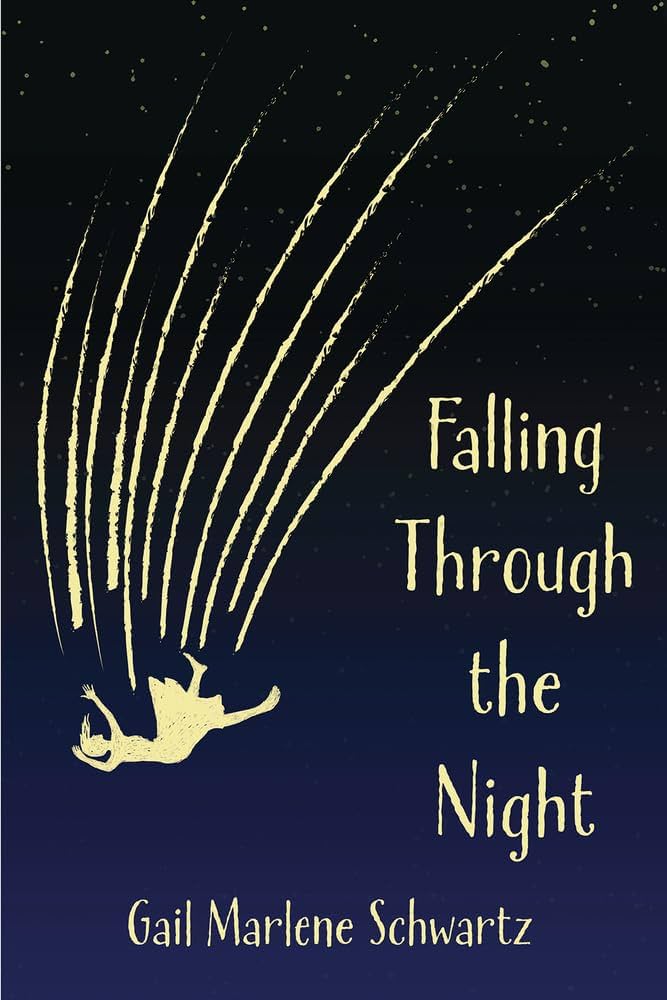
Full disclosure: I was given a free advance reader copy of this book by Books Forward in exchange for an honest review.
It’s funny how in six months, I’ve read two books about queer, Jewish women. One was the memoir Late Bloomer: Finding Authentic Myself at Midlife by Melissa Giberson. Today’s subject, the fictional Falling Through the Night by Gail Marlene Schwartz is the other. The latter is a fascinating look at one queer woman’s journey to create a healthy family.
Falling Through the Night is about Audrey Meyerwitz, a queer, 30-something, insomniatic American woman who wants to fall in love and have a family. But, it’s far from simple due to the Generalized Anxiety Disorder she has struggled with since childhood. When her best friend Jessica, a recovering alcoholic, helps the introvert Audrey with finding a partner through SheLovesHer, the latter takes the first step in fulfilling her dream. Through online dating, she finds a woman named Denise who lives in Canada. They hit it off, and soon, Audrey moves to that country. Together, they have twins, while Audrey struggles and grows. But when she unearths a secret about her mother, everything about her identity as a mom, daughter, and a person with mental illness changes. How can she create closeness from roots of deep alienation? With humor, honesty, and complexity, Audrey learns that healthy love means accepting gains and losses, taking off the blinders of fantasy, and accepting the messiness that defines human families.
I adored Audrey. She is a lesbian and Jewish, and she has an anxiety disorder. Also, she was adopted. Even with all of those identifiers, she is still relatable. She wants to create a healthy family, but there are so many obstacles like finding a partner, getting pregnant, and realizing how her adoptive mother raised her. But, in that journey, she makes some decisions that would easily irk some readers. For example, when she and her wife discover that they are having twins, one of them has Down Syndrome and heart problems. Because of the stress of raising a severely disabled child, they put the baby up for adoption. Also, Audrey is a pushover. Over the course of the novel, she develops the confidence to stand her ground. This is especially true when she has to confront a close friend about why she and her wife were being shunned from their inner circle and later, she does the same thing with her adopted mother when wanting to find out the truth surrounding her adoption. Both were quite satisfying.
In addition, I love the other characters and their relationships with Audrey. Denise is the French-speaking woman that she finds online, and readers can easily see why they were meant to be together. Both are creative and have experienced oppression in their own ways. At the same time, Denise has her own baggage since she was cheated on by past lovers. This is why she kicks Audrey out of the house when the latter tells her about her crush on the theatre director. Their relationship realistically evolves during the course of the book. It takes some time for Denise to understand and forgive Audrey. Audrey also reveals why she wanted Denise in the first place because she wanted to move to Canada to secure her healthcare coverage; she still loves her nonetheless.
Jessica is Audrey’s straight best friend, who lives in Vermont. She is loud, sassy, and caring. She is the one who encourages Audrey to go onto her journey in the first place. They bring out the silliness in each other, and scenes with them made me happy. My favorite part was when Audrey comically chases Jessica around with a “deadly pizza crust” in her Vermont apartment (p. 42). Jessica, too, has her own trauma since she’s a recovering alcoholic whose brother died recently. In fact, Jessica and Audrey met at a wellness facility while both were going through their therapies. However, when Audrey moves to Quebec, Jessica experiences some personal problems. What happened to her was extremely devastating, and Audrey must make certain choices alone as a result.
A small thing that I liked about the book was the short chapters. Most were no more than 5 pages, and there were 87 of them. The more I read the book, the more I realized that this was a deliberate decision made by Schwartz. Audrey gets overwhelmed when she has to read a lot of pages. By making the chapters short, it makes the story more authentic to Audrey’s character. In other words, it feels like Audrey wrote the book even though she would rather express herself through drawing.
I have only one nitpick, and that’s the structure. There are sections labeled stages. The first is “The Sensation of Falling,” the second is “Eye Movement Stops, Brain Waves Become Slower,” the third is “Beginning of Deep Sleep and Parasomnias,” and the last one is “Deep Sleep.” I’m not entirely sure what each of these signify, and what happens in each section doesn’t make it any clearer. Maybe someone who has experienced insomnia or some form of anxiety might understand this more. After all, Audrey displays panic attacks, excessive worrying, and sleep trouble throughout the book, and those issues are acknowledged and dealt with realistically. All I’m saying is that the structure with the four stages didn’t feel all that necessary.
Falling Through the Night by Gail Marlene Schwartz tackles the universal theme of creating families with a unique example. Given Audrey’s circumstances, it shows the obstacles of making such a thing happen realistically. All of the characters are fleshed out, and their relationships are believable. I would recommend this book to those interested in reading stories involving LGBTQ+, anxiety-prone, and/or adopted protagonists; Canada; and families. The novel is out now, so go get it!
Subscribe below to get notified when I post new updates. Also feel free to email me here for any review suggestions, ideas, or new titles!
 Book Reviews by a Chick Who Reads Everything