Full disclosure: I was given an ARC of this book from Stress Free Book Marketing in exchange for an honest review.
I’ve read a handful of mysteries, but there is one type that I haven’t covered yet: the historical mystery. These are ones that are set in the past, and historical context plays some role in the narrative. The best ones tend to be those that are thoroughly researched while still keeping readers guessing on the mystery. Today’s subject Death in a Gilded Frame by Cecelia Tichi is a clear-cut historical mystery. Does it fulfill its duty? While it’s not perfect, it does a good job with both aspects.
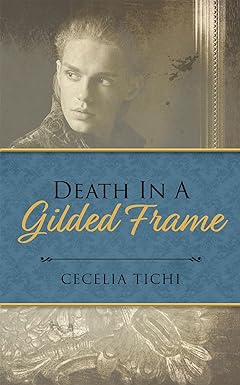
Death in a Gilded Frame is the sixth book in the Val and Roddy DeVere Gilded Age Series. It’s the Summer of 1899, and wealthy people and families are going to Newport, Rhode Island for the yachts and balls. Most importantly, there are famed artists that are eager to paint the portraits of the Society’s “Queens.” Western silver heiress Val Mackle DeVere agrees to sit for one for her husband Roddy, yet she discovers an art gallery manager screaming in silence while his hands clutch the gilt frame that’s pulled down over his head and shoulders, and blood soaks his cream-colored suit. Instinctively, Val reaches for the murder weapon, and as a result, she will find herself suspected, shamed, and shunned from Newport society as she tries to find the actual killer.
Tichi is not only a writer, but also a Professor of English and American Studies Emerita at Vanderbilt University. She has penned several books about the Gilded Age ranging from What Would Mrs. Astor Do?: The Essential Guide to the Manners and Mores of the Gilded Age to Gilded Age Cocktails: History, Lore, and Recipes from America’s Golden Age. In addition, other titles in the Val and Roddy DeVere Gilded Age include A Gilded Death, A Fatal Gilded High Note, A Deadly Gilded Free Fall, A Gilded Drowning Pool, and Murder, Murder, Murder in Gilded Central Park. Can you tell that she loves writing about the Gilded Age?
For those who aren’t familiar with that era, it’s the period between 1870 and 1914 that saw rapid economic growth in American history. This resulted in people who didn’t necessarily come from wealth becoming so. Tichi paints the Gilded Age beautifully and realistically. She establishes Newport as the go-to place for high society with all of its riches and snobbery. Cornelius Vanderbilt was right when he said, “No city on earth is as hostile to outsiders as Newport.”
Old money families are favored the most, while new money folks like Val can be tolerated as long as they learn to fit in. This establishes the personal conflict that she has throughout the story. I don’t know if this was present in the other books, but it feels like a running theme throughout the series.
I also like the characters. Val and her husband Roderick aka Roddy are an odd couple. While Val is from the West and an heiress of a silver mining business, Roddy is from the East and comes from generational wealth. Additionally, she is progressive in her politics, especially when it comes to women’s rights, but she can be impulsive. On the other hand, Roddy is more conservative and rational. Despite all of their opposites, they love each other and are able to work together to solve various cases, including the one in Death in a Gilded Frame. This is a realistic marriage that I wish more books would explore.
Another standout character is Cassie. She is Val’s best friend who has the ability to sense danger whenever she has her premonitions. Cassie is going through her own issue of trying to conceal her skill because people don’t understand it. She’s like Elsa from Frozen in that way. I would love to see her get more character development in future stories.
In addition, there were cameos from real-life historical figures. They included people like Alva Belmont – the first wife of William Kissam Vanderbilt – and Ellen Terry – a famous English actress at the time. Although they barely had an impact on the plot, these appearances were done tastefully in a way that I had to look them up to see if they were real. Again, I wouldn’t be shocked if this too was a present factor in the series.
As for the mystery of who killed Warren Eccles – the gallery manager, it was effective. It has good pacing in revealing the case’s developments. Also, it does a great job of keeping the readers on their toes on who the culprit is. I didn’t know who it was until the very end, and once I did, what Val does is extremely satisfying. Val does a lot of the sleuthing in this book, but I would’ve loved to see Roddy do some too. There are passages where he talks about going to the Reading Room – a gentleman’s club in Newport – to interview some of the members about what they know, but most of that happens off page.
A unique aspect to this series is that they include cocktail recipes. Since Roddy is a mixologist as well as a lawyer, the book includes ones for three different drinks. These are for a Martini (Dry), The Anticipation, and a Soda Cocktail. People will have to read the book in order to find out what the second one contains. This doesn’t shock me because Tichi had previously written two books about cocktail recipes in the Jazz and Gilded Ages. Not only does this provide a quirky component to the series, but also it elevates Roddy from being the stereotypical 19th century wealthy man.
My only complaint about the book is about the framing. The art frame looks stunning, but it’s the figurative one I have an issue with. Val gets accused of murdering Eccles after she’s seen holding the bloody knife by the body. I felt sorry for her as she dealt with the cruel high society making jokes about her supposed involvement. She even calls Roddy out for not helping her when a man compares her to Lady Macbeth, and she tries very hard not to punch people after making those insults. At the same time, I couldn’t help but notice that she brought it upon herself due to her impulsiveness. One would think that after 5 cases, Val would’ve known not to pick up the murder weapon when coming upon a crime scene for the first time. Even Roddy says, “Don’t.”
I guess Tichi added that in to give the Newport society a legitimate reason to force Val into the spotlight, yet it could’ve been more in line with her work as well as her character.
All in all, Death in a Gilded Frame by Cecelia Tichi is a highly enjoyable historical mystery. The main characters Val and Roddy are realistic, both as individuals and as a couple. Also, the novel portrayed 1899 Newport sensibly, and the mystery kept me on my toes. I would recommend this to readers who love whodunits, especially ones that are set in the past and contain female detectives, as well as, you guessed it, the Gilded Age! The book is out now, so have a Gilded time while reading Death in a Gilded Frame.
Subscribe below to get notified when I post new updates. Also feel free to email me here for any review suggestions, ideas, or new titles!
 Book Reviews by a Chick Who Reads Everything
2 thoughts on “Death in a Gilded Frame Book Review”