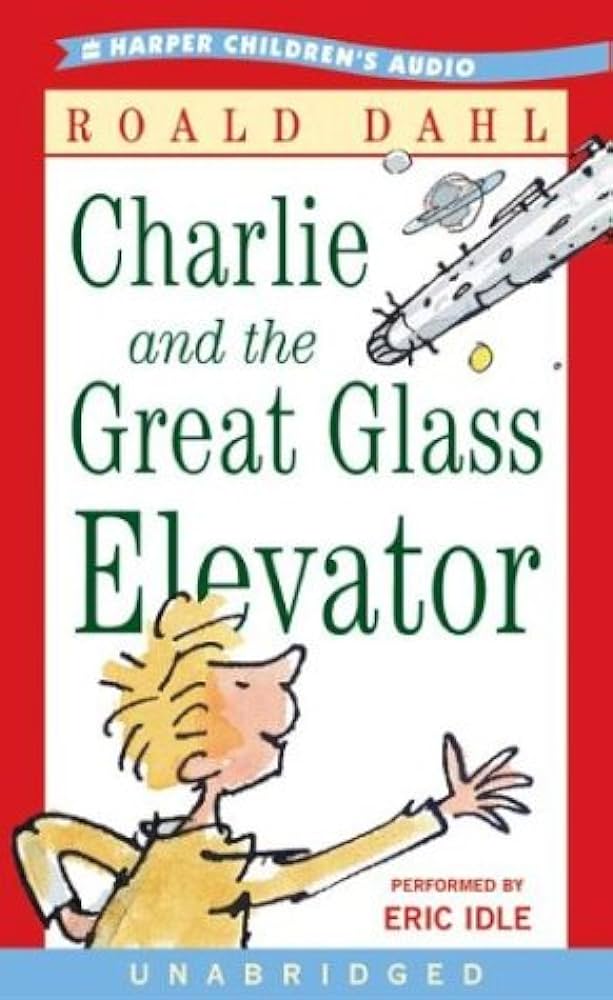

Over three years ago, I reviewed two Charlie and the Chocolate Factory audiobooks. One was narrated by Eric Idle, and the other was done by Douglas Hodge. I had such a fun time analyzing their narrations of the same story that today, I’m going to do the same thing, but with the 1972 sequel Charlie and the Great Glass Elevator by Roald Dahl. Coincidentally enough, Idle and Hodge narrated the two separate audiobooks, so it’s a rematch between the Nudge Nudge guy and the guy who played Alfred Pennyworth in Joker (2019)!
Before I get started, I need to get something off my chest. I struggled to figure out the point of Charlie and the Great Glass Elevator storywise. It has little to do with the chocolate factory and the events that took place in the prior book. It’s as if Dahl wrote the sequel due to 1. contractual obligations and/or 2. wanting to deliberately make it unadaptable because of his dissatisfaction with the movie Willy Wonka and the Chocolate Factory. Nonetheless, it was enjoyable to a degree because of the situations Wonka, Charlie, and the latter’s family got into, the locations they went to, and the vocal performances of both Idle and Hodge.
So let’s get started!
1. Charlie Bucket:
Idle still voices Charlie with politeness, but with newfound assertiveness that was mostly absent from the first book. After all, Charlie just received the chocolate factory, and Wonka stressed that he has to show him how to run it. It’s a well deserved improvement.
Meanwhile, with Hodge, Charlie sounds a little more mature. I don’t know if I picked this up while reading Charlie and the Chocolate Factory, but it’s an odd decision given that the events in Charlie and the Great Glass Elevator apparently take place on the same day as the tour of the chocolate factory. Hodge still sounds fine, but I question the decision to make Charlie sound older.
First point goes to Idle!
2. The Grandparents:
Idle once again channels fellow Monty Python member Michael Palin with his narration as Grandpa Joe. Not much has changed on that front. He gives the rest of the grandparents their own vocal distinctions. Grandpa George is like Joe but with less Palin influence. The grandmothers were my favorite. Grandma Josephine was voiced with a brash,but feminine Yorkshire accent, while Grandma Georgina had a softer tone.
Once again, Hodge let me down with his performance of grandparents. His performance as Grandpa Joe didn’t bother me since I got used to the spriteness. The problem was how the rest of the grandparents sounded almost the same. They all had a similar cranky tone, but I was amused when Hodge voiced Grandma Georgina as even more frail and cantankerous when she ages to 358 years. Like I mentioned in the previous matchup, one of the most important aspects of recording audiobooks is to distinguish each and every character, even if it is very slight.
To be fair on Hodge’s part, Idle has a whole lot of experience playing older characters, especially the Pepperpots – the old ladies on Monty Python’s Flying Circus.
Idle has another point!
3. Supporting Characters:
With Idle, the American President and his administration had their own versions of the American dialect that British people like to use to mock them. I enjoyed his take on Miss Tibbs as an old, commanding lady. He even does French, Russian, and Chinese accents for characters of those nationalities. The third was pretty cringy.
Speaking of cringe, the Oompa Loompas were improved. Idle developed his flow more, which made their chants feel more like limericks than raps.
Hodge too voiced the American President and his administration with their own kind of American accent that British people use to make fun of them. I especially enjoyed how he portrays the President as the type seen in 1990’s American action movies like Independence Day. He almost sounds like Dean Winters (Mayhem in the Allstate commercials) while voicing that character. The Chinese character was less stereotypical than Idle’s, yet it was still cringe. My only complaint with Hodge in this category is that I wish he would’ve gone further with Miss Tibbs. She barely made an impression with her faint voice.
As for the Oompa Loompas, Hodge demonstrates his great flow when reciting their chants. At various points, it even sounds like they are going to break into song. It was amusing during those sections.
Having evaluated these supporting characters, Hodge finally gets a point.
4. Character Consistency:
As mentioned in the previous review, Idle is known for doing a variety of silly voices throughout his career. It was mostly consistent. Sometimes his English accent slipped while narrating various American characters.
Hodge was also fairly consistent too. He was able to maintain various accents even though again, I wish he would’ve distinguished various supporting characters more.
At this point, I will give both Idle and Hodge half a point each because maintaining the characters’ voices is hard!
So far, here are the scores:
Idle: 2.5
Hodge: 1.5
5. Pacing:
Idle is slower in his narration this time around, but still engaging.
Hodge is still agile with his vocal delivery, and his transitions are still good.
Again, half a point is awarded to both!
6. Volume:
In my previous review, I complained how Idle could be too abrupt with his volume. I don’t know if it’s because Idle quickly learned how to perform in an audio-only environment, the sound mixing was improved, or both. Nevertheless, this is handled much better in this audio version.
With Hodge’s volume, I’m simply going to repeat what I said in that review because it’s the same evaluation. I didn’t have to tweak the volume as much when Hodge was narrating. He would take his time from being quiet to being loud, and still retain that vocal balance to prevent the listener from adjusting the volume constantly.
So, the point goes to Hodge!
7. Willy Wonka:
Idle vocally embodies Wonka in the same way he did in Charlie and the Chocolate Factory: an eccentric and highly imaginative fellow. Like I said before, I am perfectly fine with this since Idle has a natural affinity for Wonka’s mannerisms.
Hodge voices Wonka in a similar fashion, but I noticed a more sinister element to his interpretation. I don’t know if this was present in the previous audiobook for Charlie and the Chocolate Factory, yet I found it to be intriguing. Despite that, I gravitated towards Idle’s performance because that one was more suited to the story being told.
Last point goes to Idle!
Now! Here are the final scores:
Idle: 4
Hodge: 3
Even though Charlie and the Great Glass Elevator is lackluster compared to its predecessor, Idle and Hodge did a good job with elevating the material to make it their own. It wasn’t that close of a race. Idle had the edge for majority of the time because of his vocal delivery as well as the subtler differences in some of the characters that made him stand out more than Hodge.
Thanks for tuning in for another Audiobook Versus!
Also, guest Amanda Garrison from the Fictional Hangover Podcast and I cover Charlie and the Great Glass Elevator in the latest episode of the Adapt Me Podcast! It’s out now at this link!
And next week, I will be posting my Top 3 Best and Worst Books I’ve read in 2023, so stay tuned for that!
Subscribe below to get notified when I post new updates. Also feel free to email me here for any review suggestions, ideas, or new titles!
 Book Reviews by a Chick Who Reads Everything
3 thoughts on “Charlie and the Great Glass Elevator – Audiobook Narrator Edition – Eric Idle vs. Douglas Hodge”