Full disclosure: I was given a copy of this book by Dutton and Netgalley in exchange for an honest review.
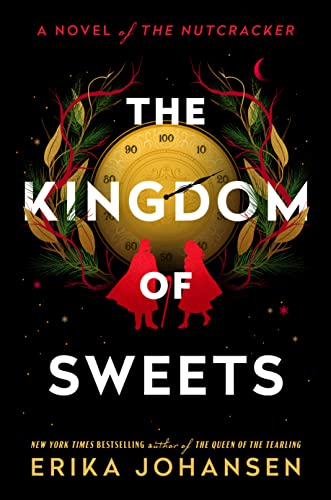
Christmas is around the corner, and that means more adaptations of timeless stories like The Nutcracker. Like many others, I grew up watching many versions and hearing its luscious score in television shows and films like Fantasia. The characters and music have inspired many books, movies, and songs. This includes today’s subject The Kingdom of Sweets by Erika Johansen. It’s a dark and fresh take on the classic tale.
The Kingdom of Sweets is about a pair of twins cursed by birth whose lives are forever changed on one Christmas. When Natasha and Clara Stahlbaum were born, a mysterious sorcerer named Drosselmeyer bestowed them with their destinies. Clara is given light, and she becomes the favorite and grows into beauty and ease. On the other hand, Natasha is disposed with darkness and is perceived as being ugly. As a result, she stands in her sister’s shadow. But on one Christmas Eve, Natasha gets her opportunity for revenge, for Drosselmeyer brings a Nutcracker to the party, which provides an entry to the Kingdom of Sweets – a deceptively beautiful world. In the land of snow and sugar, Natasha encounters the Sugar Plum Fairy, who is full of gifts and bargains and is much more powerful than Drosselmeyer. As Natasha uncovers her dark destiny, she must reckon with the earthly and magical powers and decide on where she truly belongs.
Before I begin with this review, I want to mention some personal connections with The Nutcracker. When I was 5 years old, I danced as one of the clowns in my dance class when they were a part of The Nutcracker recital. Then, in my junior year of high school, my all-girl choir class got to sing the “Waltz of the Snowflakes” at the end of Act I for a production at the Detroit Opera House. Those were some wonderful experiences.
This is truly a fresh take on the story. Apparently, Johansen was inspired to write The Kingdom of Sweets upon asking why Drosselmeyer singled out Clara for the special gift in the original tale and ballet. I love the different interpretations of the well-known characters. The Sugar Plum Fairy in earlier versions tends to be a fairy who happens to be the one everyone looks up to in the kingdom. In this novel, she rules over the kingdom with an iron fist and makes it look different depending on who is visiting. LIke Natasha, she too is hell-bent on revenge. With Drosselmeyer, he is portrayed as a kind old godfather and inventor who disappears after he gives the Nutcracker to Clara. In this book, he is much more of an enigma who has experimented with the dark arts and might have more nefarious motives. Also, the family is indebted to him in many ways, including financially. And then, there is Clara. In many adaptations, she is a nice, albeit a bit bland, girl, who gets sucked into fighting some rats and the world of sweets. The Kingdom of Sweets does an overhaul on her by making her a beautiful, but spoiled teenager who gets everything she wants and doesn’t get punished. While I understand Natasha’s twin bond with Clara, I despised the latter because of how selfish she was. Clara was like Aurora from Sleeping Beauty except unlikeable.
I understand that some readers didn’t like how every character was bothersome. I think that this was deliberate. Since Natasha is bestowed with darkness, she sees the wolves in almost every person she encounters. Hence, the flaws are going to shine brighter from her point of view. With that being said, some reviewers mentioned that she is so unlikeable that they didn’t want to root for her. I will admit that Natasha tested my patience sometimes. She commits some horrific acts like one on Clara in order to be with the boy she thinks she loves. At the same time, the feelings of being left out and having something taken away from you with little to no reason at all are ones that I know all too well. Natasha has a hard time moving on from various injustices, and so do I. In addition, she realizes overtime that she has some lightness, while Clara possesses some darkness. On a side note, there wouldn’t be much of a story had Natasha simply let go of her love much quicker.
Now, let’s talk about the titular place. Despite its name, it isn’t so sweet. I mean, it was at first because it was designed to reflect the emotions of the human who enters it. For example, when Clara arrives, it is described like one would expect in the ballet with lots of snow on the outside and pink on the inside. The kingdom remains that way when Natasha gets in and enters the ball, but overtime, it becomes more dark and spooky to mirror her mental state. This too was a unique interpretation of the location as things are not always what they seem to be.
Despite my praise for the book, there are two things that bother me about it. The first is Natasha’s name. Why Natasha? In Nutcracker and the Mouse King by E.T.A. Hoffman and in the famous ballet, Clara has two siblings: a brother named Fritz and a sister named Louise. If it makes one feel better, I didn’t know that Clara had a sister until I started doing research for this review. Fritz is present in The Kingdom of Sweets, and he slowly descends into madness after he encounters the Nutcracker for the first time. But, there is no Louise. I’m assuming that Natasha is supposed to be Louise, but why? Did Johansen think that Natasha was a more suitable name for the dark one? If that’s so, she could’ve incorporated Louise like having the main character be named that, but when she leaves Russia, she could change it to Natasha to start anew, or vice versa. This would’ve paid tribute to the original sister while still maintaining the author’s interpretation of the material.
The second is the epilogue. The book itself is structured like a 5-act opera with an overture and curtain. This is ironic given that the best known adaptation of Nutcracker and the Mouse King is a two-act ballet. I don’t have a problem with this since it gives the story more structure than the ballet does. My problem is that the epilogue aka Curtain is unnecessary. It details the life that Natasha lives after she leaves Russia and includes what happened to that country when it was transformed into the Soviet Union. The novel sprinkles in some subtle historical references like Ratsputin, Lenin, and even Dracula throughout, for even fantasy books are rooted in some form of reality. However, the Curtain provided this more in a more heavy-handed way. Sometimes, it’s best to leave it to the reader’s imagination as to what happens at the end. I wish it would have done that.
Overall, The Kingdom of Sweets is a unique retelling of the beloved story of The Nutcracker. The darker tone brings out certain elements always present in the tale, but not always acknowledged, especially why Clara is chosen to have the nutcracker. It’s not perfect, but it’s a well suited story for this time of the season. I would recommend it to those who love stories about cursed sisters and the many versions of The Nutcracker. The book will be out tomorrow, so go check it out!
Subscribe below to get notified when I post new updates. Also feel free to email me here for any review suggestions, ideas, or new titles!
 Book Reviews by a Chick Who Reads Everything
What a thoughtful review. I loved it!
I think since Clara means “bright” her name works for this story naturally. Natasha means “born on Christmas” and also “resurrection” so I love that meaningful name change.
LikeLiked by 1 person
Thank you!
I didn’t know about the name origins. That’s neat! I still would’ve wished for Louise to be incorporated somehow, but at the same time, Clara’s name in the original story was Marie.
LikeLike