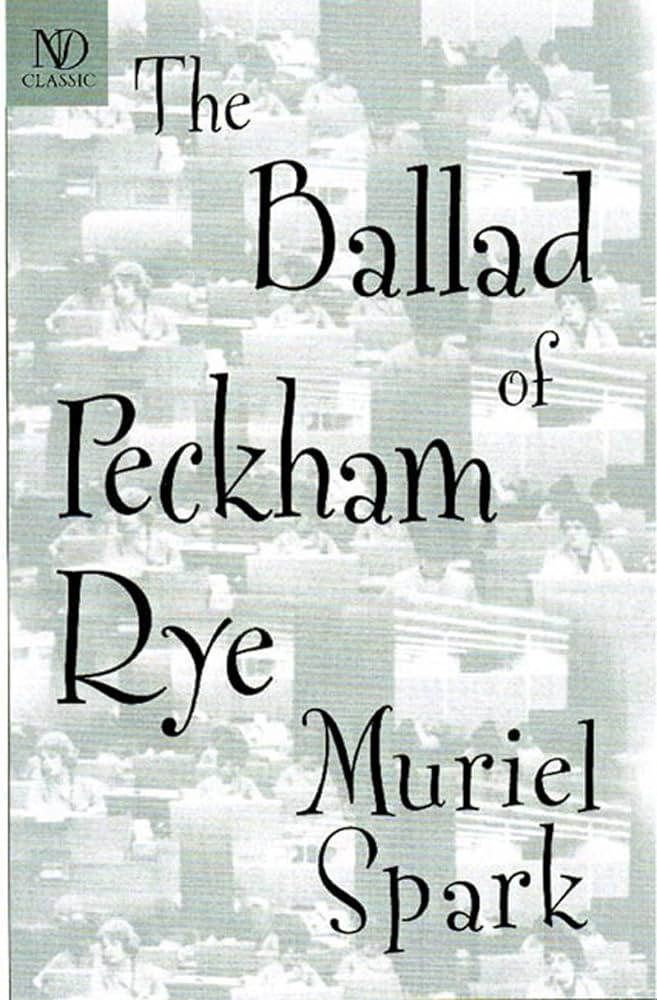
In all of the five years that I’ve been reviewing books, 2023 has to be the one where I’ve looked at the strangest titles ever. I’ve read at least two of them this year. Now, I can add another one to that list, and it’s an older one. It’s called The Ballad of Peckham Rye by Muriel Spark. It’s a devilishly good take on the stranger-coming-into-town story.
The Ballad of Peckham Rye is a farcical fable about a blue-collar town in South London that’s turned upside down. When the firm of Meadows, Meade & Grindley hires Scotsman Dougal Douglas (aka Douglas Dougal) to conduct “human research” into the private lives of their workers, they don’t foresee the mayhem, mutiny, and even murder that he will stir up. He ends up changing the lives of the eccentric characters he meets from Miss Merle Coverdale, the head of the typing pool, to V.R. Druce, the unsuspecting Managing Director.
For those who don’t know, Muriel Spark was a 20th Century Scottish writer. Her best known works were Memento Mori (1959), The Girls of Slender Means (1963), and most notably The Prime of Miss Jean Brodie (1961). The last one was turned into a play and later a movie that starred Dame Maggie Smith in the titular teacher role that got her the Best Actress Oscar in 1969 (the same year that Peter O’Toole was nominated for Best Actor for playing an instructor too!).
The first reason why I bring this up is that The Ballad of Peckham Rye was published in 1960, one year before The Prime of Miss Jean Brodie (yes, I’m fully aware that the titles are similar). The second is that it’s not among Spark’s well-known novels. I haven’t read any other books by her, but from what I’ve read from other reviewers, it’s a weird one.
I bet readers are asking how strange it is. Well, the man who comes into town and eventually wrecks havoc is one who may or may not be the Devil incarnate. Dougal/Douglas tells various people that he had horns but had them removed when he was younger, and it’s treated as if it’s completely normal. He also likes to take days off, which made me want his bosses to yell at him similar to how Alucard’s master does the same thing anytime he wants to go on a walk in the abridged version of the Hellsing Ultimate anime. But, that would be so un-British. Furthermore, he gets chummy with a bunch of employees, especially the female ones, by playing the role of the sad guy with the uneven shoulders. He has a hunch both figuratively and literally.
This isn’t just the Dougal/Douglas show even though he is the most memorable character. The rest of the cast are just as unforgettable. Spark has a knack for describing them in compact ways that I knew immediately who they were. The story is framed around why a young woman named Dixie was stood up by her fiance Humphrey at the altar. Dixie is a frugal person and works as a typist at Meadows, Meade & Grindley. She doesn’t like Dougal/Douglas because she thinks he’s putting ideas into the idiot Humphrey’s head. She wants to save and save for when they get married and purchase a home together. Then there is Miss Merle Coverdale. She’s the 38-year-old head of the typist pool at the same firm, and she’s been carrying on a loveless affair with V.R. Druce – a married man – for years. She is drawn to Douglas/Dougal since he is someone that she can talk to about her problems while still maintaining a front at work. Dixie and Miss Merle Coverdale were my favorite characters because of how defined their personalities and goals were. I always looked forward to finding out what they were up to.
I was also struck by how Pythonesque it felt. As mentioned earlier, it was farcical that Douglas/Dougal would tell people about his horns, and yet, the novel treats this as normal. However, it didn’t go all the way since the book was published in 1960, 9 years before Monty Python’s Flying Circus aired. A lot of that absurd humor was still being developed.
In fact, the tone felt closer to that of an Ealing Studios comedy. For those who don’t know, it’s a British studio that produced plenty of comedies post World War II, and they tended to focus on “unconventional, anti bureaucratic individuals in realistic settings.” These films included Kind Hearts and Coronets (1949), The Lavender Hill Mob (1951), and The Lady Killers (1955). Coincidentally, all of these movies starred Sir Alec Guiness before he became Obi Wan Kenobi. This tone is perfectly seen in The Ballad of Peckham Rye because of its exploitation of an eccentric character in a practical setting.
Despite how much I love the characters, I wasn’t really able to get into the story. I’m not entirely sure why. There wasn’t much of a plot to begin with. It’s basically a man coming into town and causing chaos. Maybe I thought since I knew what was going to go down, I wasn’t as invested as I should be although the whole Devil scenario caught me off guard. Then, there’s also how things abruptly came out of nowhere. This is especially true of what happens with Merle at the very end.
Overall, The Ballad of Peckham Rye by Muriel Spark is strange, but delightful in a British sense. The best way to look at this book is a character study of a blue-collar English town and of the man who “invades” it. Each of the main cast have well-defined personas and goals. The tone is another highlight since it captures a lot of black comedy that British films had at that time. People will certainly have opinions about Dougal/Douglas being the Devil incarnate. I would recommend this book to those love titles by 20th Century British writers, the stranger-coming-into-town trope, Ealing Studio comedies, and other novels by Spark.
Before I go, I want to let you all know that the latest episode of the Adapt Me Podcast is out now! It involves how guest Dashiell Silva and I would attempt to adapt this very book. Check it out at this link!
Subscribe below to get notified when I post new updates. Also feel free to email me here for any review suggestions, ideas, or new titles!
 Book Reviews by a Chick Who Reads Everything
One thought on “The Ballad of Peckham Rye Book Review”