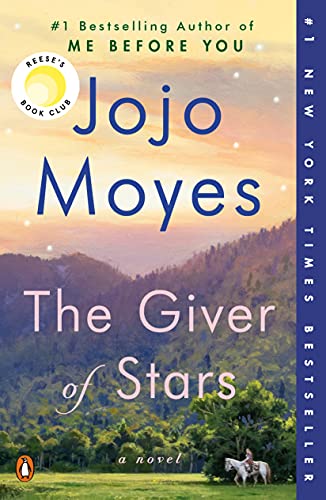
Over the years, I’ve come to accept that some books might resemble others in a variety of ways. They might cover the same topic and/or contain similar scenes. This is often a coincidence. What matters is how the titles stand out from each other. And there’s the saga of The Book Woman of Troublesome Creek by Kim Michele Richardson and today’s subject The Giver of Stars by Jojo Moyes. Released 5 months apart in 2019, the books contained so many similarities that Richardson even considered legal action against Moyes. After finally reading The Giver of Stars, all I can say is that it wasn’t all that interesting in the first half, yet it picked up in the second half.
The Giver of Stars is about an Englishwoman who becomes a Pack Horse Librarian in Depression-era Kentucky. Alice Wright marries the handsome American Bennett Van Cleve hoping to escape her restricting life. However, she soon realizes that life in Kentucky is equally limiting, especially living with her ruthless and overbearing father-in-law. Fortunately, when a call goes out for a team of women to ride the rough terrains to give books to various patrons as part of Eleanor Roosevelt’s new traveling library program, Alice gladly signs on. She meets a variety of characters like Margery, a smart-talking, self-sufficient woman who never asks for a man’s permission to do anything. They are soon joined by three other women, and they become known as the Packhorse Librarians of Kentucky. Together, they endure many obstacles, but what keeps them committed is the thought of bringing books to people who never had much, arming them with facts that will change their lives.
Before I get started with this review, I will state this: there’s a possibility that I might’ve liked The Giver of Stars more had I read that before The Book Woman of Troublesome Creek.
It wasn’t all that unique during the first part of The Giver of Stars. Not only did it share the same topic as The Book Woman of Troublesome Creek, but it also shared similar characters and plot points. Both Cussie from The Book Woman of Troublesome Creek and Alice are outsiders in their communities. One of them has blue skin, and the other is English. They also seek relief in working for the Pack Horse Library Project. Furthermore, they experience a bad first marriage and attacks from hillmen as well as read to bed-ridden patrons and recommend books to more suspicious citizens. And yes, they find true love with another guy who is nice and respectful of women. Although these resemblances are minor, it’s understandable as to why Richardson considered suing Moyes.
Even with the similarities, there are still some cliched scenarios that play out in the first half of The Giver of Stars. When Izzy, a young woman with polio, comes to work as a librarian, she is initially resistant because of her disability. Luckily, Alice and Margery help her to overcome this by constructing a leg brace that Izzy wears while riding a horse for her work. Honestly, since Jojo Moyes is the same author whose most famous novel involves a rich guy wanting to end his life because of an accident that made him severely disabled, I’m not surprised that she has an impaired character whose main purpose is to overcome obstacles. In addition, the whole story is essentially a fish out of the water tale. Alice is uprooted from her home in England and moves to Kentucky to be the wife of the handsome and wealthy Bennett Van Cleve. The outsider mentality is most apparent when she starts riding as a Packhorse Librarian. The book describes the horror of the living conditions of the hillfolk like how they have to cover up the walls of their homes with newspapers to keep it well insulated during winter. In The Book Woman of Troublesome Creek, these aspects are seen as part of the reality of living in one of the poorest areas in Kentucky.
At the same time, the second half made me more invested in the book. The moment where it clicked was when Alice decided to give two dolls that once belonged to her dead mother-in-law to two girls with a widowed father. This later resulted in a confrontation between her and Mr. Van Cleve – her controlling father-in-law (who is a villain in every sense of the word). He physically assaulted her over the loss of said dolls, and she resides with Margery for the rest of the novel despite demands from him. In addition, the library gets in some hot water. One involves the circulation of a book called Married Love or Love in Marriage by Marie Carmichael Stopes, Sc.D., Ph.D. Once Mr. Van Cleve hears of it, he advocates for its ban. He claims it’s smut, for Bennett tells him that Alice tried to do things to him after she read it. Considering the relevance of book bans today, one might think that the novel is trying to impose a twenty-first century lens onto a twentieth century environment. However, book bans were just as much of a problem back then as they are now. The controversy around The Grapes of Wrath by John Steinbeck when it was initially published in 1939 is a great example. Then, in the third act, Margery gets arrested over the possible murder of a hillman whose decomposed body held a copy of Little Women by Louisa May Alcott. Although it ends predictably, it was great seeing the women of the Pack Horse Library Project stand up for themselves. The second half overall made the book worth reading because I was invested in what Alice, Margery, and the other women were going to do.
Julia Whelan narrated the audiobook. She needs no introduction as she has recorded those for books like Educated and The Great Alone. She is an appropriate choice as she is good with the rougher-sounding and Southern characters. Alice is given a posh British accent, and Whelan voices her with misery, but determination. She provides Margery a no-nonsense vague Southern accent, which is great. The men have some degrees of gruff in their voices, and they sometimes can blur together. Even the way that Whelan plays Mr. Van Cleve doesn’t go far enough because she seems more focused on the dialect than the emotion. However, I liked how she portrayed Bennett vocally. He sounds like a refined, but timid Southern gentleman, which is appropriate for the character. It’s not Educated, but I like this performance more than I did with The Great Alone.
To summarize, even though The Giver of Stars by Jojo Moyes is predictable and banal in the first half, the second half more than makes up for it. There’s no denying the similarities between today’s novel and The Book Woman of Troublesome Creek by Kim Michele Richardson as well as how cliched it can get. Nevertheless, I wouldn’t dissuade someone from reading the former. It’s invested in its characters as well as what the Pack Horse Library Project means to them, and I’m always down with a book that advocates for libraries. I would also recommend it to those who have never heard of or know little about the Pack Horse Library Project, who like stories about women trapped in loveless marriages, and who love books by Jojo Moyes. There will always be novels that mostly unintentionally resemble others. What makes a tale worth reading is how it stands out from the pack.
Before I go, I want to let you all know that my latest episode of the Adapt Me Podcast is up now! It involves Goodreads reviewer and returning guest Cheyne Nomura and I figuring out how we would adapt The Giver of Stars as a movie. You can check it out here!
Subscribe below to get notified when I post new updates. Also feel free to email me here for any review suggestions, ideas, or new titles!
 Book Reviews by a Chick Who Reads Everything