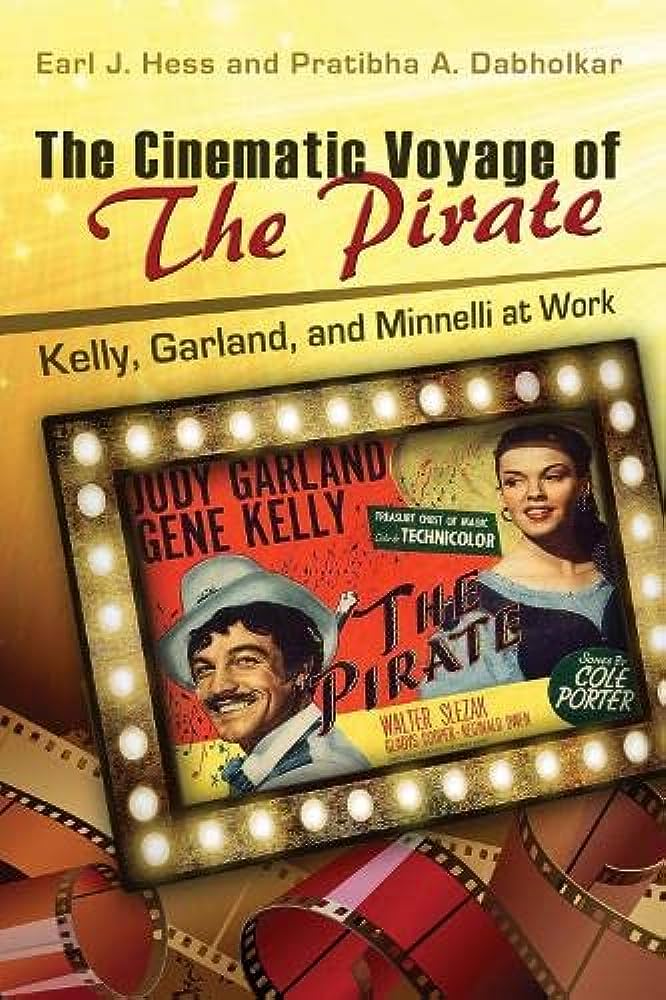
Anytime that a movie becomes iconic, there will probably be a book or a documentary about the making of it. Films that have gotten this treatment include The Wizard of Oz, Gone With the Wind, The Godfather, and The Pirate. What? Yes reader, I did say The Pirate – a 1948 movie musical starring Gene Kelly and Judy Garland. Unlike the three previously mentioned, The Pirate doesn’t have a strong cultural legacy, but authors Earl J. Hess and Pratibha A. Dabholkar argue that it should because of its stunning sets and costumes; use of Technicolor; how it helped the careers of Kelly, Garland, and director Vincente Minnelli; depicted race relations at the time of its release; and the choreography. They successfully make their case in their 2014 book The Cinematic Voyage of The Pirate: Kelly, Garland, and Minnelli at Work with thorough research and undying love for the picture.
The Cinematic Voyage of The Pirate: Kelly, Garland, and Minnelli at Work details the making of one of the most dazzling musicals that the Arthur Freed Unit made at Metro-Goldwyn-Mayer (MGM). Through a diverse use of research, authors Hess and Dabholkar examine the original conception of the story from the mind of German playwright Ludwig Fulda, Samuel N. Behrman’s Broadway production starring Alfred Lunt and Lynn Fontanne, and the multiple drafts of the MGM screenplay that took 3 years to develop. It also addresses the behind-the-scenes issues like Garland’s personal problems and how the collaboration between Kelly and Minnelli shaped the movie. They dive deep in how 1948 audiences actually reacted to the film as opposed to what the common perception of it was. Since then, the picture has grown in public and scholarly appeal and has been recognized as one of the most significant musicals from the Golden Age of Hollywood.
Before I get into the book proper, I must provide a brief plot outline for anyone not familiar with the flick. The Pirate is about a girl who is engaged to the mayor of a town on a Caribbean island, yet she has dreams about the legendary pirate Macoco. A traveling actor strolls in and falls in love with her. To impress her, he masquerades as the pirate, and hilarity ensues.
And of course, I have included my own review of it, and here it goes. It’s a fun and campy film with wonderfully over-the-top performances from Kelly and Garland, lots of vibrant colors, and great dance sequences. Also, it will get “Be a Clown” stuck in one’s head for a while.
This film may not be for everyone because of how tongue-in-cheek it can be. Likewise, readers might get slightly annoyed at the authors’ love for it if they don’t feel the same way. Moreover, there are times in which Hess and Dabholkar critique other films by Kelly and Garland in order to make their points about The Pirate that might ruffle some feathers. For instance, in the preface, they discuss the reasons why they chose the film in question. They claim that it’s a “delightfully watchable” musical with an appealing story and well executed dances all the way through (p. xi). In contrast, even though they commend the 1949 Gene Kelly film musical On the Town for its plot and choreography, they felt that it had several weak segments that viewers could skip over in order to see the better ones (p. xi). They wisely don’t list which scenes fell short.
Nevertheless, they show a great deal of impartiality with the evidence they present. They point out the goofs and gaffes that are present in the movie towards the end of the book (p.176-181). This objectiveness is especially present when they discuss Garland’s personal problems during the filming. She was addicted to drugs, which for the most part resulted in her missing several days of shooting and occasionally having to leave early due to sickness and/or anxiety. A common conclusion that many people proclaim is that the studio was responsible for her addiction. They debunk this with excerpts from Judy Garland’s daughter Lorna Luft book Me and My Shadows. In them, Luft reports that while MGM first gave her mother benzedrine – an amphetamine to curb her appetite – when she was 16 in 1938, she notes “that amphetamines were widely used everywhere in America at that time.”
Once the studio realized that Garland had a problem, the executives “tried in every way possible to help her get off drugs” because she was a much-loved and respected entertainer. On top of that, she had a “boiling mixture of emotions” due to trauma associated with being a child performer (p.63-64). While Luft’s book is a secondary source, the authors used primary research like the internal MGM memos sent by Al Shenberg – the production manager who kept record of how many days Garland missed and the reasons why – and newspaper articles that reported on her emotional state (p. 76, 88, 91). Furthermore, The authors make it clear that while they understand why Garland had the issue to begin with, they make no excuses for it and acknowledge the trouble with keeping her in line, especially for Minnelli whom Garland was married to at the time.
Much like with The Beat, The Scene, The Sound, the strongest part of The Cinematic Voyage of the Pirate is the variety of sources that the authors utilize. In fact, the latter is not Hess and Dabholkar’s first book of that kind since they wrote Singin’ in the Rain: The Making of an American Masterpiece (oh hey, another Gene Kelly movie) earlier, and it shows. They sail broad and deep with archival research, newspaper coverage, memoirs, and interviews in order to create a more nuanced story about the making of the film and to disprove some common misconceptions surrounding it. For starters, many film commentators praise it for its witty dialogue and actions. Hess and Dabholkar expertly point out that while there were plot and character changes, many elements of the final script written primarily by Frances Goodrich and Albert Hackett come “directly from Behrman’s stage play” (p. 45).
In fact, the authors devote an entire appendix to the overlap between the Goodrich-Hackett script and the Behrman play. This includes verbatim incorporation of Behrman’s lines in critical scenes, other direct use of his words, using dialogue in different contexts, and lines spoken by other characters (p. 197-205).
One core argument made throughout the book is that the musical was a commercial failure, hence why nobody spoke more positively about it until years later. However, they utilize archival research from the Academy of Motion Picture Arts and Silences collection at the Margaret Herrick Library and newspaper clippings to demonstrate that the movie made a profit over time. They point out that the movie grossed $85,758 after four days at Radio City Music Hall, “the most that any M-G-M film did in that venue for that length of time.” (p. 141).
Despite this, they acknowledge that the initial release in 1948 only amounted to $2,956,000 although it cost $3,768,496 to make (p.141).
In addition, critics at the time also were mostly positive about it. For instance, a Newsweek critic thought that the picture was a “rare and happy combination of expert dancing, catchy tunes, and utterly unbelievable plot which manages to achieve pure escapism without becoming either sentimental or corny” (p. 137).
I couldn’t have said that better myself.
Since the book’s release in 2014, The Pirate has grown more in cultural relevance. There have been more analyses on the movie, specifically how it depicts sensuality and romance. Furthermore, in 2022, several clips, particularly the one where Kelly blows smoke in a woman’s face, went viral after news came out that Chris Evans was going to play the famous dancer in an upcoming film. I’m curious as to how the authors feel about that.
Overall, The Cinematic Voyage of The Pirate: Kelly, Garland, and Minnelli at Work by Earl J. Hess and Pratibha A. Dabholkar sails high. They go deep into research to show a more nuanced story of how the picture was created as well as to dispel some misconceptions associated with it. And obviously, they are not afraid to show their love for the film. I would recommend this to those who enjoy reading single film production histories as well as movie musicals. It’s a treasure chest of facts and love for The Pirate.
Before I go, I want to let you know that I’ll be talking about the film in more detail with Zita Short on her The 300 Passions Podcast! We’ll be discussing specific aspects like the campiness, the chemistry between Kelly and Garland, and why it failed to make the cut on the American Film Institute’s 100 Years…Passions list. It’ll be my fifth time on that podcast, and I can’t wait for all of you to hear it! Check it out at this link!
Subscribe below to get notified when I post new updates. Also feel free to email me here for any review suggestions, ideas, or new titles!
 Book Reviews by a Chick Who Reads Everything
One thought on “The Cinematic Voyage of The Pirate: Kelly, Garland, and Minnelli at Work Book Review”